

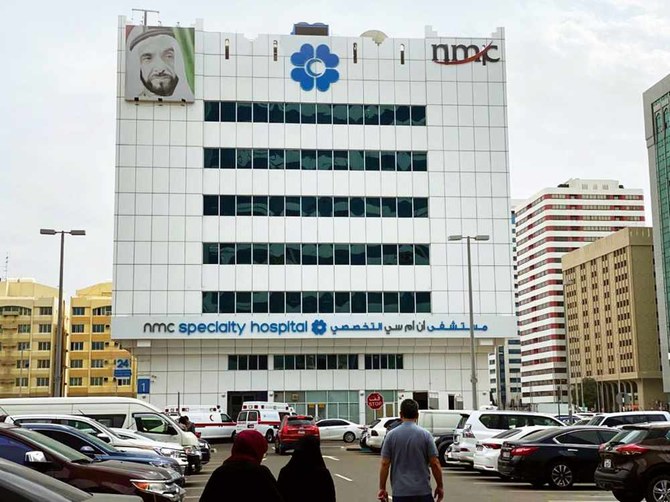
NMC founder alleges fraud, forgery ‘on a grand scale’

A UK court placed NMC Health into administration on the application of ADCB last week. (Reuters)
Short Url
Updated 30 April 2020
Follow

NMC founder alleges fraud, forgery ‘on a grand scale’

  • Billionaire former chairman B.R. Shetty blames small group of aides after probe into debt-wracked UAE health provider
  • NMC is the biggest health provider in the United Arab Emirates

DUBAI: NMC Health, the troubled UAE-based hospitals group, has been the victim of fraud, forgery and impersonation on a multibillion-dollar scale, according to its founder and former chairman B.R. Shetty.

In a strongly worded statement, Shetty detailed what he described as “serious fraud and wrongdoing” at the company and at his other major business venture, the financial services group Finablr, as well as at some of his private companies and against him personally.

NMC is in administration and has asked for its shares to be delisted from the London Stock Exchange after having uncovered total debts of $6.6 billion, most of it unaccounted.

Finablr is being broken up, with some of its operations being prepared for insolvency, while its UAE foreign exchange business is being run by the country’s central bank.

Shetty’s statement follows investigations by forensic investigators, lawyers and handwriting experts working for the Indian entrepreneur, who is believed to be still in his home country.

The statement fails to name any individuals, but said the alleged offenses appear to have been committed by “a small group of current and former executives” at the companies.

Shetty said that false companies, bank accounts and loan agreements had been set up without his knowledge or authorization, and that he had been supplied misleading financial information. The perpetrators had also used fraudulent powers-of-attorney and expenses payments from his personal companies and bank accounts.

Authorities in the UAE and UK have been informed of the findings. Shetty said that he is cooperating with authorities to “get to the truth and help ensure that misappropriated or missing funds” are identified and returned.

“I will work tirelessly to clear my name,” he said.

“To see everything that my family and I have strived to build over the past 45 years eroded over the course of a few short months, and mainly due to the misconduct and wrongdoing of people I put so much trust in, saddens me beyond words. It has also left my entire family in a perilous financial position,” he added.

Shetty, who founded NMC in the UAE in 1975, ended his executive involvement with the company in 2017, but remained joint chairman until earlier this year, after the scale of its problems became apparent.

Doubts over NMC’s financial health were first raised last year by activist investor Muddy Waters, which identified serious irregularities at the company. Over the space of a few weeks, its share price collapsed and shares eventually suspended.

The crisis at NMC — the biggest health provider in the UAE — comes at a difficult time for the country as it combats the coronavirus pandemic.

An economic downturn because of global lockdowns has put increased strain on the country’s financial system.

Abu Dhabi Commercial Bank (ADCB) is the biggest creditor to NMC, with outstanding liabilities of nearly $1 billion, although many others also have big exposures, as well as international banks such as Barclays, Standard Chartered and HSBC.

ADCB has filed criminal cases against several former executives at NMC, who cannot be named under the country’s laws. There were reports that the UAE central bank has issued freeze orders against several companies and individuals, but these have not been officially confirmed.

A spokesman for Alvarez & Marsal, joint administrator to NMC, said: “We will review the statement as part of our ongoing investigation into the affairs of NMC and look forward to (Shetty) sharing the findings of his investigation with us.”


GCC growth set to accelerate to 4.4% in 2026 on non-oil strength: World Bank 

Updated 6 sec ago
Follow

GCC growth set to accelerate to 4.4% in 2026 on non-oil strength: World Bank 

RIYADH: Economies across the Gulf Cooperation Council are forecast to grow 4.4 percent in 2026, accelerating to 4.6 percent in 2027, driven by rising non-oil activity in countries including Saudi Arabia, according to an analysis. 

In its Global Economic Prospects report, the World Bank said the Kingdom’s real gross domestic product is projected to grow 4.3 percent in 2026 and 4.4 percent in 2027, up from an expected 3.8 percent in 2025. 

Earlier this month, a separate analysis by Standard Chartered echoed similar expectations, forecasting the Kingdom’s GDP to expand by 4.5 percent in 2026, outperforming the projected global growth average of 3.4 percent, supported by momentum in both hydrocarbon and non-oil sectors. 

The World Bank’s latest forecast broadly aligns with the International Monetary Fund’s October outlook, which projects Saudi Arabia’s GDP to grow by about 4 percent in both 2025 and 2026. 

In its latest report, the World Bank said: “Growth in GCC countries is forecast to increase to 4.4 percent in 2026 and 4.6 percent in 2027, mainly reflecting a steady expansion of non-hydrocarbon activity, in addition to a further rise in hydrocarbon production.” 

It added: “The strengthening of non-hydrocarbon activity — accounting for more than 60 percent of GCC countries’ total GDP — is projected to be supported by expected large-scale investments, including in Kuwait and Saudi Arabia.” 

Expanding the non-oil sector remains a core objective of Saudi Arabia’s Vision 2030 agenda, as the Kingdom continues efforts to reduce its long-standing reliance on crude revenues. 

Highlighting the strength of Saudi Arabia’s non-oil momentum, S&P Global said the Kingdom recorded the highest purchasing managers’ index reading in the region in December, at 57.4, supported by rising new orders, continued growth in non-energy business activity, and expanding employment.

At the country level, the UAE’s economy is projected to grow by 5 percent in 2026, before accelerating to 5.1 percent in 2027. 

Oman’s GDP is forecast to expand by 3.6 percent in 2026 and 4 percent in 2027, while Qatar is expected to record growth of 5.3 percent next year, rising sharply to 6.8 percent in 2027. 

In Kuwait and Bahrain, GDP growth is projected at 2.6 percent and 3.5 percent, respectively, in 2026. 

Across the broader Middle East, North Africa, Afghanistan and Pakistan region, growth is estimated to have reached 3.1 percent in 2025 and is projected to strengthen further to 3.6 percent in 2026 and 3.9 percent in 2027, largely driven by improving performance among oil-exporting economies. 

Potential growth challenges 

The World Bank also outlined several downside risks that could weigh on economic growth across the region. 

These include a re-escalation of armed conflicts, heightened violence or social unrest, which could disrupt economic activity and weaken confidence. 

Other risks include tighter global financial conditions, further increases in trade restrictions and tensions, greater uncertainty over global trade policies, and more frequent or severe natural disasters. 

For oil exporters, lower-than-expected oil prices or heightened price volatility could also dampen growth. 

“A re-escalation of armed conflicts in the region could cause a significant deterioration in consumer and business sentiment, not only in the economies directly affected but also in neighboring economies,” the World Bank said.  

It added: “It could spill over into a broader increase in policy uncertainty and a tightening of financial conditions, dampening investment and economic activity.” 

Global outlook 

The World Bank said the global economy has proved more resilient than expected despite last year’s escalation in trade tensions and policy uncertainty. 

Global economic growth is projected at 2.6 percent in 2026, easing from an estimated 2.7 percent in 2025. 

“The modest slowdown comes on the heels of a post-pandemic rebound over 2021–25 that represented the strongest recovery from a global recession in more than six decades,” the World Bank said, adding that the rebound was uneven and came at the cost of higher inflation and rising debt. 

Among advanced economies, US GDP is projected to grow by 1.6 percent in both 2026 and 2027. 

China’s economy is expected to expand by 4.4 percent in 2026 before slowing to 4.2 percent in 2027, while India’s GDP is forecast to grow by 6.5 percent and 6.6 percent over the same period.