COVID-19 vaccine unlikely until 2021: UK FM

Britain's Foreign Secretary Dominic Raab speaks during a daily digital news conference on the coronavirus disease (COVID-19) outbreak, at 10 Downing Street in London, Britain April 22, 2020. (REUTERS)
Short Url
Updated 27 April 2020
Follow

COVID-19 vaccine unlikely until 2021: UK FM

  • Horby previously worked on the fight against Ebola following a deadly outbreak in West Africa in 2014

LONDON: A vaccine against COVID-19 might not be developed until next year at the earliest, British Foreign Secretary Dominic Raab warned on Sunday.
A vaccine is “not likely to come to fruition this year, which could be very important if we get multiple waves of coronavirus globally down the track,” he said.
The UK, which has suffered more than 20,000 deaths from COVID-19 so far, announced on April 21 that it would be putting £41 million ($50.7 million) into two research projects to develop a vaccine.
The trials are being conducted by the Jenner Institute at Oxford University, and Imperial College, London.
The UK’s National Health Service is also currently carrying out the world’s largest trial of developed treatments for other ailments on COVID-19 patients.
The trial, called Recovery, will integrate COVID-19-specific vaccines as and when they become available.  Peter Horby, professor of emerging infectious diseases and global health at Oxford University, who is helping to lead Recovery, warned on April 17 that people should not expect trials to produce a “magic bullet” solution to the crisis.

FASTFACT

The UK, which has suffered more than 20,000 deaths from COVID-19 so far, announced on April 21 that it would be putting £41 million ($50.7 million) into two research projects to develop a vaccine.

Horby previously worked on the fight against Ebola following a deadly outbreak in West Africa in 2014. It took scientists five years to develop a vaccine for the virus.
The Jenner Institute’s Prof. Sarah Gilbert expressed hope earlier this month that up to 500 people would be part of the trial by mid-May, with the Oxford team “80 percent” confident of success.
The Oxford vaccine, called ChAdOx1 nCoV-19, consists of a genetically engineered chimpanzee virus altered to carry part of the coronavirus.  
But former Deputy Chief Medical Officer Prof. Gina Radford said: “We haven’t got a hugely good track record with vaccines for this particular virus, coronavirus, the family of viruses.”
She added: “I think those who are very used to the process of developing vaccines are saying they are not anticipating it being available until well into next year.”


Kabul shakes as 5.8-magnitude earthquake hits eastern Afghanistan

Updated 9 sec ago
Follow

Kabul shakes as 5.8-magnitude earthquake hits eastern Afghanistan

  • The 5.8-magnitude quake struck a mountainous area around 130 kilometers northeast of Kabul
  • Earthquakes are common in Afghanistan, particularly along the Hindu Kush mountain range

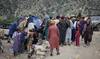
KABUL: A strong earthquake rocked eastern Afghanistan including the capital Kabul on Friday, AFP journalists and residents said.
The 5.8-magnitude quake struck a mountainous area around 130 kilometers (80 miles) northeast of Kabul, the United States Geological Survey said.
The epicenter was near several remote villages and struck at 5:39 p.m. (1309 GMT), just as people in the Muslim-majority country were sitting down to break their Ramadan fast.
“We were waiting to do our iftars, a heavy earthquake shook us. It was very strong, it went on for almost 30 seconds,” said Zilgay Talabi, a resident of Khenj district near of the epicenter.
“Everyone was horrified and scared,” Talabi told AFP, saying he feared “landslides and avalanches” may follow.
Power was briefly cut in parts of the capital, while east of Kabul an AFP journalist in Nangarhar province also felt it.
Earthquakes are common in Afghanistan, particularly along the Hindu Kush mountain range, near where the Eurasian and Indian tectonic plates meet.
Haqmal Saad, spokesman for the Panjshir province police, described the quake as “very strong” and said the force was “gathering information on the ground.”
Mohibullah Jahid, head of Panjshir Natural Disaster Management agency, told AFP he was in touch with several officials in the area.
The district governor had told him there were reports of “minor damage, such as cracks in the walls, but we have not received anything serious, such as the collapse of houses or anything similar,” Jahid said.
Residents in Bamiyan and Wardak provinces, west of Kabul, told AFP they also felt the earthquake.
In Pakistan’s Khyber Pakhtunkhwa province, rescue service official Bilal Ahmad Faizi said the quake was felt in border areas.
In August last year, a shallow 6.0-magnitude quake in the country’s east wiped out mountainside villages and killed more than 2,200 people.
Weeks later, a 6.3-magnitude quake in northern Afghanistan killed at least 27 people.
Large tremors in western Herat, near the Iranian border, in 2023, and in Nangarhar province in 2022, killed hundreds and destroyed thousands of homes.
Many homes in the predominantly rural country, which has been devastated by decades of war, are shoddily built.
Poor communication networks and infrastructure in mountainous Afghanistan have hampered disaster responses in the past, preventing authorities from reaching far-flung villages for hours or even days before they could assess the extent of the damage.