Lebanon slashes exchange rate at money transfer firms

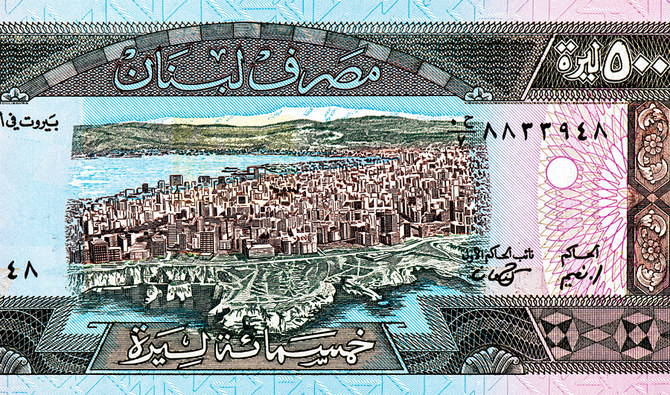
Beirut, as depicted above on a vintage Lebanese banknote, is struggling to keep a lid on the country’s financial problems. (Shutterstock)
Short Url
Updated 25 April 2020
Follow

Lebanon slashes exchange rate at money transfer firms

  • New rate applies to cash sent through wire transfer offices used by Lebanese diaspora to send funds home

BEIRUT: The Lebanese central bank set an exchange rate of 3,625 Lebanese pounds per dollar to be applied by money-transfer firms on Friday, a central bank source said, 58 percent weaker than the official peg as the country grapples with a financial crisis.

The new rate is seen as part of wider moves by the central bank away from a peg in place since 1997, bankers say. Though the official pegged rate of 1,507.5 pounds is still in place, it amounts to an effective devaluation of the pound.
The new rate applies to money sent through wire transfer offices, which are used by many Lebanese abroad to send money to family at home.
The Lebanese pound has slumped on a parallel market since October, when the country’s long-brewing economic troubles came to a head, prompting a financial and banking crisis considered the biggest risk to stability since the 1975-90 civil war.
The authorities are still applying the official pegged rate for essential imports — fuel, wheat and medicine — in an effort to slow spiralling inflation in the import-dependent economy.
“Prices may change every day and will be set the day before,” the central bank source said, adding that the rate reflected the price dollars were fetching at foreign exchange offices. “In the event that there are major fluctuations during the day, the price may be set again during the same day.”
A senior banker said central bank governor Riad Salameh was effectively devaluing the currency without announcing it.
With dollars in short supply, the central bank earlier this month said the money-transfer services must issue cash in the local currency at a “market rate.” This week, the central bank said

FASTFACT

With dollars in short supply, the central bank earlier this month said the money-transfer services must issue cash in the local currency at a “market rate.”

depositors with dollar accounts in Lebanon would be paid cash in pounds, also at a “market rate,” within withdrawal limits.
Banking sources said they expected the rate applied to such withdrawals to be close to the rate set by the central bank for wire transfer firms. Banks, exchange dealers and the central bank will meet on Monday to make a decision.
Parliament speaker Nabih Berri urged the government on Thursday to use its legal powers to halt the pound’s “dramatic collapse” before it is “too late.”
Finance Minister Ghazi Wazni told Al-Joumhuria newspaper on Friday the fall could not be attributed to economic, financial or monetary reasons and said it was down to “strong speculation and manipulation in the market.”
“This increased the fear of citizens and their concern, which brought about an increase in demand for the dollar.”
Foreign currency dealers will strike until Monday “to warn about the continued deterioration of the exchange rate,” their syndicate announced late on Thursday.


PIF’s Humain invests $3bn in Elon Musk’s xAI prior to SpaceX acquisition

Updated 18 February 2026
Follow

PIF’s Humain invests $3bn in Elon Musk’s xAI prior to SpaceX acquisition

JEDDAH: Humain, an artificial intelligence company owned by Saudi Arabia’s Public Investment Fund, invested $3 billion in Elon Musk’s xAI shortly before the startup was acquired by SpaceX.

As part of xAI’s Series E round, Humain acquired a significant minority stake in the company, which was subsequently converted into shares of SpaceX, according to a press release.

The transaction reflects PIF’s broader push to position Saudi Arabia as a central hub in the global AI ecosystem, as part of its Vision 2030 diversification strategy.

Through Humain, the fund is seeking to combine capital deployment with infrastructure buildout, partnerships with leading technology firms, and domestic capacity development to reduce reliance on oil revenues and expand into advanced industries.

The $3 billion commitment offers potential for long-term capital gains while reinforcing the company’s role as a strategic, scaled investor in transformative technologies.

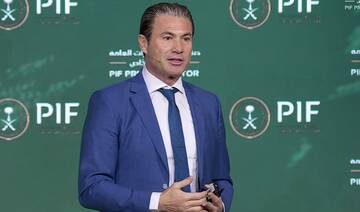
CEO Tareq Amin said: “This investment reflects Humain’s conviction in transformational AI and our ability to deploy meaningful capital behind exceptional opportunities where long-term vision, technical excellence, and execution converge, xAI’s trajectory, further strengthened by its acquisition by SpaceX, one of the largest technology mergers on record, represents the kind of high-impact platform we seek to support with significant capital.” 

The deal builds on a large-scale collaboration announced in November at the US-Saudi Investment Forum, where Humain and xAI committed to developing over 500 megawatts of next-generation AI data center and computing infrastructure, alongside deploying xAI’s “Grok” models in the Kingdom.

In a post on his X handle, Amin said: “I’m proud to share that Humain has invested $3 billion into xAI’s Series E round, just prior to its historic acquisition by SpaceX. Through this transaction, Humain became a significant minority shareholder in xAI.”

He added: “The investment builds on our previously announced 500MW AI infrastructure partnership with xAI in Saudi Arabia, reinforcing Humain’s role as both a strategic development partner and a scaled global investor in frontier AI.”

He noted that xAI’s trajectory, further strengthened by SpaceX’s acquisition, exemplifies the high-impact platforms Humain aims to support through strategic investments.

Earlier in February, SpaceX completed the acquisition of xAI, reflecting Elon Musk’s strategy to integrate AI with space exploration.

The combined entity, valued at $1.25 trillion, aims to build a vertically integrated innovation ecosystem spanning AI, space launch technology, and satellite internet, as well as direct-to-device communications and real-time information platforms, according to Bloomberg.

Humain, founded in August, consolidates Saudi Arabia’s AI initiatives under a single entity. From the outset, its vision has extended beyond domestic markets, participating across the global AI value chain from infrastructure to applications.

The company represents a strategic initiative by PIF to diversify the Kingdom’s economy and reduce oil dependence by investing in knowledge-based and advanced technologies.