

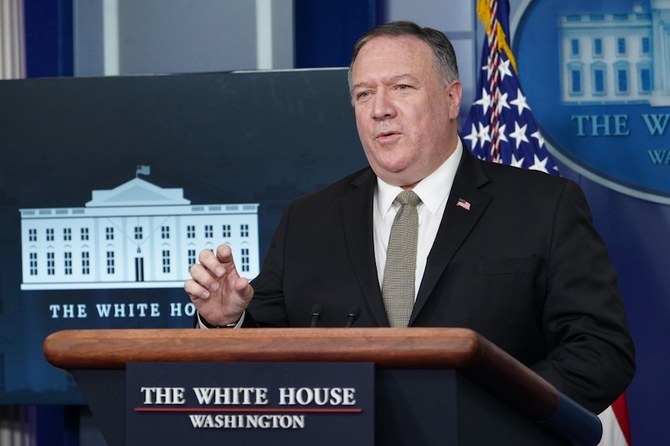

RIYADH: US Secretary of State Mike Pompeo on Wednesday blasted Iran for its behavior during the coronavirus pandemic.
He was speaking after President Donald Trump said he had ordered the American military to attack and destroy any Iranian vessel that harasses US Navy ships.
Pompeo’s comments on Wednesday came in a wide-ranging telephonic roundtable with seven selected journalists from around the world.
“While they (Iran) are telling the world they are broke and don’t have any money, they continue to underwrite the butcherous activities of the Assad regime,” he said in response to a question from Arab News.
“They say they don’t have any money to feed their people or provide medicine, but they continue to launch missiles or send satellites into orbit.”
Iran came under fire on Wednesday for attempting to launch a satellite, and after its foreign minister met Syrian President Bashar Assad in Damascus this week.
At the same, Iran has been hit by one of the worst coronavirus outbreaks in the region, which is widely believed to be far more deadly than the government is revealing.
Attacking the poor “prioritization of the regime,” Pompeo said Washington’s “maximum pressure campaign” would “use economic and diplomatic components … to build up an international coalition to convince the Iranian regime to change its behavior.”
Last week, US Navy ships were circled by a number of small fast boats from Iran’s Islamic Revolutionary Guard Corps (IRGC) in international waters in the northern Arabian Gulf.
Responding to a question about challenging Tehran in international waters, Pompeo said Washington will continue to “do everything we need to do to make sure that our forces are safe and secure.”
He added: “The president’s statement this morning made clear that we won’t tolerate putting our soldiers, airmen, sailors or marines at risk. We’re going to defend ourselves against those ships that violated international waters.”
During the roundtable, Pompeo answered questions relating to efforts to combat coronavirus, the US position toward the World Health Organization (WHO), Iran and China, as well as reports that his country is considering a halt of oil imports from the world’s biggest producers.
Pompeo said the economic harm of the COVID-19 crisis has reached “nearly every country in the world,” but stressed that the US is prepared to help support the energy market.
Arab News asked him for a comment on reports that Trump is considering halting imports of Saudi oil due to the impact COVID-19 is having on the energy market.
“I don’t want to get in front of what the president may decide on the energy markets,” Pompeo said. “We’re seeing a historic decline in demand. Once the market recovers, we’ll see a rise in demand all across the world for American crude oil products and Saudi crude oil products. That is what the president is truly focused on.”
He added: “Trump wants to make sure that the American energy network continues to be in a position that it’s thriving and succeeding when global demand comes back up. We’re working in the US, and with our partners across the world, to try and put in place systems for a more stable and rational set of energy markets.”
Pompeo also discussed the global response to the coronavirus pandemic, and the US decision to halt funding for the WHO over what he said was its poor response and bias toward China.
He also said it is essential that China give access to laboratories in the city of Wuhan, where the pandemic started, to make sure the origins of the virus are understood.
“You have to know the nature of the pathway that the virus took in order to save lives, and that didn’t happen,” Pompeo said. “They (China) were too slow. This information didn’t get to the world quick enough.”
The US is reported to be looking into whether the outbreak could have leaked from a laboratory studying pathogens in Wuhan. China said it was passed to humans at a wet market.


