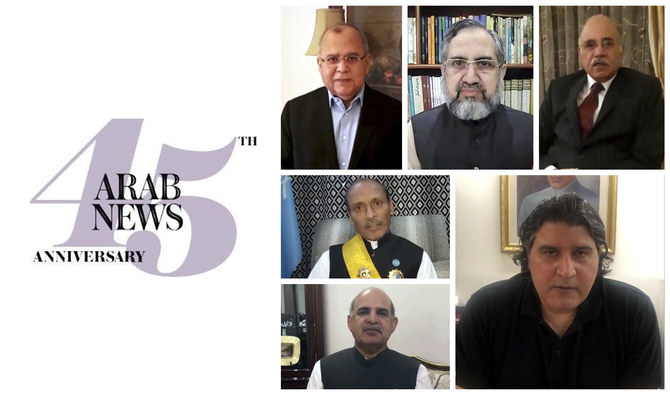
ISLAMABAD: As Arab News celebrates 45 years since its inception, Pakistan’s envoys felicitated the Riyadh-based publication, sending special video messages to the team and sharing their experience during the tenure served in the Kingdom.
Congratulating the publication, Pakistan’s current Ambassador to Saudi Arabia, Raja Ali Ejaz, said: “It’s a milestone and I must congratulate its very talented team for bringing the newspaper to a new level, a new height,” adding that “the maturity of the newspaper can be gauged from the fact that it has become the first choice for every resident diplomat, for scholars, politicians, [and many others].”
Expressing his gratitude, Ejaz said: “For me personally, I begin my day by going through Arab News ... so thank you for making my day every day.”
Describing his interaction with the editorial team during his two visits to the publication’s headquarters, the envoy said: “It was a wonderful experience in the sense that they had some very candid, forthright and diverse views on matters of regional and international interest. For me, it was a pleasant and educating experience.”
Ejaz’s predecessor, Ambassador Vice-Admiral (r) Khan Hasham bin Saddique underscored the fraternal ties between the two countries, saying: “Arab News arguably is one of the leading newspapers not only in the Middle East but the entire world. It enjoys extensive viewership and readership across Saudi Arabia and across all segments of society, especially the expatriate community.”
Saddique continued that he found Arab News to be an authentic and credible source of information on global and regional affairs.
“I am extremely glad to note that the digital version of Arab News (Pakistan edition) was launched during my tenure in 2018 in Pakistan,” he added while pointing out that the initiative had helped forge a better understanding between the peoples of the two countries.
A frequent traveler to the Kingdom, World Chairman of the International Human Rights Commission (IHRC) Ambassador Dr. Muhammad Shahid Ameen, who is also the first elected Muslim and Asian to chair the IHRC and recipient of the Hijra Medal by the World Hijra Council in Jeddah, said it was an honor for him to have interacted with the editorial team of Arab News.
“Arab News is an outspoken newspaper and (online) publication in the Middle East,” Ameen said.
Describing the publication as the number one choice for daily information, especially within the diplomatic circles, Pakistan’s former first secretary and consul to Jeddah, Abrar Hussain, said that it “was the most attractive thing for us in the morning like all other diplomats.”
Sharing fond memories of his three-year diplomatic stint in Saudi Arabia, Hussain informed that he “had the pleasure of visiting [the publication’s] offices many times,” and recalled his meetings with its former editor-in-chief. Speaking on the publication’s editorial guidelines, the retired diplomat said its “policy was very friendly” toward Pakistan.
In his felicitation message, Salman Bashir, former foreign secretary, noted: “Arab News was a central source of information, a platform which not only provided information, but also gave us varied perspectives on global and regional issues.”
Veteran diplomat Javed Hafiz who served in the Kingdom for several years under multiple designations during his tenure applauded the paper for its “achievement of keeping people informed around the globe.”
This, he added, was a sacred responsibility since “keeping people informed is a way of promoting regional peace and security.”
Hafeez said the publication had worked hard to present a balanced news coverage of vital issues and disseminate information with great accuracy.


![]()

Pakistani diplomats describe Arab News as authentic information source
Short Url
https://arab.news/gxp95
Pakistani diplomats describe Arab News as authentic information source
- Former and incumbent diplomats send congratulatory video messages to the publication
- Say Arab News is their first choice due to accurate and balanced news coverage
Latest updates


© 2026 SAUDI RESEARCH & PUBLISHING COMPANY, All Rights Reserved And subject to Terms of Use Agreement.