

Pakistani PM to undergo COVID-19 test – personal physician

The photograph shows head of Edhi Foundation, Faisal Edhi, handing over a cheque of Rs10mln to Prime Minister Imran Khan in Islamabad on April 15, 2020. (Photo courtesy: PTI)
Short Url
Updated 21 April 2020
Follow

Pakistani PM to undergo COVID-19 test – personal physician

  • Imran Khan recently interacted with the head of a leading charity organization who was diagnosed with the coronavirus on Tuesday
  • Similar virus scare has also been witnessed in neighboring India and Afghanistan where COVID-19 has infected the presidential staff

ISLAMABAD: Prime Minister Imran Khan has agreed to be tested for COVID-19, said his personal physician, Dr. Faisal Sultan, on Tuesday after the head of Edhi Foundation, who handed over a substantial amount to the premier last week to fight the pandemic, was diagnosed with the coronavirus.
Dr. Sultan, who is also the country's focal person for COVID-19, made the announcement in Khan's presence during a media briefing.
Edhi Foundation's chairman, Faisal Edhi, met the prime minister on April 15 to donate Rs 10 million to the government's Corona Relief Fund.
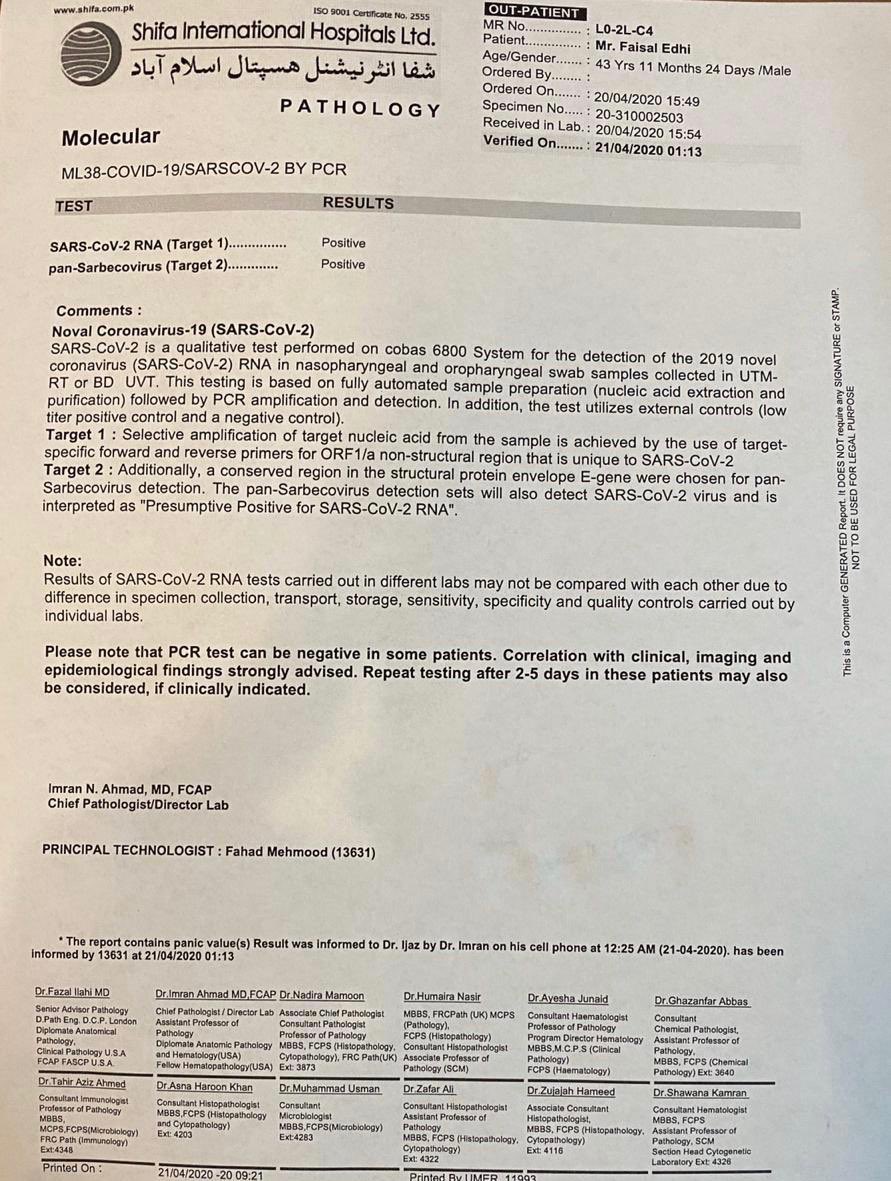


Faisal Edhi's test report. (Supplied)

His picture with Khan was widely circulated after the meeting in which neither was wearing a face mask.
According to the World Health Organization, COVID-19, which causes severe respiratory illness, can have an incubation period of one to 14 days. In other words, it can take about two weeks for an infected individual to display symptoms of the disease.
Being the head of the government, Khan held several meetings since interacting with the head of the charity organization. These included his consultations with cabinet ministers, president and other senior officials.
The prime minister also decided to relax the lockdown across the country by allowing "low-risk" industries to resume their operations.
Similar COVID-19 scare has also been witnessed in neighboring India and Afghanistan where the coronavirus has reportedly infected members of the presidential staff.


Pakistan explores new food export routes, protections for farm supply amid Middle East conflict

Updated 10 March 2026
Follow

Pakistan explores new food export routes, protections for farm supply amid Middle East conflict

  • Senior ministers review alternative sea routes, new markets amid the war in Iran
  • Pakistan relies heavily on Middle Eastern sea lanes for its imports and exports

ISLAMABAD: Pakistan reviewed the supply of perishable food items and fertilizer stocks on Monday, according to the state media, as the escalating conflict in the Middle East threatens to disrupt shipping routes and energy supplies critical to the country’s trade and agriculture.

The meetings, chaired separately by Deputy Prime Minister and Foreign Minister Ishaq Dar and Food Security Minister Rana Tanveer Hussain, came as tensions following US-Israeli strikes on Iran have raised concerns about the security of key maritime routes and energy markets that underpin Pakistan’s economy.

Pakistan relies heavily on Middle Eastern sea lanes for both fuel imports and exports of agricultural and food products, making disruptions in the region particularly sensitive for the country.

Dar chaired a meeting of the PM’s Committee to review the supply and export of perishable food items, examining steps to maintain domestic availability while ensuring timely exports of surplus produce.

“In the light of evolving regional trade dynamics and disruptions to some traditional routes, the committee explored alternative export pathways, sea routes, and potential new markets,” Radio Pakistan reported after the meeting.

Officials also discussed proposals from exporters and emphasized improving storage facilities, logistics and market access while assessing global demand and pricing trends to support export competitiveness.

In a separate meeting in Islamabad, Food Security Minister Rana Tanveer Hussain said the government would ensure stable fertilizer availability despite regional uncertainties.

“Agricultural productivity and food security will remain protected despite external challenges,” he said while chairing a meeting of the Fertilizer Review Committee.

He stressed the need for close coordination among manufacturers, distributors and provincial authorities to maintain uninterrupted fertilizer supply across the country.

The committee also reviewed fertilizer pricing and distribution mechanisms to prevent artificial shortages and hoarding, officials said, adding that authorities would monitor prices closely to ensure farmers have access to affordable inputs.