

Art in isolation: Pakistani creatives show how life has changed

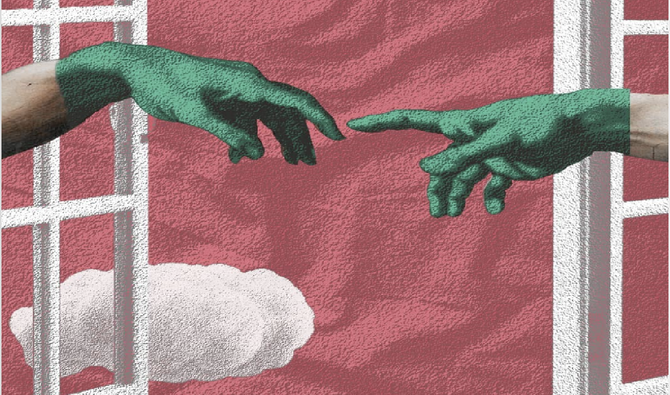
Artist Serwat Ibraaz shares a painting on her social media with a COVID-19 twist on the classic Michelangelo painting "The Creation of Adam." (Photo courtesy: Serwat Ibraaz Instagram)
Short Url
Updated 21 April 2020
Follow

Art in isolation: Pakistani creatives show how life has changed

  • From satirical artwork to stunning portraiture, Pakistani creatives share their quarantine works on social media
  • Themes featuring medical masks and life in isolation are currently at the forefront of creative work

RAWALPINDI: Through photography, animation, digital illustrations and more, Pakistani artists are adjusting to life in a world upended by COVID-19.

Stylized to resemble a Mughal miniature painting, Mariam Ibraaz’s illustration shows a doctor donning protective wear, which has become a symbol of this point in time.

The choice was deliberate “to show respect and honor,” the Lahore-based artist Ibraaz told Arab News, “People of great significance were the subject matter of traditional miniature paintings.” She wanted to recognize the efforts of medical workers who are at the front lines of the ongoing health crisis. “An illustration is a small gesture to show appreciation,” she said.
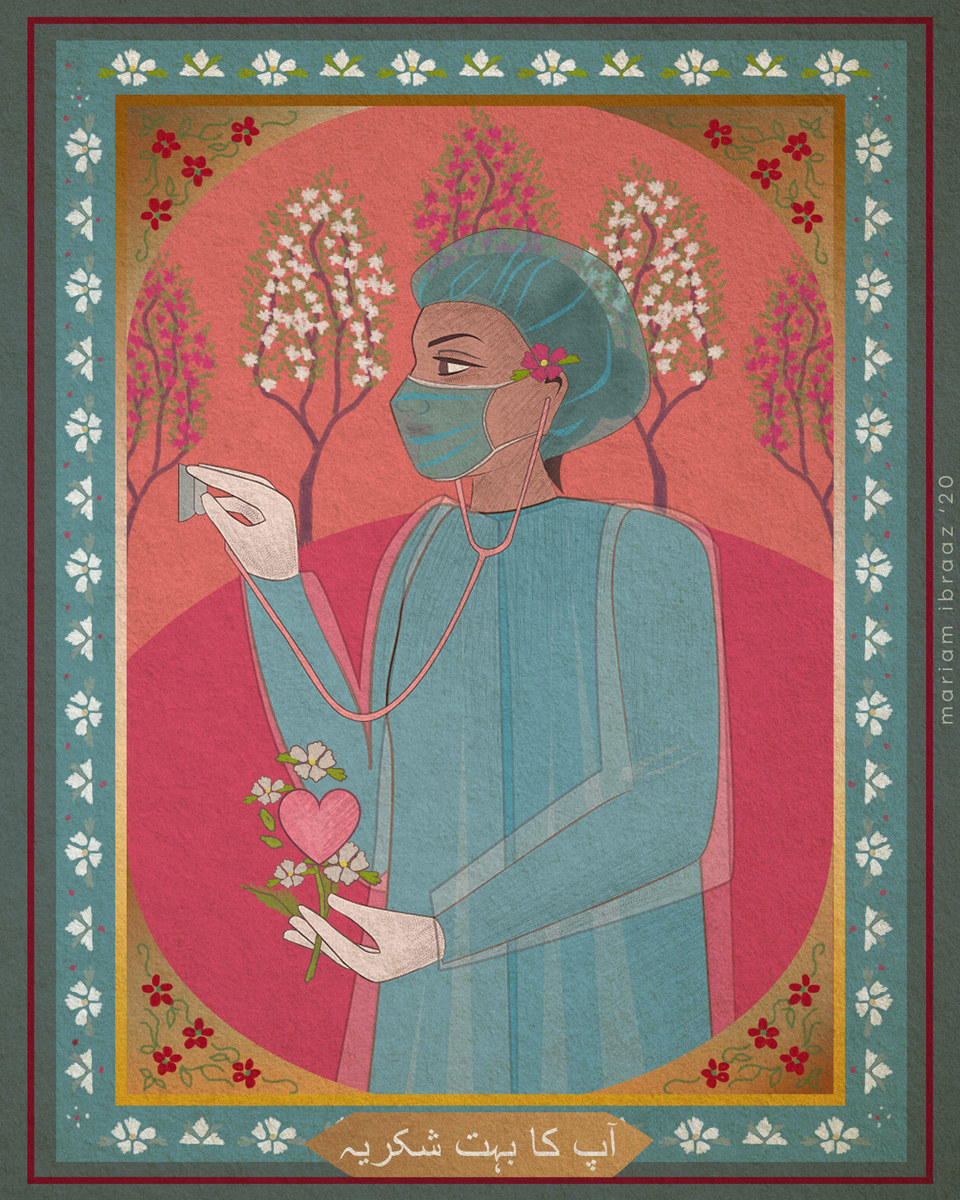


Mariam Ibraz pays homage to Pakistani doctors in a miniature-style illustration. (Photo courtesy: Mariam Ibraaz Instagram)

Digital artist and freelance illustrator Mahnoor Ahmad who hails from Lahore, produced a series depicting life as it is now, with a strong focus on how women, who have been disproportionally affected by lockdown regulations, are living through and coping with quarantine.


“Queens of Quarantine” by Mahnoor Ahmad. (Photo courtesy: Mahnoor Ahmad Instagram)

An illustration showing a woman in a t-shirt and shalwar — the unofficial at-home-uniform of urban Pakistani women — standing in front of piles of folded clothes with a broom in her hand, is titled “Queens of Quarantine.” Ahmad said, “For me this quarantine time emphasizes that our women are queens, warriors and wonder women, and I wanted to show them as such.”

Digital pop-artist Digink draws inspiration from what is happening around him, which these days has been isolation, he told Arab News over the phone from Istanbul. When calls for social distancing began, he created a series juxtaposing modern backgrounds against old photographs of women from South Asia.


Dignik’s work shows a woman from a vintage photograph pasted into a modern setting. (Photo courtesy: Dignik Instagram)

Social isolation and having to stay apart from one another has been a challenge for creatives in industries such as fashion and photography. But even there Pakistanis have found their way.

Fashion and travel photographer Areesh Zubair has been cruising around Lahore to create a series of portraits he is calling “Duur Se Portrait,” which means far-away portraits. He takes photos of other Lahori creatives posing from the safety and distance of their home balconies. “I wanted to do something during this unusual time,” Zubair told Arab News, “I wanted to make memories.”
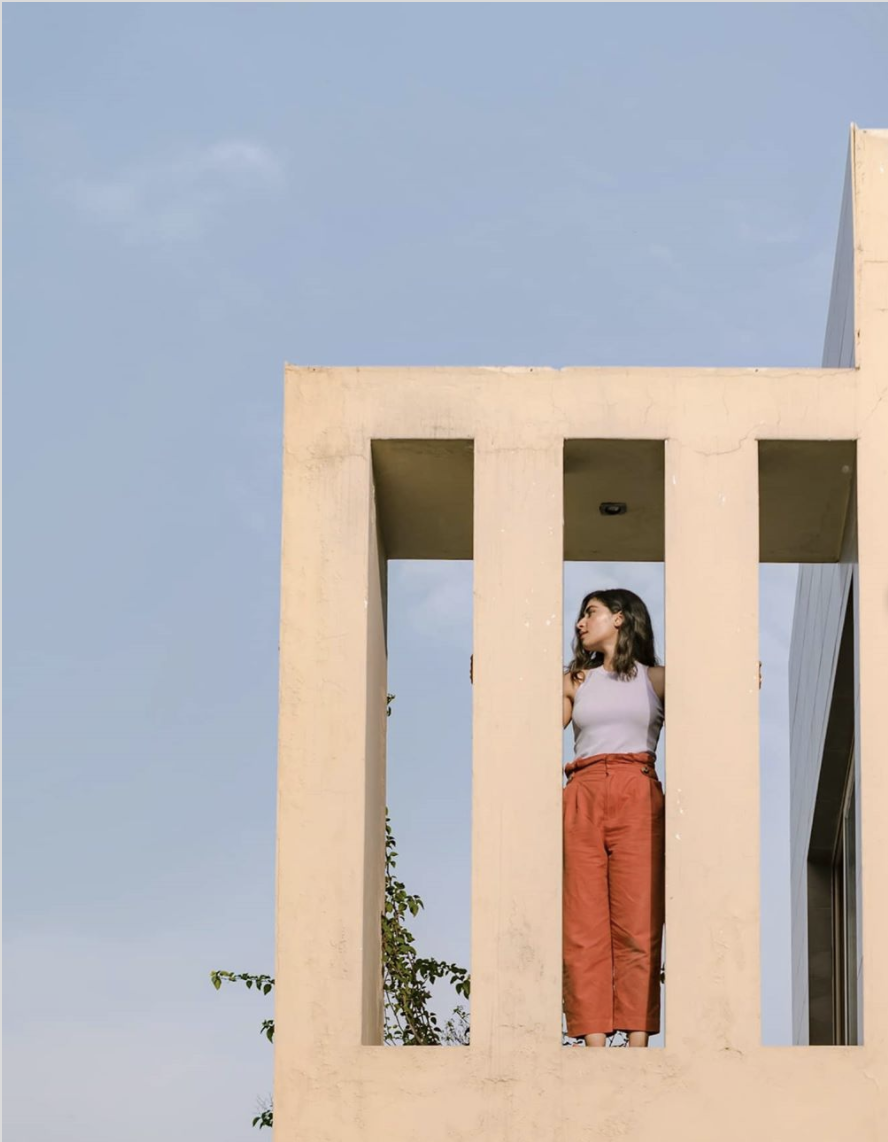


Stylist Mehek Saeed is photographed from the safe distance of her balcony by Areesh Zubair who came up with the idea of far-away portraiture to respect social distancing while documenting this moment in history. (Photo courtesy: Areesh Zubair Instagram)

Freelance artist, designer and illustrator Aamina Hashmi of Rawalpindi has created striking portraits through materials at her home and garden. Since social distancing and isolation began, Hashmi has focused a series of portraits, utilizing masks. Titled “Desperate Gardner,” the series starts with a gas mask.


Aamina Hashmi’s “Desperate Gardner” starts with a gas mask. (Aamina Hashmi Instagram)

“It is a satire based on a modern terrace gardener running out of supplies like soil and pots during this quarantine,” Hashmi said. “All of this happening at the start of the Spring season is all the more troubling, and I thought I could do something a bit dark and funny with it.”

When asked what role art would play, if any, to get people through this pandemic, she said, “Fear is a big part of any epidemic, and it’s our job to bring some form of comfort to the audience as artists and entertainers, it’s also a time to spread awareness and caution as well.”

IMF warns against policy slippage amid weak recovery as it clears $1.2 billion for Pakistan

Updated 11 December 2025
Follow

IMF warns against policy slippage amid weak recovery as it clears $1.2 billion for Pakistan

  • Pakistan rebuilt reserves, cut its deficit and slowed inflation sharply over the past one year
  • Fund says climate shocks, energy debt, stalled reforms threaten stability despite recent gains

ISLAMABAD: Pakistan’s economic recovery remains fragile despite a year of painful stabilization measures that helped pull the country back from the brink of default, the International Monetary Fund (IMF) warned on Thursday, after it approved a fresh $1.2 billion disbursement under its ongoing loan program.

The approval covers the second review of Pakistan’s Extended Fund Facility (EFF) and the first review of its climate-focused Resilience and Sustainability Facility (RSF), bringing total disbursements since last year to about $3.3 billion.

Pakistan entered the IMF program in September 2024 after years of weak revenues, soaring fiscal deficits, import controls, currency depletion and repeated climate shocks left the economy close to external default. A smaller stopgap arrangement earlier that year helped avert immediate default, but the current 37-month program was designed to restore macroeconomic stability through strict monetary tightening, currency adjustments, subsidy rationalization and aggressive revenue measures.

The IMF’s new review shows that Pakistan has delivered significant gains since then. Growth recovered to 3 percent last year after shrinking the year before. Inflation fell from over 23 percent to low single digits before rising again after this year’s floods. The current account posted its first surplus in 14 years, helped by stronger remittances and a sharp reduction in imports. And the government delivered a primary budget surplus of 1.3 percent of GDP, a key program requirement. Foreign exchange reserves, which had dropped dangerously low in 2023, rose from US$9.4 billion to US$14.5 billion by June.

“Pakistan’s reform implementation under the EFF arrangement has helped preserve macroeconomic stability in the face of several recent shocks,” IMF Deputy Managing Director Nigel Clarke said in a statement after the Board meeting.

But he warned that Islamabad must “maintain prudent policies” and accelerate reforms needed for private-sector-led and sustainable growth.

The Fund noted that the 2025 monsoon floods, affecting nearly seven million people, damaging housing, livestock and key crops, and displacing more than four million, have set back the recovery. The IMF now expects GDP growth in FY26 to be slightly lower and forecasts inflation to rise to 8–10 percent in the coming months as food prices adjust.

The review warns Pakistan against relaxing monetary or fiscal discipline prematurely. It urges the State Bank to keep policy “appropriately tight,” allow exchange-rate flexibility and improve communication. Islamabad must also continue raising revenues, broadening the tax base and protecting social spending, the Fund said.

Despite the progress, Pakistan’s structural weaknesses remain severe.

Power-sector circular debt stands at about $5.7 billion, and gas-sector arrears have climbed to $11.3 billion despite tariff adjustments. Reform of state-owned enterprises has slowed, including delays in privatizing loss-making electricity distributors and Pakistan International Airlines. Key governance and anti-corruption reforms have also been pushed back.

The IMF welcomed Pakistan’s expansion of its flagship Benazir Income Support Program, which raises cash transfers for low-income families and expands coverage, saying social protection is essential as climate shocks intensify. But it warned that high public debt, about 72 percent of GDP, thin external buffers and climate exposure leave the country vulnerable if reform momentum weakens.

The Fund said Pakistan’s challenge now is to convert short-term stabilization into sustained recovery after years of economic volatility, with its ability to maintain discipline, rather than the size of external financing alone, determining the durability of its gains.