AMMAN: Syrian President Bashar Assad and Iranian Foreign Minister Mohammad Javid Zarif wore face masks on Monday for their meeting in Damascus where they said the West was exploiting the coronavirus pandemic for political ends, state media said.
State media said Assad conveyed condolences to Iran, where more than 5,200 people have died from the disease.
Echoing comments by Iranian President Hassan Rouhani, Zarif, who was also wearing gloves, was quoted as saying the US administration showed its “inhumane reality” by its refusal to lift sanctions on Syria and Iran when coronavirus was spreading around the world.
Assad said the handling of the crisis showed the West’s moral failure.
USSecretary of State Mike Pompeo has held out the possibility that the United States may consider easing sanctions on Iran and other nations to help fight the epidemic but given no concrete sign it plans to do so.
Speaking last month, Pompeo said humanitarian supplies were exempt from sanctions Washington reimposed on Tehran after President Donald Trump abandoned Iran’s 2015 multilateral deal to limit its nuclear program.
The United States has also ratcheted up sanctions on Syria since the uprising against Assad began in March 2001. The State Department says it is “trying to deprive the regime of the resources it needs to continue violence against civilians.”
The Syrian government says it has 39 confirmed cases of coronavirus and three dead. Medics and witnesses say there are many more. Officials, who deny any cover-up, have imposed a lockdown and measures including a night-time curfew to stem the pandemic.
The presence of thousands of Iranian militias fighting alongside Assad’s forces in Syria and Iranian pilgrims have been cited by some medics and humanitarian workers as a main source of the contagion in Syria.


![]()
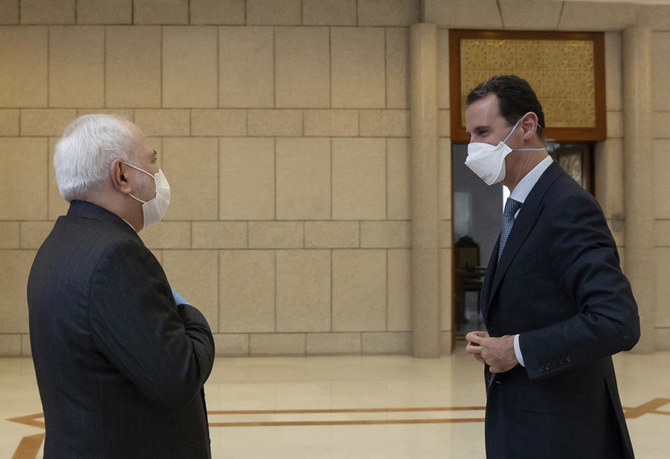
Wearing face masks, Syria’s Assad and Iran’s Zarif condemn West at Damascus meeting

Short Url
https://arab.news/ms84z
Wearing face masks, Syria’s Assad and Iran’s Zarif condemn West at Damascus meeting
- Assad said the handling of the coronavirus crisis showed the West’s moral failure

Latest updates


© 2026 SAUDI RESEARCH & PUBLISHING COMPANY, All Rights Reserved And subject to Terms of Use Agreement.