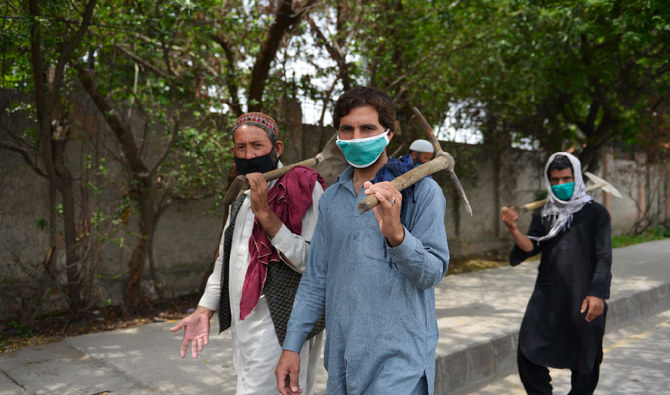
ISLAMABAD: With Ramadan just around the corner, ordinary Pakistanis out of work say they are living on a prayer that the holy month will bring with it divine relief despite the relentless rise in cases of Covid-19 in the country.
With over 8,000 confirmed cases of the virus and 160 deaths as of Sunday, most provinces have reported a steady spike in the rates of cases and fatalities. As part of strict containment measures, most cities remain on partial lockdown, bringing the economy to a virtual halt despite the easing of some rules by the government earlier this week and a weekend announcement that Ramadan prayers in mosques around the country would be allowed.
Wearing a facemask, gloves and with a hand sanitizer tucked into his pocket, Muhammad Ashfaq Abbasi, a server at a local food joint in the federal capital said he used to make between Rs25,000 to Rs30,000 ($184) a month at work before the global pandemic hit Pakistan in February. But since the lockdown was imposed, Abbasi told Arab News he hadn’t been able to earn even 10 percent of that figure.
“The coronavirus has gripped us all in fear. Our predicament has limited choices. If we try to survive the virus, we’ll die of starvation. If we try to overcome the financial problem, we expose ourselves to the disease,” he said.
Abbasi added he was now living on a prayer that Ramadan might bring with it divine intervention, and said he was uncertain about how to cope with the approaching month, when business activity usually witnesses a dip even under normal circumstances.
Pakistan said on Saturday it had disbursed more than Rs53 billion to over 4.4 million people under its Ehsaas Emergency Cash program to help support families falling into the lowest income brackets in the resource-strapped country of 210 million people.
Many are still waiting for government help.
“I haven’t received any relief or funds from the government,” Abbasi said.
“Daily work is the only option I have to sustain my lifestyle and support my family,” he said.
Earlier this week, Prime Minister Imran Khan announced restrictions would be eased on some categories of industries, merchants, and small businesses to resume operations in a move aimed to counter the economic fallout of the lockdowns. But with consumers and customers largely indoors and supply chains still shut down, the effort hasn’t had the desired effect.
“Under the circumstances, I can’t even prepare for Sehr and Iftaar when I am out of pocket and unable to buy food and essentials,” mobile shop owner, Muhammed Saeed Bajwa, told Arab News.
Defying shutdown, Bajwa has reopened his business but keeps his shop shuttered down. With mounting bills and a family to support, he said he had no time or money to even think of Ramadan preparations this year.
It is undignified to beg for relief or a loan, Bajwa said, but he appealed to Prime Minister to allow businesses to resume operations with all preventive measures taken to protect against the virus.
“Expenses won’t stop so the government needs to introduce standard operating procedures and penalties for those breaking protocol but at least allow business activity to continue,” Bajwa said.
In one corner of Islamabad’s main markets, cobbler Karam Khan said it felt like Ramadan had come early for his family, who had been going hungry for weeks, unable to afford basic food items.
On a good month, he said he usually earned roughly Rs15,000 ($92).
“I won’t die from corona but definitely from hunger,” Khan said.


![]()

Living on a prayer: As Ramadan approaches, Pakistanis lament loss of livelihood
Short Url
https://arab.news/58hkn
Living on a prayer: As Ramadan approaches, Pakistanis lament loss of livelihood
- Lockdown has left families grappling with rising expenses and no money to prepare for Ramadan
- Most provinces have reported a steady rise in the rates of Covid-19 cases and fatalities
Latest updates





© 2026 SAUDI RESEARCH & PUBLISHING COMPANY, All Rights Reserved And subject to Terms of Use Agreement.