
LONDON: A Muslim burial ground in Greater London has adopted an unprecedented method of burying the deceased that is compliant with Islamic law to cope with the growing number of people dying from COVID-19.
The method, which involves burying up to 10 people in individual chambers within one plot after a single funeral prayer is performed for all of them, is being used by Eternal Gardens, which is located in Chislehurst, a district in southeast London.
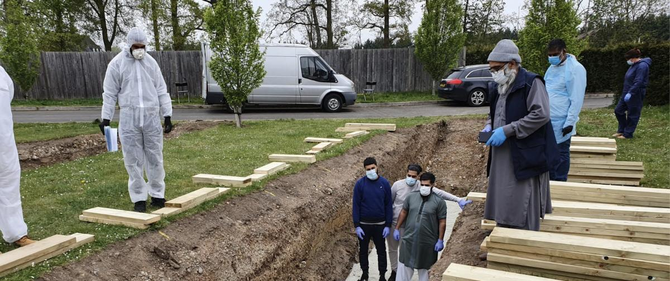
The second of such “saff” burials took place on Saturday. Saff means row in Arabic, and the name reflects the method of laying the deceased to rest in rows within a plot.
Asif Hassanali, development manager for Eternal Gardens, said his team usually buries a maximum of 10 people per week at the grounds under normal circumstances.
But due to the increase in people dying from COVID-19, his team has buried 50 people this week, including the eight who were laid to rest in the saff burial on Saturday.
“Under normal circumstances, we bury an average of eight people per week. Three weeks ago that figure had doubled, and the following week it trebled. Last week we buried 54 people, and 90 percent of them were coronavirus victims,” Hassanali told Arab News.
“Obviously we aren’t used to dealing with this sort of volume of burials, and we understood that this would be a problem. I approached my directors and highlighted the need to come up with a plan for our cemetery that will enable us to cope with the increased demand for burials.”

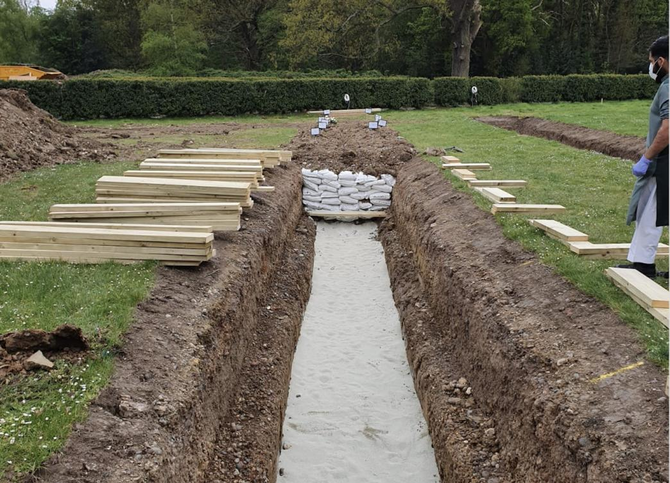
Employees of Eternal Gardens prepare for a saff burial on April 18, 2020. (Supplied)
Hassanali says Eternal Gardens decided to adopt the saff burial method after consulting local Muslim scholars on the best way to deal with the spike in demand for burials that meant families would have to wait for over a week to see their loved ones buried.
Muslims bury their dead as soon as possible, and the deceased is washed and shrouded in cloth according to Islamic guidelines.
A funeral prayer is then performed, and the person is laid to rest in a grave on their right side facing Makkah. The grave should be perpendicular to the holy city.
Hassanali said although there was enough space at Eternal Gardens to bury the rising number of Muslim coronavirus victims in the area, the challenge he faced was the time it took to dig an individual grave with the machinery that the burial ground has.
“It can take up to an hour to dig each grave, and with the equipment we have available, we’re only able to do six individual burials per day, even though we have extra staff available,” he added.
“We came up with the idea of the saff burials after we met with local Muslim scholars whom we asked for advice on our options and how we could cope with the increased demand. They approved of the idea of opening 10 individual graves together in a plot that’s 10 meters long, 2 meters wide and around 1.5 meters deep,” he said.
“We use boards to make individual chambers within this space. The scholars said we have to have a row of soil in between each chamber. We open the plot of land, bury as many as 10 individuals over two rows, then we individually mold them as separate graves from above as well,” he added.
“From above, each chamber looks like a normal grave. However, in order to get the backlog cleared and bury a larger number of people during the same time period, we came up with this option.”
London Imam Suliman Gani, who performed a single funeral prayer for the eight deceased who were laid to rest in a saff burial on Saturday, said this method allows “up to 10 individuals to be buried in a shorter amount of time. The whole burial takes around two hours.”
Gani, who is also a Muslim chaplain at St. George’s Hospital in Tooting, a district in south London, said the saff burials are “practical whilst also ensuring the dignity of the deceased.”