

Israel rivals resume unity government talks with two-day deadline

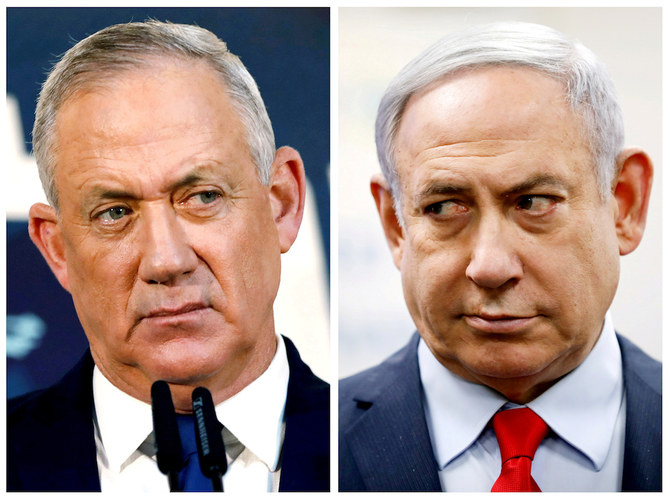
Prime Minister Benjamin Netanyahu (R) and his rival Benny Gantz (L) are in talks to form an emergency unity government. (Reuters)
Short Url
Updated 15 April 2020
Follow

Israel rivals resume unity government talks with two-day deadline

  • Israel has gone to the polls three times in the last year, each time failing to form a government
  • Political crisis comes as the country grapples with increasing coronavirus cases

Jerusalem: Israeli Prime Minister Benjamin Netanyahu and his main rival Benny Gantz held new talks on forming an emergency unity government Tuesday, with a deadline less than two days away.
A deal would give Israel its first fully functioning government since December 2018, stability that could prove crucial as it confronts the coronavirus pandemic.
The two men had been negotiating prior to a deadline that expired at midnight Monday night, but jointly asked President Reuven Rivlin for a two-day extension to finalize details.
They met in Jerusalem on Tuesday morning, after releasing a joint statement late Monday hailing “significant progress.”
There have been repeated claims of progress in coalition talks since an inconclusive March 2 election, Israel’s third poll in less than a year, but a deal has remained elusive.
Tuesday’s talks ended without a breakthrough but the two men committed to meet again after the Jewish passover holiday ends at sunset on Wednesday, with a view to reaching a deal by a midnight that evening.
As Israel’s unprecedented political deadlock has persisted, there have been widespread calls for an interim national unity government to combat the novel coronavirus, which has infected more than 11,500 Israelis and killed 117.
Gantz, a centrist ex-military chief, has squared off against the veteran right-wing prime minister in three elections since April last year.
Neither has earned enough support from voters and potential coalition partners to form a government.

In the March 2 election, Netanyahu’s Likud emerged as the largest party but Gantz’s Blue and White won the backing of most of the country’s 120 MPs.
Gantz was therefore given a 28-day mandate to try and form a government.
But deep divisions within the anti-Netanyahu camp meant his chances of forging a stable coalition were always remote.
In a surprise move last month, Gantz was elected speaker of parliament and effectively stopped seeking to form a coalition with himself as prime minister.
He called for an alliance led by Netanyahu for a defined period, allowing Israeli politics a rare moment of unity as it stares down an unprecedented health crisis.
In the process, Gantz broke his political party in two, with more than half his allies in parliament leaving to join the opposition rather than ally with the deeply divisive Netanyahu.
Since then talks have stalled over a number of key issues.
Forming a government involves distributing ministerial portfolios and agreeing a political roadmap for the country.
A major source of tension has been the choice of a justice minister who will be tasked with overseeing the corruption case against Netanyahu.
Disputes have also emerged over the nomination of a defense minister, including speculation that Gantz, a former army chief, may want the job.
Policy toward the Palestinians, notably Netanyahu’s stated desire to unilaterally annex the strategically important Jordan Valley in the occupied West Bank, has also reportedly caused friction.
“Netanyahu, this is our moment of truth. It’s either a national emergency government or a senseless fourth round election, costly and unnecessary in this hour of crisis,” Gantz said on Monday night.
“History will not be forgiving toward leadership that shirks its responsibility at this critical point of time.”
In office since 2009, Netanyahu is Israel’s longest-serving premier and the first to be indicted while in office.
The premier denies charges of bribery, fraud and breach of trust, filed against him in January.
Netanyahu critics have charged that he will stop at nothing to make the indictments disappear, including pushing for a fourth election in the hope of gaining a parliamentary majority to push through a law granting him immunity from prosecution.


Turkiye’s Kurdish party says Syria deal leaves Ankara ‘no excuses’ on peace process

Updated 4 min 10 sec ago
Follow

Turkiye’s Kurdish party says Syria deal leaves Ankara ‘no excuses’ on peace process

  • Turkish officials said earlier on Monday that the Syrian integration deal, if implemented, could advance the more than year-long process with the ​PKK, which is based in northern Iraq

ANKARA: Turkiye’s pro-Kurdish DEM Party said on Monday that the Turkish government had no more “excuses” to delay a peace process with the Kurdistan Workers Party (PKK) now that a landmark integration deal was achieved in neighboring Syria.

On Sunday in Syria, the Kurdish-led Syrian Democratic Forces (SDF) agreed to come under the control of authorities in Damascus — a move that Ankara had long sought as integral to ‌its own peace ‌effort with the PKK.

“For more than a ‌year, ⁠the ​government ‌has presented the SDF’s integration with Damascus as the biggest obstacle to the process,” Tuncer Bakirhan, co-leader of the DEM Party, told Reuters, in some of the party’s first public comments on the deal in Syria.

“The government will no longer have any excuses left. Now it is the government’s turn to take concrete steps.” Bakirhan cautioned President Tayyip Erdogan’s ⁠government against concluding that the rolling back Kurdish territorial gains in Syria negated the need ‌for a peace process in Turkiye.

“If the ‍government calculates that ‘we have weakened ‍the Kurds in Syria, so there is no longer a ‍need for a process in Turkiye,’ it would be making a historic mistake,” he said in the interview.

Turkish officials said earlier on Monday that the Syrian integration deal, if implemented, could advance the more than year-long process with the ​PKK, which is based in northern Iraq. Erdogan urged swift integration of Kurdish fighters into Syria’s armed forces.

Turkiye, the strongest ⁠foreign backer of Damascus, has since 2016 repeatedly sent forces into northern Syria to curb the gains of the SDF — which after the 2011–2024 civil war had controlled more than a quarter of Syria while fighting Islamic State with strong US backing.

The United States has built close ties with Damascus over the last year and was closely involved in mediation between it and the SDF toward the deal.
Bakirhan said progress required recognition of Kurdish rights on both sides of the border.

“What needs to be done is clear: Kurdish rights must be recognized ‌in both Turkiye and Syria, democratic regimes must be established, and freedoms must be guaranteed,” he said.

Meanwhile, outlawed Kurdish militants in Turkiye said they will “never abandon” Kurds in Syria following the offensive by Damascus. 

You should know that we will not leave you alone. Whatever the cost, we will never leave you alone.. we as the entire Kurdish people and as the movement, will do whatever is necessary,” Murat Karayilan of the Kurdistan Workers’ Party (PKK) was quoted as saying by Firat.

Karayilan said the Damascus-led offensive was an “attempt to nullify” the peace process in Turkiye.
“This decision by international powers to enable these attacks, will be a black mark for the US, the UK, Germany, France and other international coalition states,” he said.
On Monday, at least 500 people rallied in Turkiye’s Kurdish-majority city of Diyarbakir against the Syrian offensive. Clashes erupted when pollice tried to break up the protest.
The pro-Kurdish DEM party, the third largest force in the Turkish parliament, called for a rally on Tuesday in the town of Nusaybin, located on the border with Syia.

*With Reuters and AFP