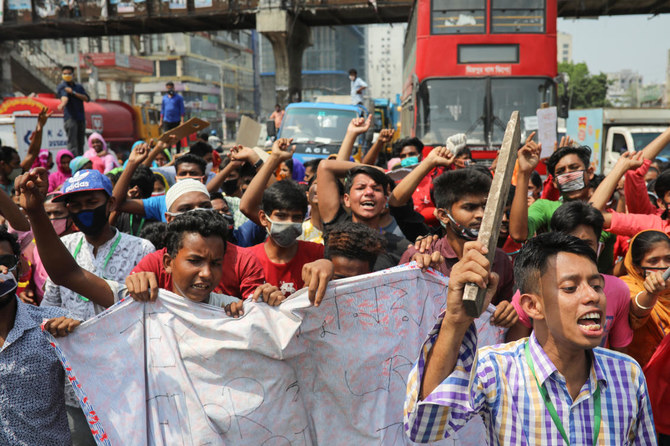
DHAKA: Thousands of garment workers who produce items for top Western fast fashion brands protested against unpaid wages in Bangladesh’s streets Monday, saying they were more afraid of starving than contracting coronavirus.
Bangladesh’s apparel factories account for some 84 percent of the country’s $40 billion export sector, which is facing its worst crisis in decades after retailers including H&M, Walmart and Tesco canceled orders because of the pandemic.
Protesting workers say many factories have not paid them after the orders were cut.
Workers shouted slogans such as “we want our wages” and “break the black hands of the owners” as they blocked roads despite a nationwide lockdown to combat the spread of the deadly disease.
“We are afraid of the coronavirus. We heard a lot of people are dying of this disease,” protesting worker Sajedul Islam, 21, told AFP.
“But we don’t have any choice. We are starving. If we stay at home, we may save ourselves from the virus. But who will save us from starvation?“
The lockdown, which started on March 26, also forced the closure of the vast majority of the country’s garment factories.
“We have not been paid for two months. We are starving,” said another protester, who gave her name as Brishti, from the Tex Apparel factory in the capital Dhaka.
“If we don’t have food in our stomach, what’s the use of observing this lockdown?“
Some 5,500 workers protested on Monday while 20,000 turned out on Sunday, police inspector Islam Hossain told AFP.
“Some workers broke doors and glasses of a factory. But they were largely peaceful,” Hossain told AFP. No one was arrested.
Bangladesh has announced $590 million in loans for export-oriented factories to pay workers.
The South Asian nation is the world’s second-biggest garment maker after China, with $35 billion dollars of exports a year.


![]()


’Starving’ Bangladesh garment workers protest for pay during COVID-19 lockdown
Short Url
https://arab.news/rsyv8
’Starving’ Bangladesh garment workers protest for pay during COVID-19 lockdown
- Bangladesh’s apparel factories account for some 84 percent of the country’s $40 billion export sector
- Protesting workers say many factories have not paid them


Blizzard warnings cascade across East Coast as winter storm hits
NEW YORK (AP) — New York City and New Jersey announced travel bans, airlines canceled thousands of flights and even Broadway shows were canceled Sunday evening as a fierce winter storm bore down on the Northeastern U.S., prompting blizzard warnings from Maryland to Massachusetts.
Snow began falling in New Jersey and New York as the storm moved northward. The National Weather Service said 1 to 2 feet (30 to 60 centimeters) of snow was possible in many areas, along with heavy winds. Visibility in many areas was expected to be a quarter-mile (400 meters) or less. Officials throughout the region urged residents to avoid travel.
“It’s been a while since we’ve had a major nor’easter and major blizzard of this magnitude across the Northeast,” said Cody Snell, a meteorologist at the service’s Weather Prediction Center. “This is definitely a major winter storm and a major impact for this part of the country.”
The weather service issued blizzard warnings for New York City and Long Island, Boston and coastal communities in Delaware, Maryland, New Jersey, Connecticut, Rhode Island and Massachusetts. State of emergency declarations were issued in New Jersey, Delaware, Rhode Island, Connecticut, Massachusetts and parts of New York as officials mobilized readiness efforts.
New York City Mayor Zohran Mamdani announced a ban on non-emergency travel on all streets from 9 p.m. ET Sunday through noon Monday, with travel restrictions planned in New Jersey, Pennsylvania, Rhode Island and elsewhere in the region. Regional airports canceled flights ahead of the storm, and even DoorDash announced it was suspending deliveries in the city overnight.
To the south, landmarks such as the Arlington National Cemetery in Washington, D.C., announced closures Monday.
Some of the heaviest snow forecast for overnight Sunday into Monday
The weather service said some of the heaviest snow was expected to fall overnight, with as much as 2 inches (5 centimeters) of snow per hour accumulating at times in some areas, before tapering off by Monday afternoon.
It said the storm's strong wind gusts could cause whiteout conditions and warned of a “Potentially Historic/Destructive Storm” southeast of the Boston-Providence corridor.
“Winds like that, combined with heavy, wet snow, are a recipe for damaged trees and prolonged power outages," said Bryce Williams, a meteorologist with the weather service's Boston office. “That's what we're most concerned with, is the combination of those extreme snow amounts with that wind.”
The storm could possibly meet the definition of a bomb cyclone, said Frank Pereira, another weather service meteorologist. That’s when a storm drops at least 24 millibars in pressure in 24 hours.
“We’re expecting it to drop by that magnitude at least over the course of the next 24 hours,” Pereira said. “I think when all is said and done, it will meet the definition of a bomb cyclone.”
New York City Mayor Zohran Mamdani also canceled in-person and virtual classes for city schools on Monday, calling it the “first old-school snow day since 2019."
“And to kids across New York City, you have a very serious mission if you choose to accept it: Stay cozy," he said.
In addition to their robust plow operations, city officials recruited people to shovel snow, some of whom will begin work Sunday night to get an early start on the first wave of snowfall, Mamdani said.
Meanwhile, outreach workers have also been out working to coax homeless New Yorkers off the street and into shelters and various warming centers.
More than 3,500 flights were canceled across the U.S. as of Sunday afternoon along with thousands of delays, according to the flight tracking website FlightAware. Airports in the path of the storm, including in New York City and Boston, were also seeing widespread cancellations and delays.
Preparations for major snow clearing
With the storm zeroing in, John Berlingieri scrapped plans for a family trip to Puerto Rico. Instead he was preparing his company, Berrington Snow Management, for what could well be a mammoth task: Clearing snow from millions of square feet of asphalt surrounding shopping malls and industrial parks across Long Island.
Employees spent the last few days recharging batteries on the company’s 40 front-end loaders and replacing windshield wipers on snow-removal vehicles, before resting up Saturday.
“I’m anticipating at least one week of work around the clock,” Berlingieri said. “We’re going to work 24 to 36 hours straight, sleep for a few hours and then go back.”
___
Izaguirre reported from Albany, New York. Associated Press writers Mark Kennedy in New York, Darlene Superville in Washington, D.C, and Claire Rush in Portland, Oregon. contributed.
Snow began falling in New Jersey and New York as the storm moved northward. The National Weather Service said 1 to 2 feet (30 to 60 centimeters) of snow was possible in many areas, along with heavy winds. Visibility in many areas was expected to be a quarter-mile (400 meters) or less. Officials throughout the region urged residents to avoid travel.
“It’s been a while since we’ve had a major nor’easter and major blizzard of this magnitude across the Northeast,” said Cody Snell, a meteorologist at the service’s Weather Prediction Center. “This is definitely a major winter storm and a major impact for this part of the country.”
The weather service issued blizzard warnings for New York City and Long Island, Boston and coastal communities in Delaware, Maryland, New Jersey, Connecticut, Rhode Island and Massachusetts. State of emergency declarations were issued in New Jersey, Delaware, Rhode Island, Connecticut, Massachusetts and parts of New York as officials mobilized readiness efforts.
New York City Mayor Zohran Mamdani announced a ban on non-emergency travel on all streets from 9 p.m. ET Sunday through noon Monday, with travel restrictions planned in New Jersey, Pennsylvania, Rhode Island and elsewhere in the region. Regional airports canceled flights ahead of the storm, and even DoorDash announced it was suspending deliveries in the city overnight.
To the south, landmarks such as the Arlington National Cemetery in Washington, D.C., announced closures Monday.
Some of the heaviest snow forecast for overnight Sunday into Monday
The weather service said some of the heaviest snow was expected to fall overnight, with as much as 2 inches (5 centimeters) of snow per hour accumulating at times in some areas, before tapering off by Monday afternoon.
It said the storm's strong wind gusts could cause whiteout conditions and warned of a “Potentially Historic/Destructive Storm” southeast of the Boston-Providence corridor.
“Winds like that, combined with heavy, wet snow, are a recipe for damaged trees and prolonged power outages," said Bryce Williams, a meteorologist with the weather service's Boston office. “That's what we're most concerned with, is the combination of those extreme snow amounts with that wind.”
The storm could possibly meet the definition of a bomb cyclone, said Frank Pereira, another weather service meteorologist. That’s when a storm drops at least 24 millibars in pressure in 24 hours.
“We’re expecting it to drop by that magnitude at least over the course of the next 24 hours,” Pereira said. “I think when all is said and done, it will meet the definition of a bomb cyclone.”
New York City Mayor Zohran Mamdani also canceled in-person and virtual classes for city schools on Monday, calling it the “first old-school snow day since 2019."
“And to kids across New York City, you have a very serious mission if you choose to accept it: Stay cozy," he said.
In addition to their robust plow operations, city officials recruited people to shovel snow, some of whom will begin work Sunday night to get an early start on the first wave of snowfall, Mamdani said.
Meanwhile, outreach workers have also been out working to coax homeless New Yorkers off the street and into shelters and various warming centers.
More than 3,500 flights were canceled across the U.S. as of Sunday afternoon along with thousands of delays, according to the flight tracking website FlightAware. Airports in the path of the storm, including in New York City and Boston, were also seeing widespread cancellations and delays.
Preparations for major snow clearing
With the storm zeroing in, John Berlingieri scrapped plans for a family trip to Puerto Rico. Instead he was preparing his company, Berrington Snow Management, for what could well be a mammoth task: Clearing snow from millions of square feet of asphalt surrounding shopping malls and industrial parks across Long Island.
Employees spent the last few days recharging batteries on the company’s 40 front-end loaders and replacing windshield wipers on snow-removal vehicles, before resting up Saturday.
“I’m anticipating at least one week of work around the clock,” Berlingieri said. “We’re going to work 24 to 36 hours straight, sleep for a few hours and then go back.”
___
Izaguirre reported from Albany, New York. Associated Press writers Mark Kennedy in New York, Darlene Superville in Washington, D.C, and Claire Rush in Portland, Oregon. contributed.
Latest updates


© 2026 SAUDI RESEARCH & PUBLISHING COMPANY, All Rights Reserved And subject to Terms of Use Agreement.