Help at hand for Bangladeshi workers in Middle East
Help at hand for Bangladeshi workers in Middle East/node/1657261/world
Help at hand for Bangladeshi workers in Middle East
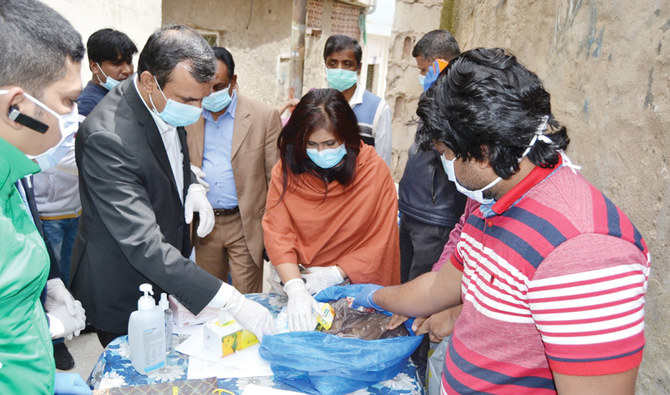
Bangladesh Ambassador to Jordan Nahida Sobhan distributes food to migrants in Amman. There are around 150,000 Bangladeshi migrants in Jordan. (Supplied)
DHAKA: Bangladeshi missions across the Middle East have launched a special food assistance program to help thousands of migrant workers impacted by the anti-coronavirus lockdown, officials told Arab News on Saturday.
Nearly 4 million Bangladeshi workers live in Arab countries, with many facing difficulties due to reduced work opportunities and limited funds.
“Due to the ongoing curfew, we cannot move much. We have applied to the Saudi Foreign Ministry for vehicle movement permission, which would be provided shortly. Once we receive it, our mission’s officials will hand over the food packages to the workers,” Golam Moshi, Bangladesh’s ambassador to Saudi Arabia, told Arab News on Saturday.
It follows an announcement last week by Bangladesh’s Expatriates’ Welfare Minister Imran Ahmad allocating $560,000 towards the initiative.
In addition to providing food packs, the mission has launched a 24-hour toll-free helpline for its workers in the Kingdom and posted a notice on its Facebook page asking for contact, location and visa details so that they can be reached.
Moshi said that Bangladeshi officials had already received nearly 3,000 requests from different locations in the Kingdom and were getting deliverables ready to support the workers for at least 20 days.
He thanked the Kingdom for lifting restrictions on undocumented workers — who make up part of the nearly 2.2 million Bangladeshis living in the Kingdom — so that they could receive assistance during the pandemic.
“Gradually we will expand the food assistance program to other major cities of the Kingdom, too,” said Moshi, who is also Bangladesh’s permanent representative to the Organization of Islamic Cooperation.
The Bangladeshi Embassy in the UAE has also distributed about 1,000 food packages to overseas workers in the emirates.
“It’s very challenging to reach the migrants amid this lockdown. In some areas, the Bangladeshi community is also helping the migrants with food and other emergency stuff. Our mission officials are trying their level best to assist the migrants who are in extreme need,” Mohammed Iqbal Hosain Khan, Bangladeshi consul general in the UAE, told Arab News.
He added that from among the 700,000 Bangladeshi migrants living in the UAE, about 200,000 were facing “extreme hardship” due to the lockdown.
Meanwhile, the Bangladesh mission in Jordan has received 2,500 requests for assistance from expatriates in the country.
“On Thursday, we have distributed food packages to several hundred Bangladeshi migrants in two locations of Amman — Mahatta and Jebel Hussein — which will help them for two weeks. With the current funding, we can support around 3,000 migrants,” Nahida Sobhan, Bangladeshi ambassador to Jordan, told Arab News, adding that 150,000 Bangladeshi migrants were currently living in Jordan.
“I think we will be required to support more than 4,000 migrants eventually. So, I am trying to have some more funding to help the migrants as much we can,” Sobhan said.
Similar initiatives have been taken by Kuwait, Bahrain and other Bangladeshi missions in the region, foreign ministry sources said.
She was an orphan adopted from Iran by a US veteran. The Trump administration wants to deport her
Updated 2 sec ago
AP
She was an orphan adopted from Iran by a US veteran. The Trump administration wants to deport her
A woman adopted as a toddler by an American war veteran, who he found in the 1970s in an Iranian orphanage and raised as a Christian, is being threatened with deportation to Iran, a country notoriously dangerous for Christians and now on the brink of war with the United States. She is one of thousands adopted from abroad who were never granted citizenship because of a fracture at the intersection of adoption and immigration law. The woman, who The Associated Press is not naming because of her legal situation, received a letter from the Department of Homeland Security earlier this month ordering her to appear for removal proceedings before an immigration judge in California. She has no criminal record. The letter says she is eligible for deportation because she overstayed her visa in March 1974 at 4 years old. “I never imagined it would get to where it is today,” said the woman, who believes that, as a Christian and the daughter of an American Air Force officer, deportation to Iran might be a death sentence. “I always told myself that there is no way that this country could possibly send someone to their death in a country they left as an orphan. How could the United States do that?” The already terrifying prospect of being deported to Iran was made more so in recent days, she said, as the Trump administration began amassing the largest force of American warships and aircraft in the Middle East in decades, preparing for possible military action against Iran if talks over its nuclear program fail. The Associated Press profiled the woman in 2024 as part of a story about how many international adoptees were left without citizenship because their American adoptive parents failed to naturalize them. The woman has tried to rectify her legal status for years, so the Department of Homeland Security has been aware of her situation since at least 2008. She guesses their file on her is thousands of pages long. She does not know what prompted the sudden threat of removal. The Trump administration has been on a mass deportation campaign, touting that it is removing the “worst of the worst” criminals. But many with no criminal records have been swept up. The only interaction with law enforcement the woman can recall is being pulled over 20 years ago for using her phone while driving. She works a job in corporate health care, pays taxes and owns a home in California. “When the media refuses to give names, it makes it impossible to provide details on specific cases or even verify any of this even happened or that the people even exist. If you can’t do your job, we can’t do ours,” the Department of Homeland Security wrote in a statement. The AP did not provide them the woman’s name, but sent a detailed description of the letter she received, the stated reasons she is eligible for deportation and the date she was ordered to appear in court, March 4. A judge delayed the hearing to later next month and agreed with her attorney, Emily Howe, to specify the woman does not have to appear in person — a relief as they worried immigration officers would be waiting at the courthouse to take her away. Adopted in Iran when she was 2 The woman’s father was a prisoner of war in Germany during World War II, captured in 1943 and held until the end of the war. When he retired from the Air Force, he worked as a government contractor in Iran, where he and his wife found her in an orphanage in 1972 and adopted her. She was 2 years old. They returned to the US in 1973, and the local newspaper ran a full-page story about the family and their new daughter. Her adoption was completed in 1975. But at that time, parents had to separately naturalize the children through the federal immigration agency. The woman’s parents have since died. She didn’t learn she hadn’t been naturalized until she applied for a passport at 38 years old. She still doesn’t know how the oversight happened. She searched her father’s papers and found a letter from a lawyer, dated 1975, that said he was working with immigration officials, “it appears this matter is concluded,” and billed her father for his services. She did not keep her situation secret. She has for years asked everyone she could think of for help: the State Department, immigration officials, senators. She has contacted her congresswoman, Rep. Young Kim, a Republican from California, but to no avail. Most recently, Kim’s office responded to her plea about her pending removal by saying that they were “not able to advise or interfere.” “It just baffles me that it’s OK to send me to a foreign country that I could potentially die or I could get imprisoned because of a clerical error,” she said. More modern adoptees do not face this legal limbo: Congress passed a bill in 2000 meant to rectify the issue and confer automatic citizenship on everyone legally adopted from abroad. But they did not make it retroactive, and it applied only to those younger than 18 when it took effect; everyone born before the arbitrary date of Feb. 27, 1983, was not included. Coalition tries to protect older adoptees A bipartisan coalition — from the Southern Baptist Convention to liberal immigration groups — has been lobbying Congress ever since to pass another bill to help the older adoptees left out of the law, but Congress has not acted. Some of those lobbyists say now that the administration threatening to deport an adoptee is the exact scenario they worked hard to try to avoid. “I’m horrified. It’s rare for me to feel shocked by a story these days. But this is an absolutely unbelievable situation,” said Hannah Daniel, who, as the director of public policy for the Ethics and Religious Liberty Commission, the lobbying arm of the Southern Baptist Convention, begged legislators for years to address the issue. Intercountry adoption has been a rare topic championed by lawmakers on both sides of the aisle. Many Christian churches preach intercountry adoption as a biblical calling, a mirror to God welcoming believers into a family of faith. Daniel, who recently joined World Relief, a Christian humanitarian organization, said threatening to send a Christian adoptee to Iran represents a collision of two issues she and many other Christians care deeply about: international adoption and the persecution of Christians around the globe. “That is what is most troubling to me about this: We are a nation that prides itself on fighting for religious freedom both here and abroad,” Daniel said. “And it feels so antithetical to that to then say we’re going to send this person who, for me, is a sister in Christ to face a death sentence.” She called it “un-American and unconscionable.” Converts to Christianity in Iran face intense discrimination Ryan Brown, chief executive officer of Open Doors, a nonprofit that supports persecuted Christians around the world, said some in Iran are Christians by birth and face widespread discrimination. But it is much worse for those considered converts to Christianity from Islam. He said he expects a deported adoptee would be viewed in that later category — as a convert. “It is assumed that you are an enemy of the state. It is assumed that if you are a Christian, that you are aligned to the West and you desire to see that the regime toppled,” he said. “There is no benefit of the doubt extended.” Converted Christians are arrested routinely. Some are sentenced to death. “Their prisons are world renowned for their deplorable conditions,” Brown said. There is no sanitation. Food, water and access to health care are scarce. Iranian prisons are “notoriously more evil for women,” he said, and women have routinely reported sexual assault by their captors. Others have been forced into marriages. Brown, an adoptive father himself, struggled to even contemplate what a Christian woman, accustomed to the freedom of the United States, might experience if she had to walk off a plane into Iran. She does not know the language. She knows nothing about its customs. She has lived a fully American life. “I cannot even fathom that,” Brown said. “My prayers are with her.” The woman believes Iran would likely view her with even more suspicion given her father’s military service and work as a US government contractor. She grew up listening to her father’s war stories. She read the journal he kept while in the prison camp, how cold and hungry he had been, and she was proud of his sacrifice and his service to a country she believed had saved her. When she is sad or scared now, she said, she looks at her favorite photo of him in his military uniform, medals lined up on his left shoulder, a slight, confident smile on his face. “I’m proud of my father’s legacy. I’m part of his legacy. And what’s happening to me is wrong,” she said. “And I know that he was here, it would break his heart to know that I’m on this path.”