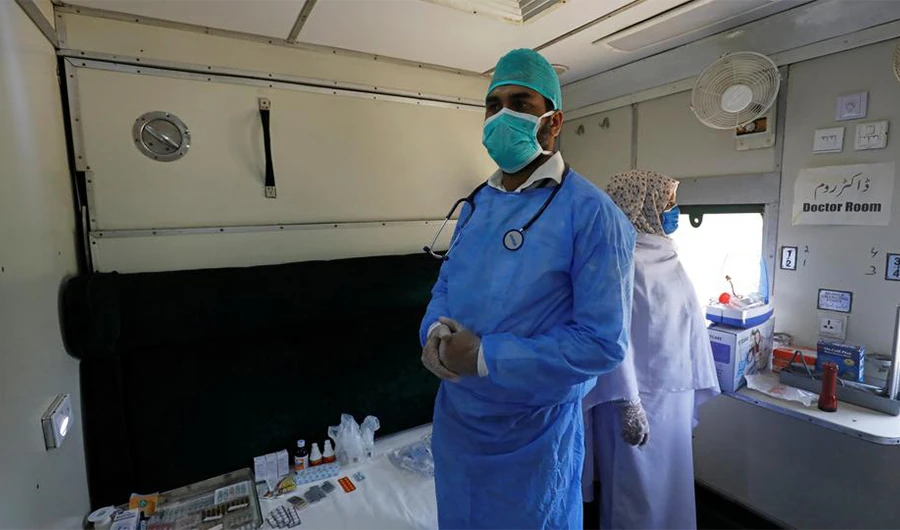
- According to an official manual, only those providing direct care to COVID-19 patients will get hazmat suits
- Doctors insist that those working outside isolation wards are also vulnerable and can contract the virus
LAHORE: Dr. Arsalan Shah has been in a Dera Ghazi Khan isolation ward in Pakistan’s Punjab province for nearly a week now. The 27-year-old cardiologist is housed with nine other doctors, all of whom have tested positive for coronavirus.
In the ward, mornings and afternoons are spent alone in individual rooms, but the 10 colleagues usually get together and talk during the evenings.
“The topic of discussion is always the same. When will we get back to work?” Dr. Shah told Arab News.
“We can’t be sitting around doing nothing. Not right now, not when we are needed the most.”
Shah was posted at a quarantine facility for COVID-19 carriers late last month. He never came in direct contact with any patient although he had to regularly interact with other health care providers that required him to move in and out of wards and intensive-care units.
Some of the men and women had Personal Protection Equipment (PPE), but not all.
“Some of us didn’t even have basics like N-95 masks,” he said.
Earlier this week, nearly 60 doctors in the southwestern city of Quetta were arrested while protesting the lack of PPEs to shield them from the deadly virus. They were later released after a two-day-long stalemate over how to resolve the issue.
When Shah developed a mild fever and cough, he said he decided to have himself tested as a precaution. On April 4, Shah and nine doctors were diagnosed positive.
Still, the cardiologist said he does not blame the government for not providing the required number of protection suits, masks and gloves.
“I understand that Pakistan has very few resources,” he said over the phone from his ward.
“As doctors, I think we are already mentally prepared to fight this war with whatever little resources we have.”
But others say protection measures at hospitals are inadequate. Many health care workers in quarantine wards are only using surgical masks and gloves to shield themselves from the contagion, whereas the National Command and Operation Center has issued comprehensive guidelines regarding Personal Protective Equipment (PPE) and its usage by medical staff.
An instruction manual lists down health care workers who qualify to be provided complete protection equipment. As per the manual, only those providing direct care to COVID-19 patients, including those performing the physical examination of patients with respiratory symptoms, ambulance drivers, laboratory technicians and officials tasked to trace out suspected cases of coronavirus, will be given hazmat suits.
Pakistan has 1,279 public hospitals and 220,829 registered doctors for a population of over 207 million, according to Pakistan’s Economic Survey 2018-2019. This amounts to one doctor for every 963 people.
As of April 11, more than 4,970 cases of coronavirus have been reported in Pakistan, and 77 deaths. Of those infected, 83 are doctors. However, adding the number of infected nurses, technicians and sanitary staff at hospitals across the country, the number of health care professionals hit by coronavirus has neared 111, according to data provided to Arab News by health departments in four provinces, Gilgit-Baltistan and Kashmir.
There are 36 health care professionals infected by coronavirus in southern Sindh province-- and 29 of them are doctors, Meeran Yousaf, media coordinator at the Sindh health department told Arab News. Similarly, the number of infected health care workers — doctors and paramedics included — in Punjab is recorded at 28, according to Hafiz Qaiser Abbas from the primary and secondary health department of Punjab.
Southwestern Balochistan has reported 30 health care workers hit by the coronavirus out of which 18 are doctors, Dr. Waseem Baig, spokesman for the DG health and civil hospital Balochistan, told Arab News.
Khyber Pakhtunkhwa (KP) recorded 15 health workers downed with the infectious disease, eight of them doctors, according to Dr. Ikram Ullah Khan, director of public health KP.
Gilgit-Baltistan and Azad Jammu and Kashmir did not report any cases of infected doctors until Saturday, though of the two physicians who died from the virus in the country, one belonged to GB.
On April 9, Pakistani Prime Minister Imran Khan said that if the number of COVID-19 patients kept surging, it could put a lot of pressure on hospitals by the end of April.
Medical professionals fear this could further strain Pakistan’s health care system, as staffing problems become more acute.
“I worked in an emergency ward at a public hospital in Mardan,” Dr. Zia-ur-Rehman, a doctor in Mardan, Khyber Pakhtunkhwa told Arab News over the phone.
“We would at times receive hundreds of patients in a day. That is even more dangerous because any of those patients could have been a carrier.”
Rehman’s fears were not unfounded. On April 4, he tested positive for COVID-19 after feeling feverish. He is now a week into his treatment at an isolation ward in the same city.
“What doctors are doing today is no ordinary duty,” Rehman said, “They are serving humanity. Protecting them should be the government’s first priority.”
He suggested the state procure protection suits on an emergency basis.
“Please, it is my request, save the men and women working on the front lines so they can save you.”
Additional reporting by Nazar ul Islam