

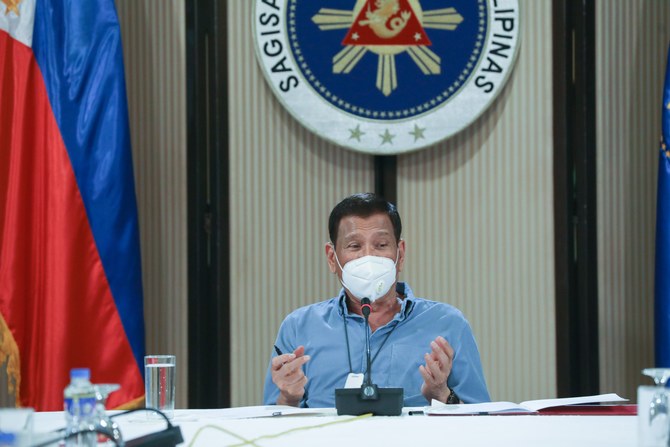

MANILA: Philippines President Rodrigo Duterte has said he will sell government property as a last resort to keep the country afloat as it grapples with the COVID-19 pandemic.
Duterte raised the idea during a televised meeting with the Inter-Agency Task Force for the Management of Emerging Infectious Diseases (IATF-EID) in Malacañang in the early hours of Thursday.
“What is the end game? If we run out of money, I will sell the properties of the government — the Cultural Center (of the Philippines), PICC (Philippine International Convention Center), the land there,” Duterte said. “If I can’t find anything more and we are about to sink —really sink — I will sell all the assets of the government to help the people… I will give it to you. Do not worry about the money.”
On Monday, based on the recommendations of the IATF, the president approved the extension of the Luzon-wide lockdown until April 30 as COVID-19 infections in the country continue to soar.
As of Thursday, the Department of Health (DOH) reported 206 more confirmed COVID-19 cases, bringing the total to 4,076.
The DOH also reported 28 recoveries, which brings the number of people in the Philippines who have recovered from the disease to 124. The death toll is now 203.
The president recently signed the Bayanihan to Heal As One Act as part of his response to the COVID-19 pandemic, which has brought the country to a standstill.
However, he said that the government is looking for additional sources of funds, admitting that the allotted P270 billion emergency subsidy was not enough.
Finance Secretary Carlos Dominguez III said that COVID-19 has hit the country “in a very hard way” and that an estimated 1.2 million workers face temporary unemployment as a result of the lockdown. He added that zero or negative economic growth is predicted in 2020, while the budget deficit will likely widen from 3.2 percent to 5.3 percent, because the government will be spending more than it will be collecting.
“But we are spending more in order to save the people and make sure that they have food on the table during this time,” Dominguez said. “So we are also coming up with a program to continuously borrow more money to support the Philippine economy and our fight against (COVID-19).”
Dominguez said the government is looking to borrow from the Asian Development Bank and World Bank.
“We probably will be borrowing around 5.6 billion US dollars from them,” he said. “If that is still not enough, we will go to the commercial market.”
Meanwhile, some senators welcomed the possibility of disposing of government properties in support of the country’s response to the socio-economic crisis caused by the COVID-19 pandemic.
Senator Panfilo Lacson said, “This is a time for the survival of our people and the whole country as well, and the president must (consider) anything — even the most extraordinary measure — to save us all.”
Opposition Senator Franklin Drilon agreed, saying that the COVID-19 crisis should be an “opportunity to better utilize (government) assets.”
Senate President Vicente Sotto III said he doubts it will reach the point where the government will have to sell its assets to raise funds. Sotto said he believes the president “is merely giving us the assurance that he will do whatever it takes to fund the health and recovery of the entire country.”
Duterte warned that the problem of COVID-19 could last for two years and said there would be severe consequences if this happens.
He stressed that the development of a vaccine for the virus is the only solution, saying, “No vaccine? COVID stays.”


