

Foreign expats choose Saudi Arabia over home countries during virus pandemic

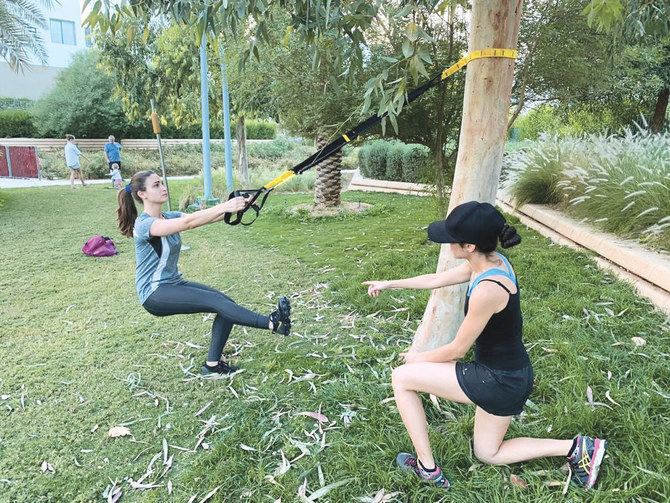
Jessica Ramalho (right) feels safe in Saudi Arabia and stays busy working out with her trainer. She says it is the result of clear government instructions that the situation has been contained. (Photo/Supplied)
Short Url
Updated 09 April 2020
Follow

Foreign expats choose Saudi Arabia over home countries during virus pandemic

  • Government measures to check the spread of the coronavirus disease (COVID-19) win praise

RIYADH: Foreign expats living in Saudi Arabia have been resisting the temptation to head home in the wake of the coronavirus disease (COVID-19) pandemic, opting instead to stay put in the Kingdom. 

Since the start of the deadly virus outbreak, Saudi authorities have acted quickly to introduce measures aimed at preventing the spread of COVID-19 and ensuring the safety of citizens. 

And the government’s moves have reassured many residents from abroad to remain in the Kingdom rather than return to their home countries. 

Alexis DeBerry, an events and delegations specialist at King Abdullah University of Science and Technology, told Arab News: “I have been very impressed by the swift actions to safeguard all of the people living in the Kingdom. 

I have been very impressed by the swift actions to safeguard all of the people living in the Kingdom.

Alexis DeBerry, events and delegations specialist , King Abdullah University of Science and Technology

“Given the circumstances, I am comforted by the measures taken and the efforts to communicate the adjustments to all.” 

On March 30, King Salman ordered that coronavirus treatment be made available for all, including people who had overstayed their visas, one of many announcements made by the Saudi government to care for the population of the country. 

“It is moving to see the level of generosity displayed by the Kingdom in ensuring that anyone who gets sick from COVID-19 will not have to worry financially about treatment. I am confident in the way things are being handled here and proud to support the requests to stay at home to help save lives,” added DeBerry. 
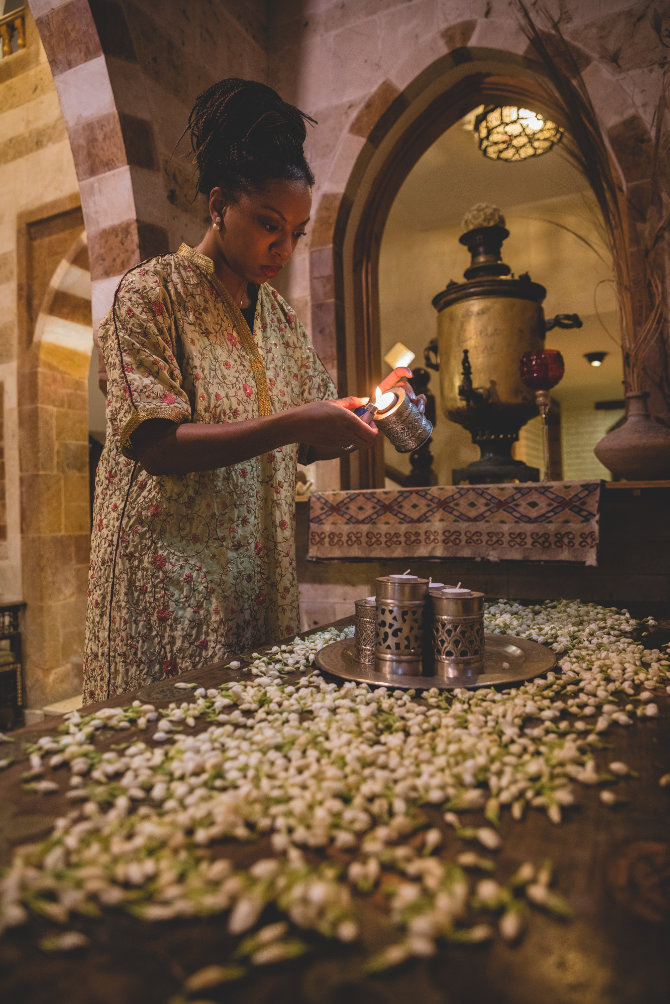


Alexis DeBerry keeps herself busy in different fun-filled creative activities. (Photo/ Supplied)

She praised the Saudi Health Ministry for its clear communication of COVID-19-related messages via text, social media and other marketing platforms. “I feel safe, calm, and confident that everything I need is right here.” 

Despite her family being back in the US, DeBerry opted to stay in the Kingdom, fearing that she could have potentially put her family at risk if she had contracted COVID-19 while traveling to America. “It’s best for me to stay here and stay safe. Everything I need is here,” she said. 

In a recent video posted on the US Mission of Saudi Arabia’s social media platforms, American Ambassador to the Kingdom John Abizaid urged the US community in Saudi Arabia to “shelter in place” instead of returning home during the global health crisis. 

“Food supply is good, emergency services are sound, medical system is functioning,” said the envoy. 

Food supply is good, emergency services are sound, medical system is functioning.

John Abizaid, US ambassador

Jessica Ramalho, a senior consultant at LPC-Omnia International Paris, an advisory and networking agency based in Riyadh, said she had found a way to accommodate her work-life balance during the 24-hour curfew.

“I have a fantastic working environment here where the leadership quickly modified our schedules to allow us to continue our work-life balance with the new regulations in mind. 

“I can take a walk around my garden in the morning to clear my mind or reschedule an afternoon meeting as needed if I have to go to the grocery shop or pharmacy before curfew,” she told Arab News. 

“Zoom meetings and monday.com are a few of the great ways my team keeps in contact. We even go so far as to have virtual coffee and foul (fava beans) once a week and check in with each other, offering support and sometimes funny updates of what is happening at home.” 

Ramalho pointed out that being at home had given her the time and opportunity to try out new food recipes from her Saudi friends and perfect her duggus and tabbouleh dishes. “Virtual cooking sessions on my tablet is extra fun. I am sure some of this would have been possible if I had gone back to the US, but it would not have been the same,” she added. 

Although given the chance to take a flight to the UK for returning British nationals, she decided to stay in Saudi Arabia. 

Unlike some other countries, the Kingdom was quick to take swift action and measures at an early stage.

Jessica Ramalho, senior consultant at LPC-Omnia International Paris

“Unlike some other countries, the Kingdom was quick to take swift action and measures at an early stage, some of which included suspending international flights, prohibiting foreigners from visiting Makkah, closing public places, enforcing curfews, and so on,” she said. 

“It is the result of clear instructions from the government and the consolidation of all these actions that has led to the situation here being contained, giving citizens optimism that life can return to normalcy sooner than in other parts of the world.”

Alexander Sell, the German general manager of the Ritz-Carlton hotel in Jeddah, told Arab News: “I am impressed with the precautionary steps that the Kingdom has taken from the beginning, earlier than most countries. 

“The decrees came strong but precise. They felt too much at first but made perfect sense right after. Society has accepted the circumstances and supports it in unity. No discussions about special rules or exceptions, this seems to be the best, fastest and most secure way to overcome the crisis. 

“I feel deeply connected with the company, property and country and for me it’s a duty to stay, being with my team and offering support with my presence in such challenging times.” 

Sell said he had been passing time doing sports activities, although under the new curfew he has had to switch indoors which has limited space. 

“Self-discipline is the most important asset to either nurture or learn now. Establishing a routine, and sticking to it daily, is the best advice I can give. Use your time to trim your body, eat well and healthily, educate yourself with reading and stay positive. The crisis will be over soon and we all will value different, more important things then before COVID-19.” 


Saudi House kicks off Davos with push on Vision 2030, AI platform and ‘humanizing’ tourism

At Saudi House, ministers and executives set out how the Kingdom sees the next phase of its transformation. (Supplied)
Updated 20 January 2026
Follow

Saudi House kicks off Davos with push on Vision 2030, AI platform and ‘humanizing’ tourism

  • Saudi ministers dominate pre-summit spotlight at Saudi pavilion, touting Vision 2030’s next phase and human capital as key to global edge
  • Ministry of Economy and Planning announced the SUSTAIN Platform which aims to accelerate AI-enabled, cross-sector collaboration for sustainable development

DAVOS: For regulars at the World Economic Forum, Monday in Davos is usually a chance to ease into the week, a time to reconnect, plan meetings and prepare for the intense schedule ahead.

This year, Saudi Arabia moved quickly to fill that lull, taking center stage with a packed program of panels ahead of Tuesday’s official opening.

At the Saudi House — the Kingdom’s official pavilion on the Promenade, returning after its debut as a standalone venue at the 2025 WEF Annual Meeting — Saudi ministers and global executives set out how the Kingdom sees the next phase of its transformation.

Monday’s speakers at the Saudi House included Minister of Finance Mohammed Al-Jadaan, Minister of Investment Khalid Al-Falih, Minister of Tourism Ahmed Al-Khateeb, and President and Vice Chairman of Meta Dina Powell McCormick. (Supplied)

Established by the Ministry of Economy and Planning, the venue is pitched as a platform for international thought leaders to tackle the challenges, opportunities and solutions shaping the global economy.

Opening a session on the Kingdom’s role at this year’s Forum and the next phase of Vision 2030 — now in its 10th year and roughly two-thirds complete — Princess Reema bint Bandar, Saudi Arabia’s ambassador to the US, said human capital “is the actual driver if you want a competitive, modern economy.”

She described one of the biggest achievements of the past decade as the emergence of a highly qualified cohort of young Saudis who could work anywhere in the world but “choose to come home, choose to build at home and choose to deliver at home,” calling this “the biggest symbol of the success of Vision 2030.”

Who can give you optimum access to opportunities while addressing risks? I contend that Saudi Arabia has been able to provide that formula.

Khalid Al-Falih, Saudi minister of investment

On the same panel, Minister of Finance Mohammed Aljadaan said this success is rooted in a “behavioral change” that has strengthened the Kingdom’s credibility with both international partners and its own citizens.

“Credibility comes from being very pragmatic, making sure that you maintain your fiscal policy discipline, but at the same time refocus your resources where it matters,” he said, warning that “markets will call your bluff if you’re not serious.”

The Saudi House, a cross-ministerial initiative led by the Ministry of Economy and Planning, is intended to underscore the Kingdom’s “commitment to global cooperation” by offering “a platform where visionary ideas are shared and shaped,” while showcasing opportunities and lessons from its “unprecedented national transformation.”

Lubna Olayan, Chair of the Corporate Board, Olayan Group

Echoing earlier comments to Arab News, Economy and Planning Minister Faisal Alibrahim said the Kingdom’s role as an anchor of stability has helped unlock its potential, stressing that while the objective is to decouple from reliance on a single commodity, “2030 is not the finishing line.”

Khalid Al-Falih, Saudi minister of investment, said Saudi Arabia has been able to enable access to opportunities while addressing major risks, arguing that few countries can match the Kingdom’s overall mix.

“No country has all of those to 100 percent,” he said. “But who can give you the mix that gives you optimum access to opportunities while addressing all of those risks?

Dr. Bedour Alrayes, Deputy CEO, Human Capability Development Program, Saudi Arabia

“I contend that Saudi Arabia has been able to provide that formula and the proof is in the pudding,” noting that local investment has doubled in recent years to reach levels comparable with India and China.

While societal transformation dominated the morning discussions, the afternoon turned to technology, tourism, sport and culture, four strategic sectors expected to spearhead Vision 2030’s next phase.

The Ministry of Economy and Planning used the day to announce the SUSTAIN Platform, due to launch in 2026, which aims to accelerate AI-enabled, cross-sector collaboration for sustainable development.

The ministry said SUSTAIN will translate the Kingdom’s public and private-sector coordination mandate into a practical national tool to help government entities, businesses, investors, academia and civil society identify credible partners, form trusted coalitions and move initiatives “from planning to implementation more efficiently,” addressing a global challenge where fragmented partnerships often slow delivery and blunt impact.

“We are in a moment in time where technology may well impact the face of humanity,” said Dina Powell McCormick, recently appointed president and vice chairman of Meta, welcoming the Kingdom’s “desire” to partner with technology companies and its embrace of innovation.

Minister of Tourism Ahmed Alkhateeb, discussing how technology is being deployed in his sector, underlined that “in travel and tourism, people are very important. We learn about other people’s culture through interacting with people. We digitalize the unnecessary and humanize the necessary.”

He added that while technological transformation is a priority, “we don’t want to replace this big workforce with technology. I think we need to protect them in Saudi Arabia, where we’re being a model. I’m an advocate of keeping the people.”

Throughout the week, Saudi House will host more than 20 sessions, including over 10 accredited by the WEF, across six themes: Bold Vision, Insights for Impact, People and Human Capability, Quality of Life, Investment and Collaboration, and Welcoming the World.

The pavilion will also launch “NextOn,” a new series of influential and educational talks featuring leading global voices.