



LAHORE: Health officials had repeatedly warned Dost Muhammad against bathing the body of his deceased brother-in-law, Sadaat Khan, who became the first person in Pakistan to die of the highly contagious coronavirus on March 18. Still, at midnight, Muhammad quietly went ahead with the funeral at his home in the northern Pakistani city of Mardan.
“We are Muslims and this is a Pashtun society,” he told Arab News, over the phone from his village. "I had to perform my duties. I had to wash and bury the dead.”
Since Khan’s death, his village has been placed under lockdown. As of April 5, Mardan has reported 91 positive cases of the virus, the highest in the Khyber Pakhtunkhwa province.
After the burial, 70 members of Mohammad’s family were quickly whisked off to a quarantine facility in Mardan. Many later tested positive, including himself, his wife and his two young children, age five and 14.
During the two weeks he stayed in isolation and underwent treatment, the confusion, fear and loneliness took a toll on his mental health.
“It was terrible,” he said of the days he spent at the hospital, “No one could come near us. I could not touch or kiss my children.”
At one point, Muhammad said he contemplated suicide, as the thought that he had infected his children weighed heavily on his mind.
“I would cry all the time,” he said. “I was sure I was going to die.”

Dost Mohammad, who has recently recovered from coronavirus, with his children in Mardan, Khyber Pakhtunkhwa on April 6, 2020. (Photo Courtesy: Dost Mohammad)
Last week, Muhammad was discharged from the hospital. His wife and children remain in isolation. When Muhammad finally returned home, he said he pulled out some cash and immediately gave sadqa (charity) hoping that his family’s troubles would soon end.
For now, his house is empty. Yet, Muhammad is overjoyed to have survived. “I feel like I have been given a new life,” he said.
Pakistan has recorded over 4000 cases of coronavirus since February 26. As the death toll rose to 54, on April 6, the tally of recovered patients has also spiked, to 257, across the country.
Those returning home after braving the virus are telling stories of heroic doctors, medical professionals and government health officials putting up a formidable fight against the deadly outbreak.
A 19-year-old law student Amir, who had recently returned from the United Kingdom, was diagnosed with the disease on March 18. The next day health officials in Lahore, Punjab, showed up at his front door to take him to a public health facility.
He has been in isolation for over 19 days now, and will be discharged this week. In the first few days of his treatment, Amir said he feared that he would die. Talking to doctors, nurses and other patients in the ward helped dispel the teenager’s worst fears.
“I can’t wait to go home,” he said, overcome with emotion. “I just want to be with my parents and have a home cooked meal.”
Despite the high number of recoveries in comparison to the death toll in Pakistan, a negative stigma surrounds those who have been infected. Other survivors Arab News reached out to were reluctant to talk or to reveal their identities fearing they would be discriminated against due to the diagnosis.
Adil Rehman, 30, was one of the few who agreed to speak on record. Rehman was under treatment at a hospital in Peshawar, Khyber Pakhtunkhwa, after he became unwell with high temperature, body aches and some congestion. On testing positive for Covid-19, he was moved to a state-run isolation ward. There, he said he received the “best treatment” and that the doctors, although exhausted, were kind and cooperative throughout his eight day stay.
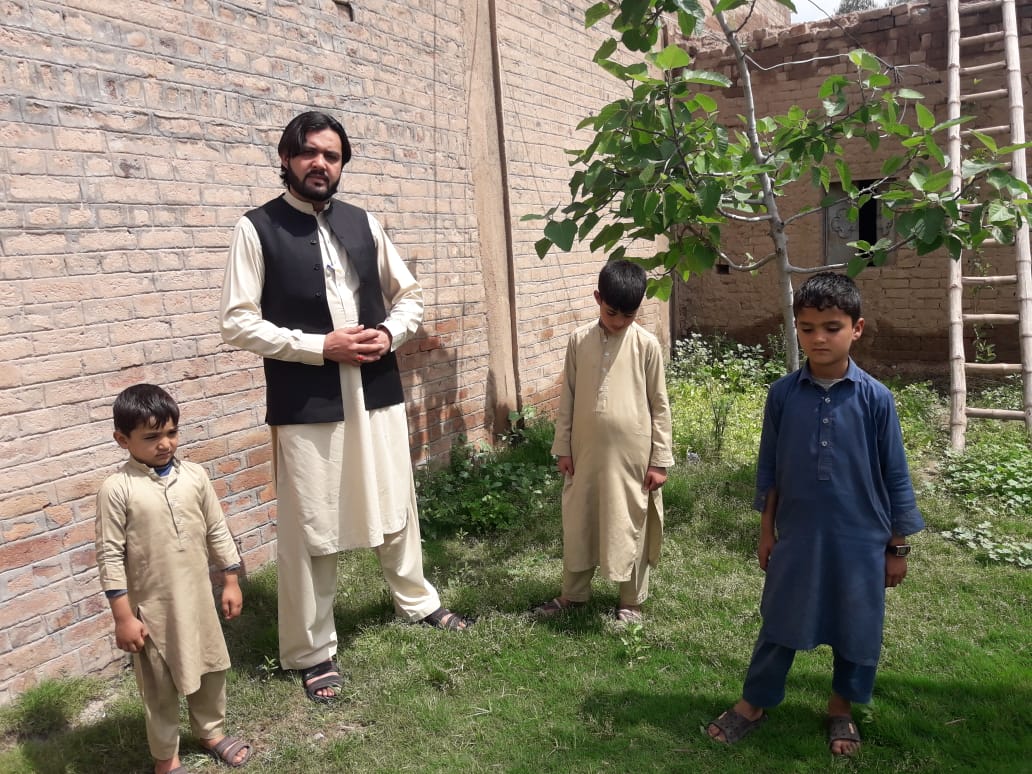
Adil Rehman with his three sons after returning from an isolation ward for coronavirus patients in Peshawar on April 6, 2020. (Photo Courtesy: Adil Rehman)
Alone in a room, Rehman said he would often have nightmares and suffer panic attacks after reading about global casualties on social media.
“But the doctors would always assure me that I was young and I could beat the disease. That really helped,” he said.
Last month, the 30-year-old was allowed to return to his village in the Khyber Agency. Before he left, the doctors advised him to maintain social distance for a few more days, as a precaution, and to wear a face mask and gloves at all times.
When he reached home at midnight, his old father opened the gate. They exchanged greetings, but did not embrace. Rehman then peeked into the room where his wife and four children were fast asleep, before isolating himself in the guest room.
On April 1, he was finally allowed to come out of isolation. The first thing the 30-year-old did was pick up a cricket bat and play ball with his three sons.
“I can’t express my happiness,” he told Arab News, “I recovered in eight days. That should give everyone some hope. This virus is deadly, but it is also controllable.”


