

Virus lockdown spikes Pakistan’s Internet usage but capacity sufficient — PTA

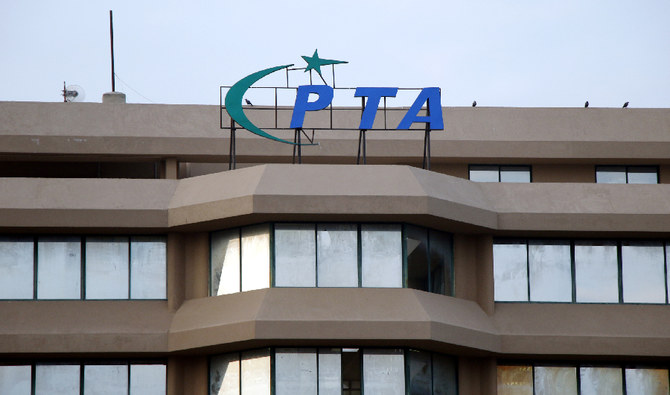
A view of Pakistan Telecommunication Authority (PTA) building in Islamabad, Pakistan, January 22, 2020. (AN photo)
Short Url
Updated 07 April 2020
Follow

Virus lockdown spikes Pakistan’s Internet usage but capacity sufficient — PTA

  • Nationwide lockdown has spiked Internet usage by 15 percent
  • 82.12 million people in Pakistan use some type of Internet connectivity platform

Islamabad: The nationwide lockdown to mitigate the spread of coronavirus pandemic has forced majority of the country into imposed isolation pushing people to work from home impacting the Internet bandwidth which spiked significantly after Pakistan announced shutdowns last month but the bandwidth utilization has stabilized, said the national telecom regulator on Monday.

“The Internet usage touched its peak in the first week of the lockdown and has been stable for last few days,” said Tayyaba Iftikhar, assistant director of public relations for Pakistan Telecommunications Authority (PTA) in an email response to Arab News adding the “on average, our bandwidth utilization has increased between 12 and 15 percent.

Pakistan’s current projected population by United Nations is at 220 million but according to the government’s bureau of statistics census conducted in 2017, it is around 208 million, of which 82.12 million people use some type of Internet connectivity platform, said the PTA official.

Asked if the bandwidth available is parallel or higher than the burgeoning demand as all segments of society, business sectors, educational institutes, and government divisions have augmented their utilization to avoid physical contact or communication, Iftikhar replied: “Pakistan has enough capacity to cater for any projected requirements of telecom subscribers.

“Service providers commission additional bandwidth based upon their needs” and in case of a of undersea cable breakdown, “telecom networks and the international Internet bandwidth providers have sufficient redundancy,” she said.

Internet Service Providers Association of Pakistan (ISPAK), established in 1997, claims on its webpage fact section updated in February, that the country has an Internet bandwidth capacity of more than 2500 Gbps combined from two authorized capacity suppliers — Pakistan Telecommunication Company Limited (PTCL) and Transworld — with five undersea cables connecting the country to the world and four companies providing the domestic fiber backbones.

“In this exceptional situation, all operators have been performing at optimum level without any serious issues so far,” said Iftikhar. “Logistical arrangements have been a major challenge for the operators but that is being managed reasonably despite social distancing and movement restrictions.” 

“PTA is maintaining close liaison with all stakeholders to resolve any challenges in this regard,” the official said. 

However, complaints over Internet connectivity and slow browsing persist and Pakistan’s President Dr. Arif Alvi took notice on Monday during a briefing “on the issues faced by Internet users, particularly students, due to pressure on existing Internet infrastructure, as people had started working from home and students were getting online education due to corona pandemic,” according to an official statement.

The regulator said that it is continuously monitoring the situation and working with all telecom operators to provide maximum possible facilitation to consumers through special Internet packages.

Iftikhar said: “All possible measures were being taken to facilitate operators and IT enabled companies to keep their networks and connectivity up and running.”

Responding on the question concerning restrictions on virtual private networks, voice over Internet protocol, video conferencing applications raised by ISPAK as these arguably secure means of communication are the most commonly used by people working from home, the PTA official refuted the claim and said, “PTA has not blocked legal VPN, VoIP and video conferencing applications.”

“Action is only taken against such traffic which is used by unlicensed operators terminating illegal calls on licensed PSTN (public switched telephone) networks. Therefore, no issue is being faced in terms of those working from home.”


On International Women’s Day, activist Abia Akram urges women with disabilities not to hide

Updated 6 sec ago
Follow

On International Women’s Day, activist Abia Akram urges women with disabilities not to hide

  • With over two decades of advocacy, Akram says disability is her identity to be celebrated
  • Women with disabilities face four times higher GBV risk, often overlooked by rights movements

ISLAMABAD: On this International Women’s Day, Abia Akram has a message for young women with disabilities: do not hide.

Born with a physical mobility impairment, the 40-year-old Pakistani activist has spent more than two decades advocating for the rights of women with disabilities while working with governments and international organizations to push for greater inclusion and a rights-based approach to disability.

For Akram, International Women’s Day is also an opportunity to challenge stigma and encourage women with disabilities to speak openly about their identities and experiences.

“I would say disability is nothing to worry about, and it’s not an issue that we need to address,” she said. “It’s just a thing to celebrate it, with all its diversity and impact. There’s no need to worry about disability, just enjoy life with it.”

Akram’s advocacy journey began in 1997, when public perceptions of disability in the region were often shaped by stereotypes representing two extremes.

“They are very close to Allah, so we have to respect them,” she said, recalling one such view. “Or on the other extreme, people were thinking they are a punishment.”

Activist Abia Akram speak to Arab News in Islamabad, Pakistan, on March 7, 2026. (AN photo)

As a woman from a developing country without a “strong background,” she said the fight for recognition and rights came with its own challenges.

In 2009, she founded the National Forum of Women with Disabilities, an initiative that helped bring attention to the challenges faced by women and girls with disabilities who were often overlooked even within their own families.

“Many parents used to pray that their daughters die before them, because there was no support system available,” she said.

Her own experience, however, was different. She credits her parents for encouraging her education and independence from an early age.

“My parents were really supportive because they were telling me like education is the most important thing. If you are qualified, if you are educated, then you have the world to contribute to.”

Today, Akram’s work extends beyond Pakistan. She serves as chair of the Global Forum on the Leadership of Women with Disabilities and is a trustee for Sightsavers, working with organizations including the UK’s Foreign, Commonwealth &

Development Office (FCDO) and humanitarian groups to promote a shift from a medical model of disability to a rights-based approach.

She is also currently chair of the Aging Disability Diversity Task Force, chief executive of the National Forum of Women with Disabilities and an executive member of the Commonwealth Disability Forum.

Akram says women with disabilities often face multiple layers of discrimination — within their families, in education, in employment and in public life.

According to advocacy data she cited, women with disabilities experience four times greater gender-based violence (GBV) and sexual harassment than women without disabilities.

Her work includes training programs that address systemic barriers and collaboration with government institutions such as Pakistan’s National Assembly, the Ministry of Human Rights and the National Commission on the Status of Women.

In recent years, Akram has also focused on using technology to address these challenges.

Last month at the Zero Project Conference in Vienna, she received a global award for “Noor AI,” an accessible mobile application designed to assist women with disabilities who are survivors of gender-based violence.

Akram argues that the difficulties often associated with disability arise not from individuals themselves but from environments that fail to accommodate different needs.

She illustrates the point with an analogy comparing wheelchairs to cars.

“Are you using a wheelchair? But you came in a car, which has the wheels and the chair. So, you are also using the wheelchair, but you park your wheelchair outside and mine is inside,” she said.

“It’s just about the diversity, accepting the diversity, not fixing the person.”

In Pakistan, she says there has been legislative progress in protecting the rights of persons with disabilities, pointing to the Rights of Persons with Disabilities Act 2020 in Islamabad and similar laws in Sindh and Balochistan.

However, she believes more work is needed in regions such as Azad Jammu and Kashmir and Khyber Pakhtunkhwa to strengthen legal protections and implementation.

Despite receiving international recognition, including the Zero Project Award and the Human Rights Award, Akram says such honors mainly reinforce her sense of responsibility.

She remains particularly focused on addressing what she describes as “double discrimination,” where women with disabilities are sometimes overlooked both within mainstream women’s movements and within male-dominated disability advocacy spaces.

As the world marks International Women’s Day, Akram says the goal must remain justice, empowerment and equality that includes everyone.

“Disability is my identity and I’m very proud of it. It’s about how we take that identity in a positive way, in a dignified way,” she said.

“It’s not about just celebrating, but also taking that positive initiative, the commitment, like how we can change the life of other people.”