

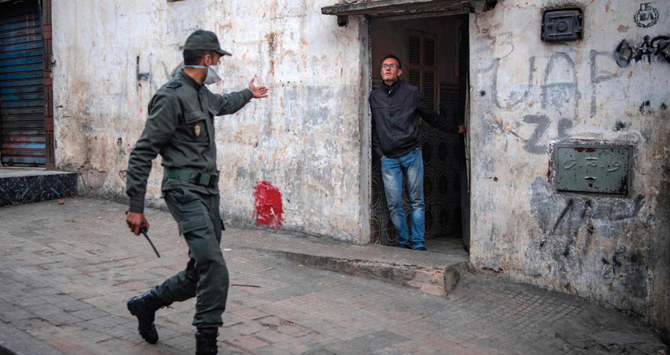

RABAT: Isolation to keep coronavirus at bay is a tall order for Moroccans like Abdellah, who is supposed to spend days cooped up indoors without sunlight in an impoverished neighborhood of the capital Rabat.
So he stays out in the street.
“I know social isolation is a must. But it’s just not possible to stay home all day,” says the 49-year-old street trader who lives with his wife and three children.
Ever since a March 20 lockdown, flats in densely populated areas like Takadoum, which is packed with concrete buildings up to four floors high with tiny windows, can feel like virtual prisons.
Those who respect the stay-at-home rules gather inside the gates of the buildings just to kill time. Many venture out.
“We’re just overcrowded and it’s not easy,” said Soufiane, 32, who lives in a two-bedroom flat with his parents and five siblings, although he is aware of “the seriousness of the illness and importance of quarantine.”
Soufiane made a living by selling clothes at a local market, which is closed and whose neighborhood is hemmed in by checkpoints.
Neighbor Abdelkhalek, 52, said his five-member family could put up with living “on top of each other in 40 square meters but how can we do that without an income?“
He continued: “Conditions to live a decent life just don’t exist in many homes.”
Moroccan authorities have deployed police, soldiers and even armored cars in some towns to enforce the lockdown, as the country’s death toll from the coronavirus pandemic rose to 33 on Tuesday out of 574 declared cases.
Apart from isolation measures, which have been imposed around the world, Morocco has also adopted economic and social measures to assist companies, workers and those dependent on social services.
State aid of between 800 and 1,200 dirhams ($80 to $120) is to be allocated for needy families to weather the crisis, from a $3.2-billion emergency package also funded by corporate and private donations.
But you need to be registered, and the bulk of the North African country’s workforce is made up of “informal workers.”
“I’ve got nothing at all. How am I going to buy my food? I really don’t know, I’m lost,” said Soufiane.
Every night from 6 p.m., security forces, normally wearing sanitary masks, patrol the narrow alleyways of Takadoum.
“Go inside, it’s better for you! Protect yourselves from this terrible disease!” an officer called out over a loudspeaker. Most comply without hesitation, others dash out for a last urgent bit of shopping, while some re-emerge once the patrol is gone.


