

Erdogan ‘risks lives’ blocking water supply to Kurds

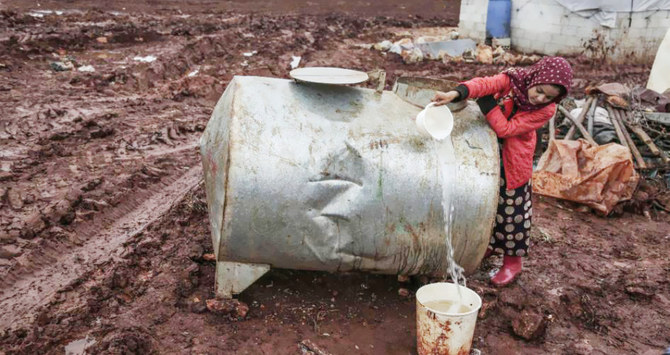
A displaced Syrian girl fills water from a cistern at a refugee camp in the northern countryside of Idlib. (AP)
Short Url
Updated 02 April 2020
Follow

Erdogan ‘risks lives’ blocking water supply to Kurds

ISTANBUL: Turkish President Recep Tayyip Erdogan was accused by aid and rights groups on Wednesday of risking lives during the coronavirus pandemic by restricting water supplies to nearly half-a-million Kurds in northeast Syria.

The restriction compromises humanitarian workers’ efforts to protect local communities against COVID-19, especially in terms of handwashing practices and personal hygiene, Human Rights Watch said.

On March 29, Turkey blocked the flow of water through Allouk pumping station near the Syrian town of Ras Al-Ain.  The station has been controlled by Turkey and allied Syrian forces since October 2019, when Ankara launched an offensive against Syrian-Kurdish forces.

“A water shortage would certainly make a coronavirus outbreak less controllable in Syria, and drive individuals to escape to where they can get treatment and be protected, and the likely target would be neighboring countries, including Turkey,” Sara Kayyali, a Syria researcher at Human Rights Watch, told Arab News.

Allouk had been providing water to about 460,000 people in Syria’s Al-Hasakeh governorate, including those living in displacement camps such as Al-Hol and Areesheh.

UNICEF warned that the “interruption of water supply during the current efforts to curb the spread of the coronavirus disease puts children and families at unacceptable risk.”

Human Rights Watch said:
“The Turkish authorities should do everything they can to immediately resume supply to these
communities.”

The group is concerned that the water shortage may lead to a greater risk of coronavirus contagion in the region.

Faruk Logoglu, a retired Turkish diplomat, called for the introduction of “corona diplomacy” by Ankara in its relations with Syria, which does not have enough hospitals, ventilators, medicines and medical equipment. “Contacts should be initiated” by Turkey with the Syrian government “to develop a joint plan of action to fight the pandemic,” he said.

Some regions of Syria, especially opposition-held Idlib province, are a ticking time bomb, with an insufficient number of coronavirus
test kits.


Lebanon approves release of former minister accused of corruption

Updated 16 December 2025
Follow

Lebanon approves release of former minister accused of corruption

  • Salam is the only ex-minister to be arrested since the start of Lebanon’s economic crisis in 2019
  • The official added that the bail was paid, with procedures ongoing to secure his release from prison

BEIRUT: Lebanon’s judiciary approved the release on bail of former economy minister Amin Salam on Tuesday after six months of detention over corruption linked to contracts deemed suspicious, a judicial official said.
Salam, who served in the cabinet of former prime minister Najib Mikati from 2021 to 2025, is the only ex-minister to be arrested since the start of Lebanon’s economic crisis in 2019.
The official, who requested anonymity, told AFP Lebanon’s judiciary “agreed to release former economy minister Amin Salam on bail of nine billion Lebanese pounds, equivalent to $100,000” and a travel ban.
The official added that the bail was paid, with procedures ongoing to secure his release from prison.
In June, another judicial official said Salam had been arrested in connection with alleged “falsification, embezzlement and suspicious contracts.”
Salam’s adviser Fadi Tamim was sentenced in 2023 to one year in prison for blackmail and personal enrichment at the expense of insurance companies.
The former minister’s brother Karim Salam was also arrested earlier this year in a “case of illicit enrichment, forgery and extortion of insurance companies,” committed “under cover of the minister himself,” the official said in June.
Many in Lebanon attribute the economic crisis to mismanagement and corruption that has plagued state institutions for decades.
President Joseph Aoun and Prime Minister Nawaf Salam, who both took office this year, have vowed to make the fight against endemic corruption a priority, as part of the reforms demanded by international donors.
Both have vowed to uphold the independence of the judiciary and prevent interference in its work, in a country plagued by official impunity.
In September, former central bank governor Riad Salameh, who faces numerous accusations including embezzlement, money laundering and tax evasion, was released after being detained for over a year by paying a record bail of more than $14 million.