
NEW DELHI: Jordan and India have signed an agreement to twin the iconic ancient city of Petra with the Ellora Caves, one of the world’s largest complexes of rock-cut Hindu, Buddhist and Jain temples dating from the 6th to 11th centuries C.E.
One of the most famous archaeological sites, Petra is situated between the Red Sea and the Dead Sea in southwest Jordan. When the Nabataeans, an Arab tribe, made it the capital of their kingdom around 300 B.C.E., it flourished as a center of the spice trade that involved such disparate realms as China, Egypt, Greece, and India.
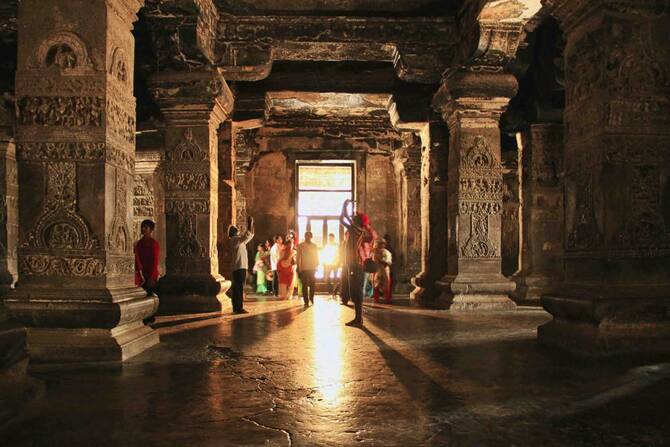
The Ellora Caves are 34 monasteries and temples, extending over more than 2 km, some 30 km from Aurangabad, in India’s Maharashtra state.
Their twinning agreement followed Prime Minister Narendra Modi’s talks with King Abdullah in Amman on Tuesday and was among a series of cooperation memoranda — including in renewable energy, water resources management, and culture.
“These outcomes mark a meaningful expansion of the India-Jordan partnership,” Modi said on social media on Tuesday.
“The Twinning Agreement between Petra and Ellora opens new avenues for heritage conservation, tourism and academic exchanges.”
Petra and Ellora are both UNESCO World Heritage sites that were carved directly out of natural rock.
In Petra, city facades, tombs, temples, and theaters were carved into sandstone cliffs. In Ellora, temples and monasteries were carved into basalt rock.
While Petra is known around the world, the temples of Ellora have not yet gained such popularity, but foreigners are known to have visited the site centuries ago.
“There have been numerous written records to indicate that these caves were visited regularly by enthused travelers and royal personages as well,” according to the Archeological Survey of India, which manages Ellora.
“The earliest is that of an Arab geographer Al-Masudi of the 10th century A.D.”
A geographer and historian from Baghdad, Al-Masudi was in Ellora around the year 980.
“This temple has an entire city as a pious foundation,” he observes in his “Meadows of Gold and Mines of Gems,” recording that Indians from distant regions travelled there on pilgrimage and stayed in “a thousand cells” within the complex.