

Twitter removes two Bolsonaro tweets questioning virus quarantine

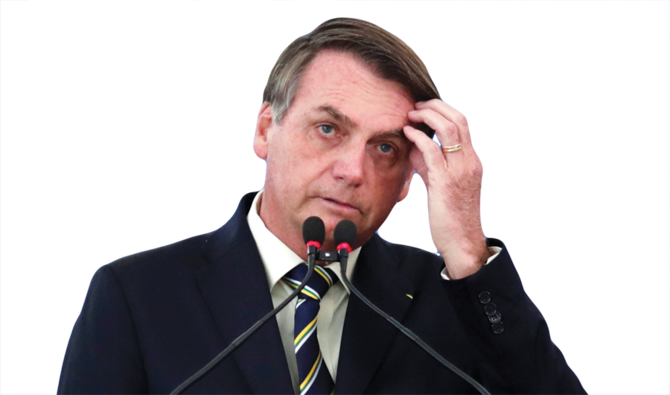
Brazil’s President Jair Bolsonaro gestures at a media statement announcing economic measures during the coronavirus disease (COVID-19) outbreak in Brasilia, Brazil, March 27, 2020. (Reuters)
Short Url
Updated 31 March 2020
Follow

Twitter removes two Bolsonaro tweets questioning virus quarantine

  • Two of the posts were removed and replaced with a notice explaining why they had been taken down

SAO PAULO: Two tweets by Brazilian President Jair Bolsonaro in which he questioned quarantine measures aimed at containing the novel coronavirus were removed, on the grounds that they violated the social network’s rules.
The far-right leader had posted several videos in which he flouted his government’s social distancing guidelines by mixing with supporters on the streets of Brasilia and urging them to keep the economy going.
Two of the posts were removed and replaced with a notice explaining why they had been taken down.
Twitter explained in a statement that it had recently expanded its global rules on managing content that contradicted public health information from official sources and could put people at greater risk of transmitting COVID-19.
In one of the deleted videos, Bolsonaro tells a street vendor, “What I have been hearing from people is that they want to work.”
“What I have said from the beginning is that ‘we are going to be careful, the over-65s stay at home,’” he said.
“We just can’t stand still, there is fear because if you don’t die of the disease, you starve,” the vendor is seen telling Bolsonaro, who responds: “You’re not going to die!”
In another video, the president calls for a “return to normality,” questioning quarantine measures imposed by governors and some mayors across the giant South American country as an effective containment measure against the virus.

Brazil cannot stop or we’ll turn into Venezuela.

Jair Bolsonaro, President of Brazil

“If it continues like this, with the amount of unemployment what we will have later is a very serious problem that will take years to be resolved,” he said of the isolation measures.
“Brazil cannot stop or we’ll turn into Venezuela,” Bolsonaro later told reporters outside his official residence.
On Saturday, Health Minister Luiz Henrique Mandetta highlighted the importance of containment as a means of fighting the coronavirus, which has already infected 3,904 people in Brazil, leaving 114 dead, according to the latest official figures.
“Some people want me to shut up, follow the protocols,” said Bolsonaro. “How many times does the doctor not follow the protocol?”
“Let’s face the virus with reality. It is life, we must all die one day.”
In the four videos posted on his Twitter account, Bolsonaro is seen surrounded by small crowds as he walked about the capital.
Bolsonaro has described the coronavirus as “a flu” and advocated the reopening of schools and shops, with self-isolation necessary solely for the over-60s.


Disinformation the new enemy in disaster zones, says Red Cross

Updated 05 March 2026
Follow

Disinformation the new enemy in disaster zones, says Red Cross

  • “Harmful information and dehumanizing narratives” undermines humanitarian aid and putting lives of aid workers at risk
  • Between 2020 and 2024, disasters affected nearly 700 million people, displaced over 105 million, and killed more than 270,000 — doubling the number in need of humanitarian aid

GENEVA: The rise of disinformation is undermining humanitarian aid and putting lives at risk, while disasters are affecting ever more people, the Red Cross warned Thursday.
“Between 2020 and 2024, disasters affected nearly 700 million people, caused more than 105 million displacements, and claimed over 270,000 lives,” the International Federation of Red Cross and Red Crescent Societies said.
The number of people needing humanitarian assistance more than doubled in the same timeframe, the IFRC said in its World Disasters Report 2026.
But the world’s largest humanitarian network said that “harmful information and dehumanizing narratives” were increasingly undermining trust, putting the lives of aid workers at risk.
“In polarized and politically-charged contexts, humanitarian principles such as neutrality and impartiality are increasingly misunderstood, misrepresented or deliberately attacked online,” it said.
The IFRC has more than 17 million volunteers across more than 191 countries.
“In every crisis I have witnessed, information is as essential as food, water and shelter,” said the Geneva-based federation’s secretary general Jagan Chapagain.
“But when information is false, misleading or deliberately manipulated, it can deepen fear, obstruct humanitarian access and cost lives.”
He said harmful information was not a new phenomenon, but it was now moving “with unprecedented speed and reach.”
Chapagain said digital platforms were proving “fertile ground for lies.”
The IFRC report said the challenge nowadays was no longer about the availability of information but its reliability, noting that the production and spread of disinformation was easily amplified by artificial intelligence.

- ‘Life and death’ -

The report cited numerous recent examples of harmful information hampering crisis response.
During the 2024 floods in Valencia, false narratives online accused the Spanish Red Cross of diverting aid to migrants, which in turn fueled “xenophobic attacks on volunteers,” the IFRC said.
In South Sudan, rumors that humanitarian agencies were distributing poisoned food “caused people to avoid life-saving aid” and led to threats against Red Cross staff.
In Lebanon, false claims that volunteers were spreading Covid-19, favoring certain groups with aid and providing unsafe cholera vaccines eroded trust and endangered vulnerable communities, the IFRC said.
And in Bangladesh, during political unrest, volunteers faced “widespread accusations of inaction and political alignment,” leading to harassment and reputational damage, it added.
Similar events were registered by the IFRC in Sudan, Myanmar, Peru, the United States, New Zealand, Canada, Kenya and Bulgaria.
The report underlined that around 94 percent of disasters were handled by national authorities and local communities, without international interventions.
“However, while volunteers, local leaders and community media are often the most trusted messengers, they operate in increasingly hostile and polarized information environments,” the IFRC said.
The federation called on governments, tech firms, humanitarian agencies and local actors to recognize that reliable information “is a matter of life and death.”
“Without trust, people are less likely to prepare, seek help or follow life-saving guidance; with it, communities act together, absorb shocks and recover more effectively,” said Chapagain.
The organization urged technology platforms to prioritize authoritative information from trusted sources in crisis contexts, and transparently moderate harmful content.
And it said humanitarian agencies needed to make preparing to deal with disinformation “a core function” of their operations, with trained teams and analytics.