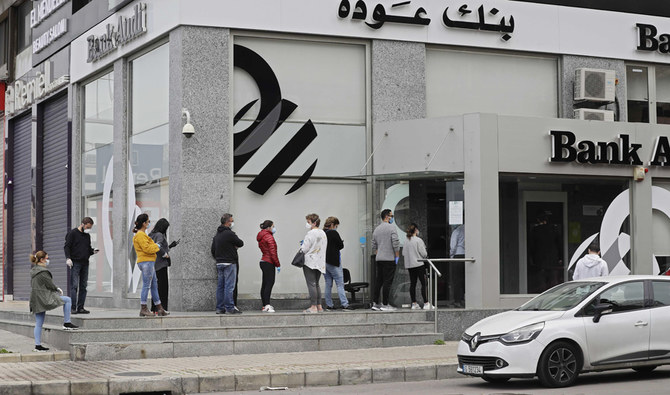

BEIRUT: Lebanese quarantine rules were broken on Monday with hundreds heading to banks to collect their salaries in northern and southern Lebanon.
Meanwhile, the Lebanese Army closed shops in violation of the shutdown laws in a Hezbollah security zone in the southern suburb of Beirut.
The violations came as eight new confirmed cases of the coronavirus disease (COVID-19) were recorded in Lebanon on Sunday and Monday. However, this low number was not shared by the director of the Hariri Governmental University Hospital, Dr. Firas Al-Abyad, as most of the laboratories operate at half capacity on weekends.
The number of COVID-19 deaths rose to 11. The Ministry of Health said that the latest fatality was a patient in her 80s suffering from chronic illnesses.
A source at the hospital told Arab News: “The quarantine is beginning to show its results now and we have to wait to see the newly infected cases in the coming days. We may reach the peak stage and we are preparing for it medically.”
The Ministry of Health said that “out of 446 people infected with the coronavirus, there are 416 Lebanese and the rest are of 18 other nationalities.”
It added: “Between Sunday and Monday, the Lebanese Red Cross transferred 430 suspected cases with COVID-19 symptoms and they are waiting for the results of their tests. There are 1,074 people still quarantined for contact with infected patients. There have been 32 cases of recovery so far.”
HIGHLIGHT
The violations came as eight new confirmed cases of the coronavirus disease were recorded in Lebanon on Sunday and Monday.
On Monday, journalist May Chidiac was discharged from hospital after she was diagnosed with COVID-19. She spent a week in the hospital. She told Arab News that she did not need oxygen or a ventilator and that “the longest hour in my life was today when I waited for my sister to take me from hospital to home.”
Chidiac has moved to home quarantine until full recovery. She said she did not know where she caught the infection. She had an appointment in Paris to change a prosthetic implant but she does not know if the infection was caught there or on the plane. When she returned to Beirut, she committed to home quarantine, fearing that she had caught the virus and once the symptoms appeared, she rushed to the hospital.
Her sister Misha told Arab News that she “adhered to home quarantine at the time, which protected me and the others who live in the home from catching the infection, and our laboratory test results were negative.”
Meanwhile, the Internal Security Forces confirmed that no COVID-19 cases were reported in Roumieh Prison in Lebanon and that “all inmates in all prisons are safe.”