

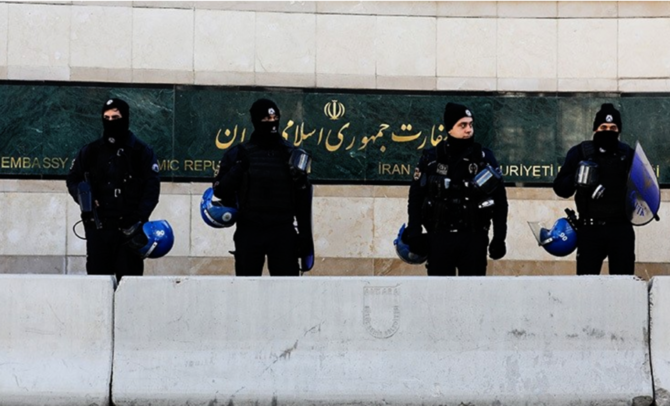

ISTANBUL: A claim that two intelligence officers at Iran’s consulate in Turkey instigated the killing of an Iranian dissident in Istanbul last November has added to simmering tensions between the two countries.
Reuters said that it had been told by two senior Turkish officials that the dissident, Masoud Molavi Vardanjani, had been killed for criticizing Tehran’s political and military leadership.
Vardanjani was shot dead on an Istanbul street on Nov. 14, 2019, a little over a year after Turkish officials say he left Iran.
The accusation will increase friction between Turkey and Iran, two regional powers which had grown closer under the government of Turkish President Tayyip Erdogan, but which had recently fallen out over the war in Syria.
Before his death, Vardanjani was known as an outspoken critic of the Islamic Republic who frequently targeted Tehran’s military and political leaders on his social media account, the Reuters report said.
“I will root out the corrupt mafia commanders. Pray that they don’t kill me before I do this,” the Iranian dissident said just three months before he was shot dead.
Vardanjani’s death came a year after he left Iran, where he was working in the Iranian Defense Ministry as a cybersecurity official. He also held a doctoral degree in artificial intelligence studies.
Reuters claimed the victim was also warned by Iran against discussing drone projects with Turkish officials.
The Turkish government is expected to take up the issue with Iran through diplomatic channels.
Seth J. Frantzman, executive director of the Middle East Center for Reporting and Analysis, said that if the Reuters claim is correct, Iran’s assassination of a dissident in Istanbul is an illegal act that warrants a harsh response.
BACKGROUND
’I will root out the corrupt mafia commanders. Pray that they don’t kill me before I do this,’ Iranian dissident Masoud Molavi Vardanjani said just three months before he was shot dead.
“Iran appears to have shown blatant disregard for Turkey’s sovereignty, even using its diplomatic posts and passports for this brazen act. This requires more than just a diplomatic complaint,” Frantzman told Arab News.
He said that the alleged perpetrators behind the killing were officials carrying diplomatic passports.
“It shows how Iran disregards borders in the region and globally. Internationally, countries should take this very seriously as part of a pattern of Iran’s assassinations of dissenters, a policy going back decades.”
Frantzman said that the alleged murder also reveals that while Iran is demanding international sanctions be reduced, it has continued to conduct illegal overseas operations and “disrespect” its neighbors.
A Turkish investigation into the dissident’s killing has resulted in the arrest of several suspects, including Turks and Iranians.
The allegations are likely to further undermine ties between Ankara and Tehran.
Although Turkey and Iran have been cooperating on a Syria strategy, their partnership is seen by many as a marriage of convenience in a conflict zone where they back opposing sides. Tehran supports Assad, while Turkey wants the regime ousted.
Last month Turkish and Iranian media outlets engaged in a war of words over Syria, with both countries accusing the other of “pursuing aggressive moves” in the war-torn country.
In October 2019, Iran condemned the presence of Turkish military posts inside Syria, which it said were a violation of Syria’s territorial integrity.
Tehran also described Turkey’s operation in northern Syria in early October against the Syrian Kurdish YPG militia as an “invasion.”
Erdogan was quick to respond, accusing Iran of betraying the consensus between the two countries.
Attacks by Iranian-backed militia on Ankara-backed fighters in Syria’s rebel-held regions have also angered Turkey.


