

Oil-rich wealth funds seen shedding up to $225 billion in stocks

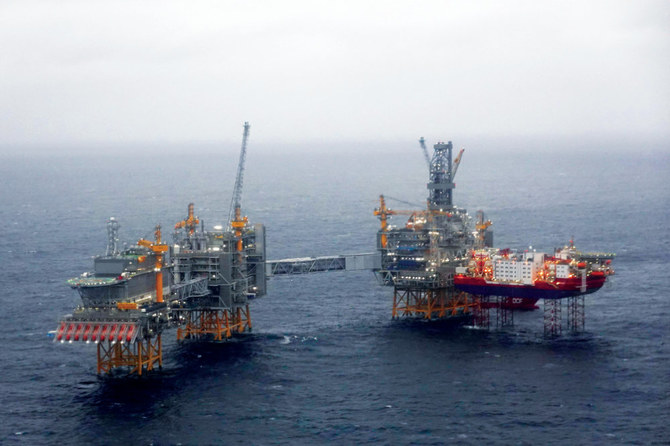
a view of the Johan sverdrup oil field in the north sea, some 140 km west from the town of stavanger, norway. the country’s sovereign wealth fund has lost $124 billion this year. (AFP)
Short Url
Updated 30 March 2020
Follow

Oil-rich wealth funds seen shedding up to $225 billion in stocks

  • Risking more losses is not an option for some funds from oil-producing nations

LONDON: Sovereign wealth funds from oil-producing countries mainly in the Middle East and Africa are on course to dump up to $225 billion in equities, a senior banker estimates, as plummeting oil prices and the coronavirus pandemic hit state finances.

The rapid spread of the virus has ravaged the global economy, sending markets into a tailspin and costing both oil and non-oil based sovereign wealth funds around $1 trillion in equity losses, according to JPMorgan strategist Nikolaos Panigirtzoglou.

His estimates are based on data from sovereign wealth funds and figures from the Sovereign Wealth Fund Institute, a research group.

Sticking with equity investments and risking more losses is not an option for some funds from oil-producing nations. Their governments are facing a financial double-whammy — falling revenues due to the spiraling oil price and rocketing spending as administrations rush out emergency budgets.

Around $100-$150 billion in stocks have likely been offloaded by oil-producer sovereign wealth funds, excluding Norway’s fund, in recent weeks, Panigirtzoglou said, and a further $50-$75 billion will likely be sold in the coming months.

“It makes sense for sovereign funds to frontload their selling, as you don’t want to be selling your assets at a later stage when it is more likely to have distressed valuations,” he said.

Most oil-based funds are required to keep substantial cash-buffers in place in case a collapse in oil prices triggers a request from the government for funding.

A source at an oil-based sovereign fund said it had been gradually raising its liquidity position since oil prices began drifting lower from their most recent peak above $70 a barrel in October 2018.

In addition to the cash reserves, additional liquidity was typically drawn firstly from short-term money market instruments like treasury bills and then from passively invested equity as a last resort, the source said.

It’s generally a similar trend for other funds.

“Our investor flows broadly show more resilience than market pricing would suggest,” said Elliot Hentov, head of policy research at State Street Global Advisers. “There has been a shift toward cash since the crisis started, but it’s not a panic move but rather gradual.”

The sovereign fund source said the fund had made adjustments to its actively managed equity investments due to the market rout, both to stem losses and position for the recovery, when it comes.

Exactly how much sovereign wealth funds invest and with whom remain undisclosed. Many don’t even report the value of the assets they manage.

On Thursday, the Norwegian sovereign wealth fund said it had lost $124 billion so far this year as equity markets sunk but its outgoing CEO Yngve Slyngstad said it would, at some point, start buying stocks to get its portfolio back to its target equity allocation of 70 percent from 65 percent currently.

Slyngstad also said that any fiscal spending by the government this year would be financed by selling bonds in its portfolio.


Reforms target sustained growth in Saudi real estate sector, says Al-Hogail

Updated 26 January 2026
Follow

Reforms target sustained growth in Saudi real estate sector, says Al-Hogail

RIYADH: The Real Estate Future Forum opened its doors for its first day at the Four Seasons Riyadh, with prominent global and local figures coming together to engage with one of the Kingdom’s most prospering sectors.

With new regulations, laws, and investments underway, 2026 is expected to be a year of momentous progress for the real estate sector in the Kingdom.

The forum opened with a video highlighting the sector’s progress in the Kingdom, during which an emphasis was placed on the forum’s ability to create global reach, representation, as well as agreements worth a cumulative $50 billion

With the Kingdom now opening up real estate ownership to foreigners, this year’s Real Estate Future Forum is placing a great deal of importance on this new milestone and its desired outcomes and impact on the market. 

Aside from this year’s forum’s unique discussions surrounding those developments, it will also be the first of its kind to launch the Real Estate Excellence Award and announce its finalist during the three-day summit.

Minister of Municipalities and Housing and Chairman of the Real Estate General Authority Majed Al-Hogail took to stage to address the diverse audience on the real estate market’s achievements thus far and its milestones to come.

Of those important milestones, he underscored “real estate balance” as a key pillar of the sector’s decisions to implement regulatory tools “with the aim of constant growth which can maintain the vitality of this sector.” He pointed to examples of those regulatory measures, such as the White Land Tax.

On 2025’s progress, the minister highlighted the jump in Saudi family home ownership, which went from 47 percent in 2016 to 66 percent in 2025, keeping the Kingdom’s Vision 2030 goal of 70 percent by the end of the decade on track.

He said the opening of the real estate market to foreigners is an indicator of the sector’s maturity under the leadership of Crown Prince Mohammed bin Salman. He said his ministry plans to build over 300,000 housing units in Riyadh over the next three years.

Speaking to Arab News,  Al-Hogail elaborated on these achievements, stating: “Today, demand, especially local demand, has grown significantly. The mortgage market has reached record levels, exceeding SR900 billion ($240 billion) in mortgage financing, we are now seeing SRC (Saudi Real Estate Refinance Co.) injecting both local and foreign liquidity on a large scale, reaching more than SR54 billion”

Al-Hogail described Makkah and Madinah as unique and special points in the Kingdom’s real estate market as he spoke of the sector’s attractiveness.

 “Today, the Kingdom of Saudi Arabia has become, in international investment indices, one that takes a good share of the Middle East, and based on this, many real estate investment portfolios have begun to come in,” he said. 

Al-Ahsa Gov. Prince Saud bin Talal bin Badr Al-Saud told Arab News the Kingdom’s ability to balance both heritage sites with real estate is one of its strengths.

He said: “Actually the real estate market supports the whole infrastructure … the whole ecosystem goes back together in the foundation of the real estate; if we have the right infrastructure we can leverage more on tourism plus we can leverage more on the quality of life … we’re looking at 2030, this is the vision … to have the right infrastructure the time for more investors to come in real estate, entertainment, plus tourism and culture.”