



WASHINGTON: In her landmark essay “The Imagination of Disaster,” published more than 50 years ago, the American writer Susan Sontag discussed cinema’s fondness for depicting the end of society or even mankind.
Watching such films is like riding a rollercoaster, Sontag suggested: What might be a dangerous experience can be viewed from a relatively safe position.
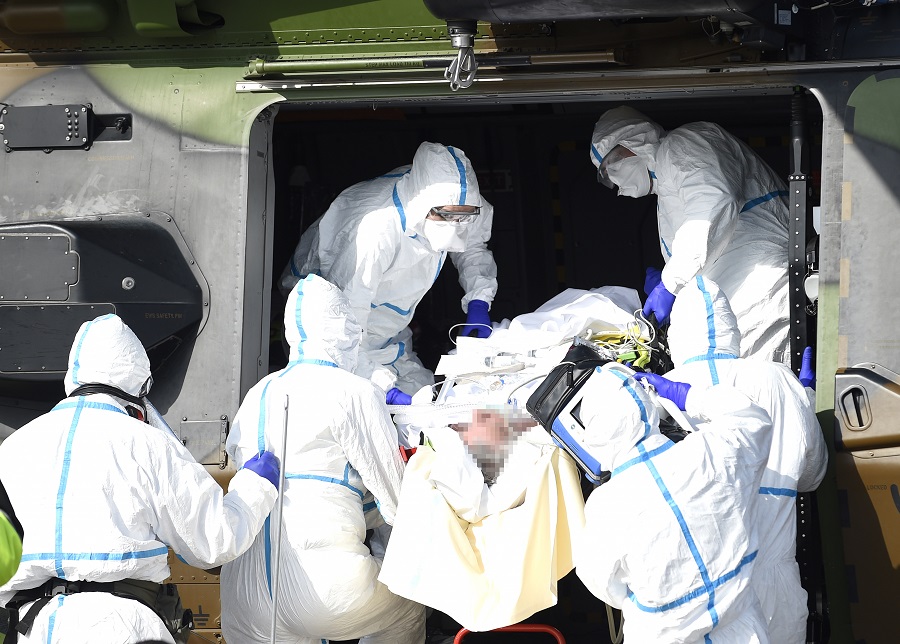
Medical staff install a patient aboard a French medical helicopter NH90 of the 1st RHC near Mercy hospital (CHR Metz), eastern France, to be evacuated to a German hospital in Essen, on March 28, 2020, amid the outbreak of the COVID-19 caused by the novel coronavirus. (AFP)
Now, with the outbreak of the coronavirus disease (COVID-19) stoking our deepest fears, it is little surprise that there has been a massive surge in streaming apocalyptic sci-fi films dealing with disease and pandemic.
“Flu” (2013), a South Korean film about a government’s failure to control a lethal airborne virus; “Outbreak” (1995), starring Dustin Hoffman as a doctor who tries to find a cure for a deadly disease; and Terry Gilliam’s “12 Monkeys” (1995), the story of a plague that threatens to wipe out humanity — all have fear at their core and explore the human need to cope with it.
TOPFLICKS
- CONTAGION - A worldwide panic ensues as the US CDC struggles to curb the spread of a deadly virus.
- FLU - Chaos erupts when a lethal, airborne virus infects a South Korean city’s population.
- OUTBREAK - Scientists struggle to tackle infection started by virus carried by an African rainforest monkey.
- 12 MONKEYS - A man-made virus has wiped out most of the human population on planet Earth.
However, the film that is enthralling many people in the midst of the present pandemic is Steven Soderbergh’s “Contagion” (2011).
The movie shows deserted airports, antiseptic hospital labs, empty office floors and gyms, and silent streets as worried officials try to help but are hampered by a squabbling bureaucracy and a lethargic government response.
Scientists call for social distancing, and images of hands touching subway handrails and cocktail glasses are tainted with an ominous feel.
Victims sweat, ache and die. A father fears for the life of his child.
“Contagion” is trending on both Amazon Prime and iTunes and is among most popular films on download sites.
In December 2019, before COVID-19 hit the headlines, “Contagion” was ranked the 270th most popular film in the Warner Bros. catalog.
The distributor says the movie is now the most in-demand film in its catalog, behind the Harry Potter franchise.
That “Contagion” has been in the top 10 rentals charts for more than two months, rivaled only by children’s and adventure titles, perhaps suggests that keeping self-quarantined children entertained is as much of a challenge as the pandemic itself.
Richard Peña, director of the New York Film Festival and professor of cinema studies at Columbia University, was in China in January and had to self-isolate when he returned to the US in early February. He was virus-free.
“Like everyone else, I have no idea when the quarantine — or ‘shelter at home’ — will end and what the world will be like when it does,” he said via email from his New York home. “So a movie like ‘Contagion’ gives people some sense of what life during a pandemic might be like.”
Had not disaster films such as “Contagion” offered governments a warning to prepare for such a crisis?
Long before the film’s release, veteran epidemiologists had been warning of impending disaster.
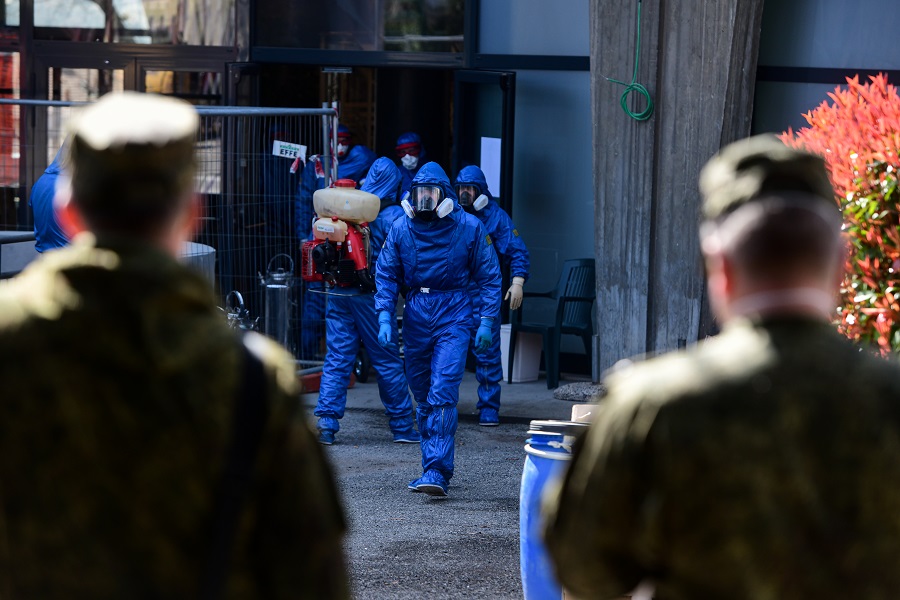
A Russian Army specialist walks outside the Honegger nursing home where 35 people have died so far from coronavirus in Albino, Italy, on March 28, 2020, amid the spread of the COVID-19 (new coronavirus) pandemic. (AFP)
The 1995 thriller “Outbreak” opens with a quote from Nobel laureate and bacteriologist Joshua Lederberg: “The single biggest threat to humankind is the virus.”
The details in “Contagion,” far from being the product of pure imagination, are grounded in science. The movie’s writer worked closely with Dr. Ian Lipkin, director of the Center for Infection and Immunity at Columbia University, who is now involved with coronavirus awareness campaigns after being diagnosed with the disease.
Bill Gates, the American philanthropist and Microsoft Corporation co-founder, warned of the threat of a virus outbreak five years ago.
In a 2015 TED talk, he said that the failure to prepare for a pandemic would result in an unprecedented catastrophe, unlike the ending in “Contagion,” where “there is a group of handsome epidemiologists ready to go. They move in, they save the day. But that is just pure Hollywood.”
While films may not bring an end to catastrophes such as war or contagion, “they can teach us about both those things and ourselves. I think that’s why we watch them,” said Janet Roach, an Oscar-nominated screenwriter who lives in Lyme, Connecticut, where she is “hunkered down” in the hope of avoiding coronavirus.
“I’m going out only to walk my dog, and bring daffodils inside the house, and, with them, the scent of spring,” she said.
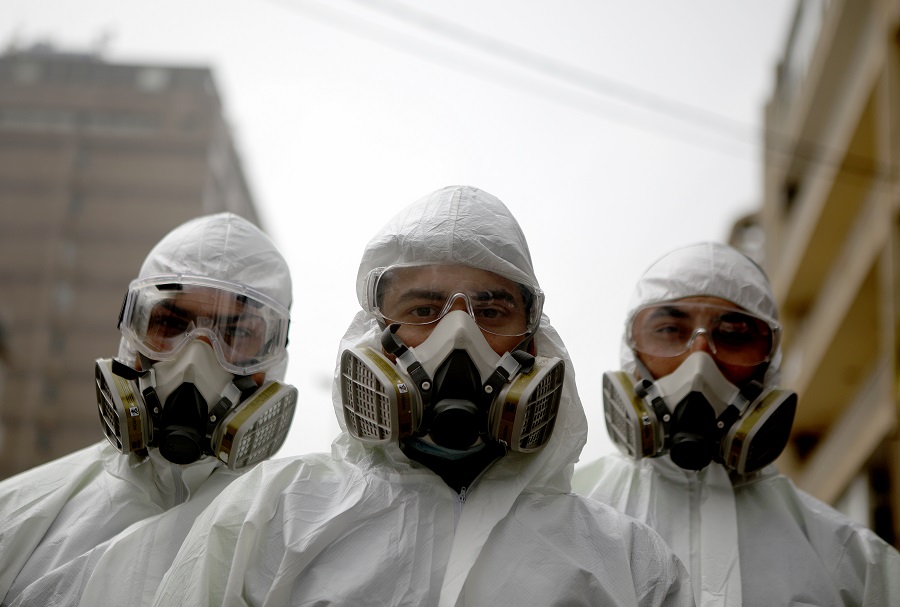
The global coronavirus infections toll has reached over 650,000 as of Sunday. (AFP)
According to Peña, “People often reach for cinematic metaphors when they confront experiences or events for which they don’t have any actual experiences to which they can be compared.
“When 9/11 happened, and there were those terrifying images of massive clouds of dust and smoke curling around street corners, all I could think about was how much it looked like a science-fiction film.”
So how do movies achieve that?
Roach said: “Such tales are almost inevitably told by those who survive. That gives the viewer comfort, and hope that he or she, too, will survive, and perhaps triumph.
“That, in turn, eases the fear and allows the viewer to consider how he or she would behave in the same circumstances.
“Since the protagonist is most often a hero, we imagine ourselves as heroic as well as survivors.
“And we know that we are not alone and that others have found their way through such challenges. Perhaps we, too, are capable of nobility, bravery and generosity.”


