WASHINGTON: US President Donald Trump said Saturday he is weighing placing a two-week quarantine on New York and nearby states, the US epicenter of coronavirus infections, to slow the spread of the disease to other parts of the country.
The harshest measure yet by the US government in the face of the coronavirus pandemic could isolate over 10 million people in the country’s most densely populated region, and would come as total infections across the country have passed 115,000.
Trump indicated he could make a decision later Saturday, even as New York Governor Andrew Cuomo said Trump hadn’t mentioned the idea in a phone call earlier in the day.
“There’s a possibility that sometime today we’ll do a quarantine — short-term, two weeks — on New York, probably New Jersey, certain parts of Connecticut,” he said as he left the White House.
The measure would be aimed at restricting travel from the crowded region to other parts of the United States, especially the southern state of Florida, a popular winter destination for New Yorkers and others in the northern part of the country.
Trump himself has residences in New York and Florida.
“Because they’re having problems down in Florida. A lot of New Yorkers are going down. We don’t want that. Heavily infected,” Trump said.
Later the US leader confirmed the idea on Twitter. A decision “will be made, one way or another, shortly,” he said.
The New York area has been the most seriously hit by COVID-19 in the United States, with more than 52,000 cases in New York state.
Cuomo said a quarantine had not come up in his talks with Trump Saturday morning.
“I don’t even know what that means,” Cuomo told a press briefing.
“I don’t know how that could be legally enforceable. And from a medical point of view, I don’t know what you would be accomplishing,” Cuomo said.
“But I can tell you, I don’t even like the sound of it. Not even understanding what it is, I don’t like the sound of it,” he said.
The number of COVID-19 infections in Florida is much lower than New York, topping 3,700 Saturday according to USA Today.
On Wednesday, Florida Governor Ron DeSantis issued an executive order mandating two-week self-quarantines for anyone arriving or recently arrived from New York.
On Friday he made the same order for people coming from Louisiana, another coronavirus hotspot, and said police will put up checkpoints along the state line.
He also announced a two-week suspension of vacation rentals in Florida to discourage visitors.
“All we are trying to do is keep our residents here safe. If you are coming from one of the epicenters... don’t come here because we are trying to protect our folks,” he said.
But with coronavirus in all 50 states, experts said a quarantine on an area as large as the New York-New Jersey-Connecticut region might not be as useful as other more targeted measures.
Kent Sepkowitz, an infectious disease expert with the Memorial Sloan-Kettering Cancer Center in New York, told CNN it would not really work.
“Certainly it does not help New York do anything. It cuts us off from everyone else,” he said.
“But the virus is all over the country now... So the notion that we can sort of blame New York and wall it off, and build a wall around Manhattan, that’s nuts.”

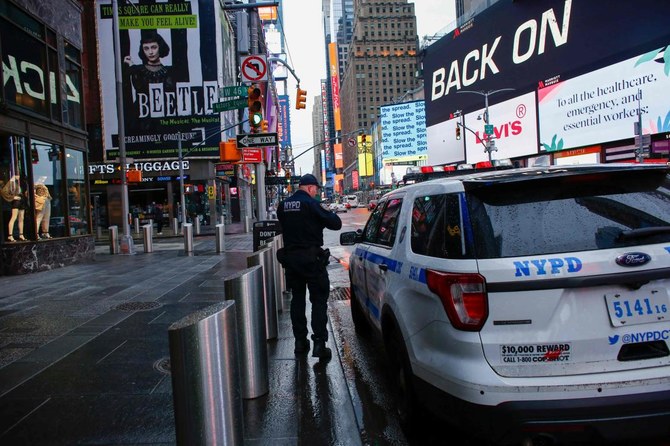
Coronavirus: Trump weighs ‘quarantine’ of New York, nearby states
https://arab.news/c7jsq
Coronavirus: Trump weighs ‘quarantine’ of New York, nearby states
- The harshest measure yet by the US government in the face of the coronavirus pandemic could isolate over 10 million people
- A decision “will be made, one way or another, shortly,” Trump said
Russian poisonings aim to kill — and send a message
- Neurotoxin epibatidine, found in Ecuadoran frogs, was identified in laboratory analyzes of samples from Navalny’s body
- Even if a poisoning can fail — some targets survived, such as Yushchenko and Skripal — it also serves to send a message
PARIS: Polonium, Novichok and now dart frog poison: the finding that Russian opposition leader Alexei Navalny was killed with a rare toxin has revived the spectre of Moscow’s use of poisons against opponents — a hallmark of its secret services, according to experts.
The neurotoxin epibatidine, found in Ecuadoran frogs, was identified in laboratory analyzes of samples from Navalny’s body, the British, Swedish, French, German and Dutch governments said in a joint statement released on Saturday at the Munich Security Conference.
“Only the Russian state had the means, motive and opportunity to deploy this lethal toxin,” said Britain’s Foreign Office, with the joint statement pointing to Russia as the prime suspect.
The Kremlin on Monday rejected what it called the “biased and baseless” accusation it assassinated Navalny, a staunch critic of President Vladimir Putin who died on February 16, 2024, while serving a 19-year sentence in a Russian Arctic prison colony.
But the allegations echo other cases of opponents being poisoned in connection — proven or suspected — with Russian agents.
In 2006, the Russian defector Alexander Litvinenko was killed by polonium poison in London. Ukrainian politician Viktor Yushchenko, campaigning against a Russian-backed candidate for the presidency, was disfigured by dioxin in 2004. And the nerve agent Novichok was used in the attempted poisoning of former double agent Sergei Skripal in the UK in 2018.
“We should remain cautious, but this hypothesis is all the more plausible given that Navalny had already been the target of an assassination attempt (in 2020) on a plane involving underwear soaked with an organophosphate nerve agent, Novichok, which is manufactured only in Russia,” said Olivier Lepick, a fellow at the Foundation for Strategic Research specializing in chemical weapons.
Toxin ‘never been used’
“To my knowledge, epibatidine has never been used for assassinations,” Lepick added.
Until now, the substance was mainly known for its effect on animals that try to attack Ecuadoran poison dart frogs.
“It’s a powerful neurotoxin that first hyperstimulates the nervous system in an extremely violent way and then shuts it down. So you’ll convulse and then become paralyzed, especially in terms of breathing,” said Jerome Langrand, director of the Paris poison control center.
But to the scientist, using this substance to poison Navalny is “quite unsettling.”
“One wonders, why choose this particular poison? If it was to conceal a poisoning, it’s not the best substance. Or is it meant to spread an atmosphere of fear, to reinforce an image of power and danger with the message: ‘We can poison anywhere and with anything’?” he said.
Russian ‘calling card’
For many experts, the use of poison bears a Russian signature.
“It’s something specific to the Soviet services. In the 1920s, Lenin created a poison laboratory called ‘Kamera’ (’chamber’ in Russian), Lab X. This laboratory grew significantly under Stalin, and then under his successors Khrushchev and Brezhnev... It was this laboratory that produced Novichok,” said Andrei Kozovoi, professor of Russian history at the University of Lille.
“The Russians don’t have a monopoly on it, but there is a dimension of systematization, with considerable resources put in place a very long time ago — the creation of the poison laboratory, which developed without any restrictions,” he added.
Even if a poisoning can fail — some targets survived, such as Yushchenko and Skripal — it also serves to send a message, and acted as “a calling card” left by the Russian services, according to Kozovoi.
“Poison is associated in the collective imagination and in psychology with a terrible, agonizing death. The use of chemical substances or poisons carries an explicit intention to terrorize the target and, in cases such as Litvinenko, Skripal or Navalny, to warn anyone who might be tempted to betray Mother Russia or become an opponent,” said Lepick.
“A neurotoxin, a radioactive substance, or a toxic substance is much more frightening than an explosive or being shot to death.”


