GENEVA: Warring parties in Syria must stop fighting “to avoid further catastrophe,” UN investigators said on Saturday, as the first cases of the COVID-19 epidemic are recorded in a country already torn apart by nine years of war.
The UN fears large numbers of preventable deaths may follow although Damascus has reported only five cases of the novel coronavirus so far.
“Syrian civilians now face a deadly threat in the form of the COVID-19 outbreak, one that will strike without distinction and that will be devastating for the most vulnerable in the absence of urgent preventative action,” said Paulo Pinheiro, chair of the Independent International Commission of Inquiry on Syria.
The parties must heed calls for a cease-fire or face a “looming tragedy,” Pinheiro said, adding: “Anything short of that will likely condemn large numbers of civilians to preventable deaths.”
The conflict has left more than 380,00 dead and the World Health Organization says Syria’s health system has been acutely weakened.
Just 64 percent of hospitals and 52 percent of primary health care centers that existed before 2011 are functioning, and 70 percent of the country’s health workers have left.
The commission noted that “much of this situation is a result of pro-Government forces systematically targeting medical facilities.”
“Nurses, doctors and medical volunteers have been attacked, detained and disappeared by parties to the conflict,” the statement said.
“All attacks on medical providers, facilities, hospitals, and first responders must cease immediately.”
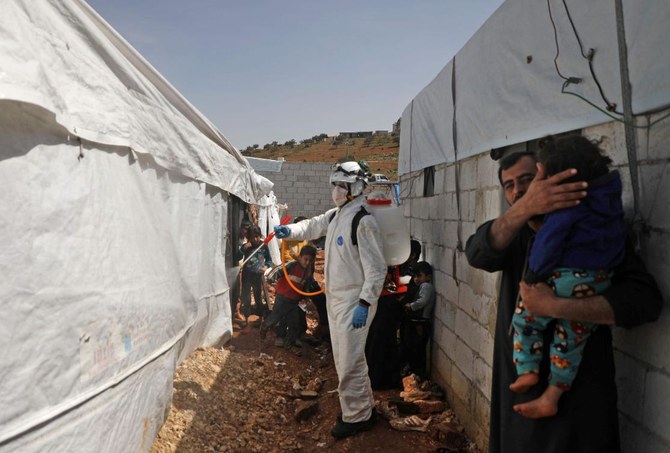
The 6.5 million displaced Syrians still living in the country are particularly threatened by the spread of the virus, including one million mainly women and children in the camps of Idlib province along the Turkish border.
The camps offer limited access to water in a region where dozens of hospitals have closed because of the fighting.
Rights groups have also warned of a health disaster in overcrowded prisons.


UN panel urges halt to Syria fighting as virus strikes
https://arab.news/4g5me
UN panel urges halt to Syria fighting as virus strikes

- The UN fears large numbers of preventable deaths may follow although Damascus has reported only five cases of the novel coronavirus so far
- Just 64 percent of hospitals and 52 percent of primary health care centers that existed before 2011 are functioning


Israel orders Gaza families to move in first forced evacuation since ceasefire
- Residents of Bani Suhaila, east of Khan Younis, said the leaflets were dropped on Monday on families living in tent encampments in the Al-Reqeb neighborhood
CAIRO: Israeli forces have ordered dozens of Palestinian families in the southern Gaza Strip to leave their homes in the first forced evacuation since October’s ceasefire, as residents and Hamas said on Tuesday the military was expanding the area under its control.
Residents of Bani Suhaila, east of Khan Younis, said the leaflets were dropped on Monday on families living in tent encampments in the Al-Reqeb neighborhood.
“Urgent message. The area is under IDF control. You must evacuate immediately,” said the leaflets, written in Arabic, Hebrew, and English, which the army dropped over the Al-Reqeb neighborhood in the town of Bani Suhaila.
In the two-year war before the US brokered ceasefire was signed in October, Israel dropped leaflets over areas that were subsequently raided or bombarded, forcing some families to move several times.
Residents and a source from the Hamas militant group said this was the first time they had been dropped since then. The Israeli military did not immediately respond to a request for comment.
SIDES FAR APART ON NEXT PHASES
The ceasefire has not progressed beyond its first phase, under which major fighting has stopped, Israel withdrew from less than half of Gaza, and Hamas released hostages in return for Palestinian detainees and prisoners.
Virtually the entire population of more than 2 million people are confined to around a third of Gaza’s territory, mostly in makeshift tents and damaged buildings, where life has resumed under control of an administration led by Hamas.
Israel and Hamas have accused each other of major breaches of the ceasefire and remain far apart on the more difficult steps planned for the next phase.
Mahmoud, a resident from the Bani Suhaila area, who asked not to give his family name, said the evacuation orders impacted at least 70 families, living in tents and homes, some of which were partially damaged, in the area.
“We have fled the area and relocated westward. It is maybe the fourth or fifth time the occupation expanded the yellow line since last month,” he told Reuters by phone from Khan Younis, referring to the line behind which Israel has withdrawn.
“Each time they move it around 120 to 150 meters (yards) inside the Palestinian-controlled territory, swallowing more land,” the father-of-three said.
HAMAS CITES STATE OF HUMANITARIAN DISRUPTION
Ismail Al-Thawabta, director of the Hamas-run Gaza government media office, said the Israeli military had expanded the area under its control in eastern Khan Younis five times since the ceasefire, forcing the displacement of at least 9,000 people.
“On Monday, 19 January 2026, the Israeli occupation forces dropped warning leaflets demanding the forced evacuation of the Bani Suhaila area in eastern Khan Younis Governorate, in a measure that falls within a policy of intimidation and pressure on civilians,” Thawabta told Reuters.
He said the new evacuation orders affected approximately 3,000 people.
“The move created a state of humanitarian disruption, increased pressure on the already limited shelter areas, and further deepened the internal displacement crisis in the governorate,” Thawabta added.
Israel’s military has previously said it has opened fire after identifying what it called “terrorists” crossing the yellow line and approaching its troops, posing an immediate threat to them.
It has continued to conduct air strikes and targeted operations across Gaza. The Israeli military has said it views “with utmost severity” any attempts by militant groups in Gaza to attack Israel.
Under future phases of the ceasefire that have yet to be hammered out, US President Donald Trump’s plan envisages Hamas disarming, Israel pulling out further, and an internationally backed administration rebuilding Gaza.
More than 460 Palestinians and three Israeli soldiers have been reported killed since the ceasefire took effect.
Israel launched its operations in Gaza in the wake of an attack by Hamas-led fighters in October 2023 which killed 1,200 people, according to Israeli tallies. Israel’s assault has killed 71,000 people, according to health authorities in the enclave.


