

Saudi Arabia denies contact with Russia over OPEC+ deal

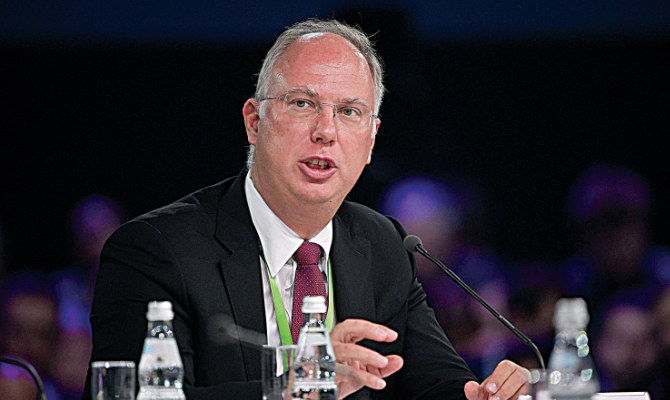
Direct Investment Fund CEO Kirill Dmitriev has called for joint action by countries to ease turmoil in global energy markets. (AFP)
Short Url
Updated 28 March 2020
Follow

Saudi Arabia denies contact with Russia over OPEC+ deal

  • Kingdom rejects claims of expanded partnership to balance global market amid major fall in oil and gas demand

DUBAI: Saudi Arabia has denied it has had any contact with Russia’s Energy Ministry over the possibility of a new OPEC+ deal to rebalance global oil markets.

A statement from the Saudi Energy Ministry dismissed reports from Moscow that there had been discussions between Russia and the Kingdom aimed at resurrecting the OPEC+ alliance, and even bringing in new members.

“There have been no contacts between Saudi Arabia and Russian energy ministers over any increase in the number of OPEC+ countries, nor any discussion of a joint agreement to balance oil markets,” a ministry official said in a statement.

The denial followed quoted comments in the Russian and international media by Kirill Dmitriev, CEO of the Russian Direct Investment Fund (RDIF), to the effect that a new arrange- ment was desirable in light of turmoil in global energy markets

FASTFACT

Brent crude — the Middle East benchmark — traded at $24.41 per barrel on Friday, compared with a 12-month high of $75 per barrel.

Since the OPEC+ partnership led by Saudi Arabia and Russia fell apart in Vienna earlier this month, energy volatility has been exacerbated by the accelerating coronavirus outbreak and a big drop in global demand for oil and gas.

“Joint actions by countries are needed to restore the global economy. They are also possible in the OPEC+ deal framework,” Dmitriev told Reuters. He declined to identify which countries he thought should get involved in any new OPEC deal. Dmitriev, whose RDIF wealth fund is a significant invest- ment partner of Saudi Arabia, was a member of the team led by Russian Energy Minister Alexander Novak that took part in the OPEC+ negotiations.

A Russian official who did not want to be named told Arab News that Dmitriev was speaking with the knowledge of the energy ministry and of Russian President Vladimir Putin.

“We are in contact with Saudi Arabia and a number of other countries. Based on these contacts we see that if the number of OPEC+countries will in crease and other countries will join, there is a possibility of a joint agreement to balance oil markets,” Dmitriev said.

Conditions in global energy markets have changed significantly since Saudi Arabia and Russia failed to agree bigger cuts to oil supply earlier this month. 

The Kingdom responded with deep discounts to its oil products for international customers and a surge in supply to more than 12 million barrels per day from next month.

Since then, oil demand has fallen faster than at any time in history, with some experts predicting a decline of around 20 percent from the roughly 100 million barrels per day consumed in normal economic conditions.

At the same time, the oil price has also dropped. On Friday, Brent crude, the Middle East benchmark, was down by 7.33 percent from the previous day, at $24.41 a barrel, compared with a 12-month high of $75 per barrel.

Lower oil prices are especially worrying for the American shale industry, which has much higher production and finance costs than either Saudi Arabia or Russia.

A group of American senators has written to US Secretary of State Mike Pompeo urging him to ask Saudi Arabia to change its current high-output, low-price policy. “Our nation’s energy dominance, which President Trump has carefully nurtured over the past three years, is now under threat,” the lawmakers said.

The energy industry did not feature in the “virtual” summit of the G20 group of nations organized by the Saudi Arabian presidency last Thursday, but before the meeting Pompeo asked Crown Prince Mohammed bin Salman to “reassure global energy and financial markets.”


Saudi Maaden reports 156% profit surge to $2bn on strong commodity prices, record production

Updated 05 March 2026
Follow

Saudi Maaden reports 156% profit surge to $2bn on strong commodity prices, record production

RIYADH: Saudi mining and metals company Maaden has reported a 156 percent jump in its net profit attributable to shareholders for 2025, driven by higher commodity prices, record production volumes, and a one-off bargain purchase gain.

The state-backed giant posted a net profit of SR7.35 billion ($1.95 billion) for the full year 2025, an increase from SR2.87 billion in the previous year. The firm’s revenue surged by 19 percent to SR38.58 billion, up from SR32.55 billion in 2024.

This comes as Saudi Arabia steps up efforts to expand its mining sector as a pillar of economic diversification, encouraging international participation and private investment to unlock the Kingdom’s estimated $2.5 trillion in untapped mineral resources under Vision 2030.    

In a statement on Tadawul, the company said: “Performance was led by record phosphate production, near record aluminum production, an increase in all three of Maaden’s main output commodity prices.”

The performance was also fueled by a 60 percent increase in gross profit, which reached SR14.79 billion. In its annual results announcement, Maaden attributed the top-line growth to “higher commodity market prices for phosphate, aluminum and gold business units,” as well as increased sales volumes in its phosphate and aluminum segments. This was partially offset by slightly lower sales volume in the gold unit.

Maaden’s CEO, Bob Wilt, hailed 2025 as a transformative year for the company, marked by strategic growth and operational excellence. “This was a great year for Maaden’s strategic growth. We delivered strong financial results and sustained operational excellence across the business,” he said in a statement.

“This was driven by growth in production across all businesses, including record-breaking DAP (di-ammonium phosphatevolumes), disciplined cost control across and a clear commitment to our role as a cornerstone of the Saudi economy,” Wilt added.

Profitability was further bolstered by an increased share of net profit from joint ventures and an associate. This included a one-off bargain purchase gain of SR768 million related to Maaden’s investment in Aluminium Bahrain B.S.C. The company also benefited from lower finance costs.

The fourth quarter of 2025 was strong, with Maaden swinging to a net profit of SR1.67 billion, compared to a loss of SR106 million in the same period of the prior year. Quarterly revenue rose 7 percent to SR10.64 billion.

The firm achieved record production of di-ammonium phosphate, reaching 6.72 million tonnes for the year, a 9 percent increase. Aluminum production remained near-record levels, while the company added a net 7.8 million ounces to its reportable gold mineral resources through discovery and resource development.

The phosphate division saw sales jump 17 percent to SR20.77 billion, with the earnings before interest, taxes, depreciation, and amortization margin expanding to 47 percent. The aluminum business reported a 9 percent increase in sales to SR10.99 billion, with EBITDA more than doubling in the fourth quarter.

Looking ahead, Wilt emphasized that the pace of growth will accelerate as the company advances key initiatives, including the Phosphate 3 Phase 1 and Ar Rjum projects, which remain on budget and schedule. Maaden has also secured a gas supply for its future Phosphate 4 project.

“This pace of growth will only accelerate. Not only as we advance projects and increase the scale of our exploration program, but as we continue to grow production and implement technology that will further modernize, streamline and unlock value,” Wilt added.

Earnings per share for the year rose sharply to SR1.91, up from SR0.78 in 2024. Total shareholders’ equity increased by 18.7 percent to SR61.59 billion.