

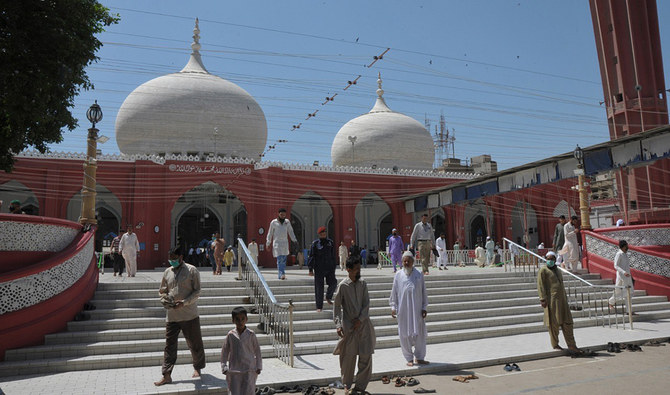

KARACHI/PESHAWAR: In defiance of the government’s restrictions on attendance at mosques, worshippers in many areas of Pakistan took part in congregational prayers on Friday.
In a move to slow the spread of coronavirus, the Ministry of Religious Affairs announced on Thursday that mosque prayers would be limited to a “few people.”
The government decision was supported by a fatwa from the Supreme Ulema Council (SUC) of Egypt’s Al-Azhar University issued on Wednesday, on request of Pakistani President Arif Alvi. The edict bans all congregational prayers at mosques to prevent the spread of the disease.
However, mosques managed by Tanzeem-ul-Madaris Ahl-e-Sunnat Pakistan (TMASP) ignored the instructions and the organization’s leader, Mufti Muneeb-ur-Rehman, who is also the head of Pakistan’s moon-sighting committee, led prayers at Jamia Aqsa in Karachi. Hundreds of people gathered to attend the service.
“All Friday congregations will continue in mosques across the country,” Rehman said in a statement on Friday.
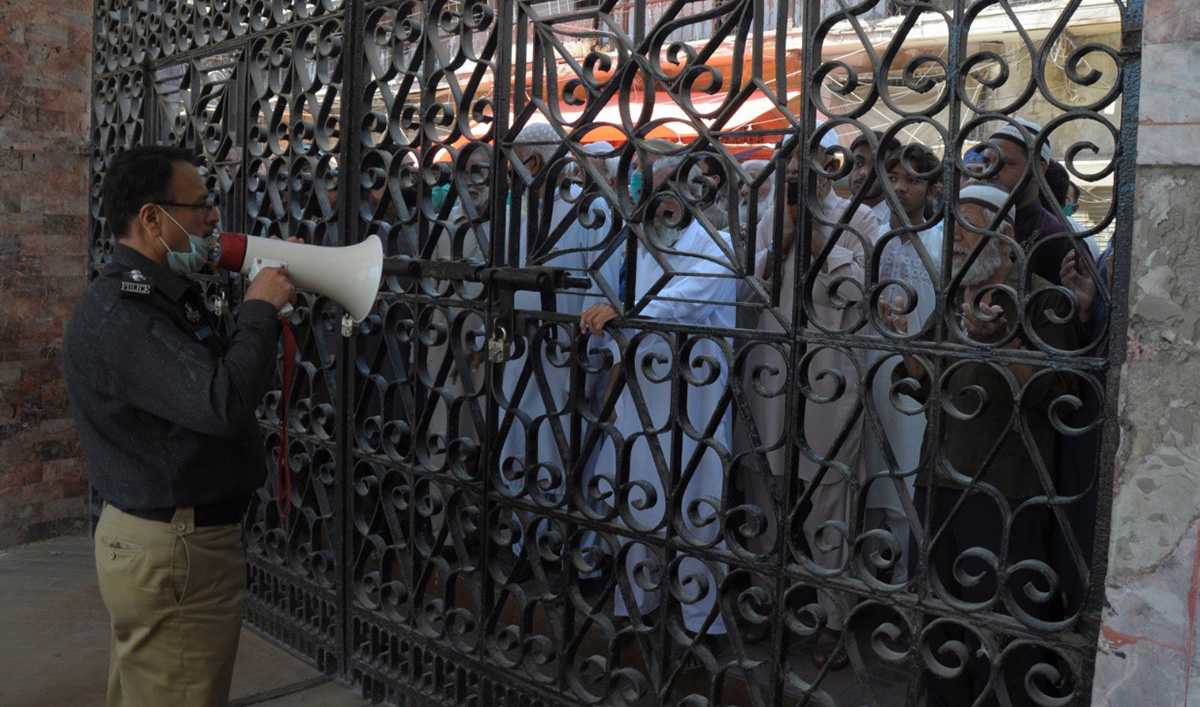
A police officer asks worshippers not to enter the New Memon mosque in Karachi on March 27, 2020. (AN photo by S.A. Babar)
At the New Memon mosque in downtown Karachi, thousands of worshipers disregarded police personnel who asked them to avoid the gathering.
Thousands of people also thronged Baitul Mukarram, a mosque run by leading Deobandi scholar Mufti Taqi Usmani, despite his own fatwa allowing followers to obey the government’s directives.
“At least 2,000 people attended the prayers today,” said Faizullah Khan, a worshipper. “Even though the mosque administration had displayed a notice asking people not to enter the building.”
In Balochistan, while the administration set the mosque attendance limit to five people only, it was not respected beyond Quetta, the provincial capital.
“Although, the mosque attendance remained thin in the central parts of the city, the government’s call was largely ignored on Quetta’s outskirts and its residential areas,” Sardar Hashmi Khan, a local elder, told Arab News.
In Khyber Pakhtunkhwa and tribal areas, hundreds of worshippers congregated to offer prayers, residents of the Khaisoor valley in South Waziristan and Karak district, confirmed to Arab News.
Maulana Amanuddin, a prayer leader in Khaisoor, said that worshippers attended Friday prayers without any fear because most them had no knowledge about the pandemic and had not received an order to cancel religious gatherings.
Maulana Taj Muhammad, chief cleric of the main mosque of Wana, South Waziristan, told Arab News that he had used the mosque venue to educate the worshippers who gathered for prayers on preventive measures agains the virus.
“Friday prayers should not be skipped, worship should be shortened. The outbreak dominated my today’s sermon, in which I stressed precautionary measures. Worshippers attended in hundreds, but I kept the session up to 15 minutes to ensure everyone’s safety,” he said.
Meanwhile, Maulana Jamaluddin, National Assembly member from the tribal region, told Arab News he had been in touch with provincial health officials and administration and they are considering a complete lockdown of the region.
“I have already conveyed to religious leaders to avoid congregational prayers at mosques and abide by government directions. I will make sure that no such gathering takes place at mosques,” he said.


