

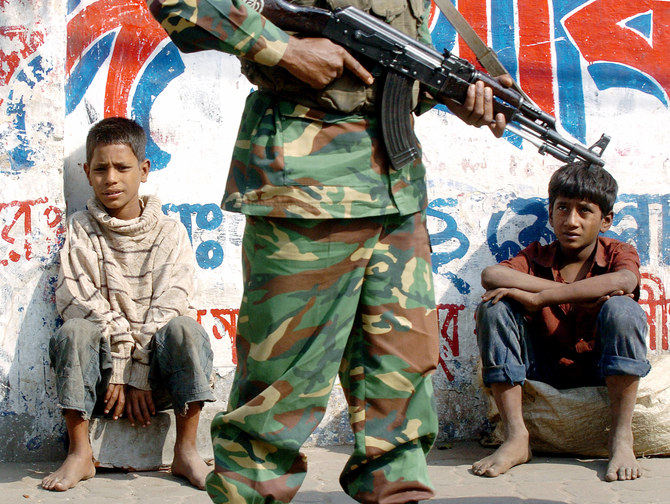
Bangladesh deploys army to stem coronavirus crisis

Four deaths and 39 infections were reported across the country. (File/AFP)
Short Url
Updated 25 March 2020
Follow

Bangladesh deploys army to stem coronavirus crisis

  • Public health experts say country at ‘extreme risk’ due to deadly outbreak 
  • “We are urging people to maintain home quarantine very strictly”: disease control director

DHAKA: Troops appeared on the streets of Bangladesh on Tuesday to assist law enforcers in implementing a lockdown to contain the spread of the coronavirus disease (COVID-19) across the country, an Inter-Services Public Relations (ISPR) official told Arab News.

“Our army has reached all the districts across the country and met civil administration officials to assess the needs of their localities. Now, we are finalizing the plans on the ground to intervene in the situation,” Lt. Col Abdullah Ibn Zaid, the director of ISPR, said.

He added that both the airforce and navy were on standby “to carry emergency medical supplies to the remote areas” and to “bring critical patients to the hospital, as and when required.”

The move follows repeated appeals by the government urging people to stay at home and limit the spread of the deadly disease.

According to Meerjadi Sabrina Flora, the director of the Institute of Epidemiology Disease Control and Research (IEDCR), Bangladesh reported its first COVID-19 infection on March 8.

As of Tuesday, four deaths and 39 infections were reported across the country.

“We are currently at stage 3, according to the guidelines of the World Health Organization (WHO), where the community-level spread is not that much in evidence,” said Professor Shahnila Ferdousi, the director of disease control at the IEDCR. 

“We are urging people to maintain home quarantine very strictly and avoid any mass gatherings and public transportation. If we can do so, we will overcome this unprecedented crisis,” she said.

Public health experts raised the red flag on Tuesday, warning Bangladeshis of the “extreme risk” facing the country. 

“We don’t have any scope to be complacent. The country needs to make an all-out effort to resist the coronavirus spread,” said Dr Mushtuq Husain, an adviser at the IEDCR, suggesting that community halls and large spaces be turned into quarantine spaces.

On Monday, to ensure people stayed at home the government announced a 10-day public holiday from March 26 to April 4.

This was followed by the authorities extending the closure of all educational institutions until April 9, on Tuesday.

As additional precautionary measures, all domestic flights have been suspended from Tuesday midnight, too, while railway and inland water transport services will remain inoperational for an indefinite period. 

The government has also decided to suspend all public transport from March 26 to April 4, as announced by Obaidul Quader, the Minister for Road, Transport and Bridges, on Tuesday.

He added, however, that the transport of emergency supplies and food materials will be exempt from the temporary ban.


Palestine Action hunger strike prisoner loses ability to speak

Updated 11 sec ago
Follow

Palestine Action hunger strike prisoner loses ability to speak

  • Heba Muraisi unable to ‘form sentences’ as she feels ‘weaker as each day passes’
  • Fellow activist Teuta Hoxha ‘virtually bedridden’ as hunger strike continues

LONDON: A prisoner on hunger strike in the UK, detained for activities in support of the banned group Palestine Action, has lost the ability to speak, The Independent reported.

Heba Muraisi said in a statement that she can no longer “form sentences, and (is) struggling to maintain conversation.” She added via the Prisoners for Palestine group that she feels “weaker as each day passes.”

Campaigners say another prisoner on hunger strike now cannot stand up. Eight activists initially went on strike awaiting trial for a range of alleged offenses relating to Palestine Action, including violence and criminal damage.

Earlier this month two of the activists, Qesser Zuhrah and Amu Gib, paused their strikes after 48 days and were admitted to hospital.

As well as Muraisi, three others remain on hunger strike: Teuta Hoxha, Kamran Ahmed and Lewie Chiaramello.

Hoxha, according to Prisoners for Palestine, is “no longer able to stand without blacking out,” experiences “increasing levels of brain fog” and is “virtually bedridden.”

The hunger strikers are demanding immediate bail and to be allowed to “send and receive communications without restriction, surveillance, or interference from the prison administration.”

The eight have been charged over two incidents, a break-in at a Royal Air Force base in June that saw two military aircraft damaged, and a break-in at a facility owned by Israeli-linked defense company Elbit Systems UK on Nov. 19, 2024.

A spokesperson for Prisoners for Palestine said: “Unlike the prison guards, who lock up the prisoners early to go home to their Christmas dinner, the hunger strikers don’t get a Christmas break.

“Just like the Christians in Gaza, who continue to suffer in the freezing cold at the hands of the settler-colonial entity.

“The hunger strikers say to us, don’t forget the people of Palestine over Christmas, and continue to demand a meeting with the British government on their behalf.”

Lawyers acting for the eight have said they risk death if their strike continues and the government does not intervene.

Earlier this month, protests took place led by MP Zarah Sultana over claims that Zuhrah had been refused an ambulance, and the hunger strikers’ legal teams have begun action against the government over what they say are breaches of its own prison safety policy framework.

Prisons Minister James Timpson said: “We are very experienced at dealing with hunger strikes. Unfortunately, over the last five years we have averaged over 200 hunger strike incidents every year and the processes that we have are well-established and they work very well — with prisons working alongside our NHS (National Health Service) partners every day, making sure our systems are robust and working — and they are.

“I am very clear. I don’t treat any prisoners differently to others. That is why we will not be meeting any prisoners or their representatives.

“We have a justice system that is based on the separation of powers, and the independent judiciary is the cornerstone of our system.”