


Dubai fitness influencer in hot water over comments amid coronavirus crisis

The influencer (not pictured in this stock photo) raised the issue of running outdoors. (Shutterstock)
Short Url
Updated 25 March 2020
Follow

Dubai fitness influencer in hot water over comments amid coronavirus crisis

DUBAI: On Monday, Dubai-based influencer Semia Azaiz, who goes by “The Trendy Frenchie” on Instagram, uploaded a series of videos on her account seemingly implying that her followers should go against the advice of health authorities regarding staying at home as much as possible in order to prevent the further spread of coronavirus, prompting several Twitter users to report the video by tagging the Dubai Police.

On Tuesday, Dubai Police announced that a member of the public had been arrested for "showing her indifference to the #StayHome national campaign."

"Dubai Police has arrested a European national of Arab origin for posting a video showing her indifference to the #StayHome national campaign and encouraging people to defy authorities' social distancing instructions. Legal measures were taken against her. The case has been referred to the Federal Public Prosecution for Information Technology Crimes. Dubai Police stresses the importance of residents fully complying with directives issued by authorities to safeguard public health," it tweeted on Tuesday evening. 


View this post on Instagram


#repost @dubaimediaoffice ・・・ شرطة دبي تلقي القبض على شابة أوروبية من أصول عربية بثت مقطع فيديو يظهر عدم اكتراثها بمبادرة #خلك_في_البيت والتعليمات الصحية والأمنية الحالية، وتحولها إلى نيابة مكافحة جرائم تقنية المعلومات بالنيابة العامة الاتحادية. الشرطة تؤكد أهمية الالتزام بالتعليمات حفاظاً على السلامة العامة، وتحذر من مخالفتها. عقوبة الحبس وغرامة لا تقل عن 200 ألف درهم ولا تتجاوز مليون درهم، أو إحدى العقوبتين، لكل من دعا أو حرض بأي طريقة تقنية أو وسيلة معلوماتية لعدم الانقياد إلى القوانين والأنظمة المعمول بها في الدولة. . Dubai Police has arrested a European national of Arab origin for posting a video showing her indifference to the #StayHome national campaign and encouraging people to defy authorities' social distancing instructions. Legal measures were taken against her. The case has been referred to the Federal Public Prosecution for Information Technology Crimes. Dubai Police stresses the importance of residents fully complying with directives issued by authorities to safeguard public health. Inciting non-compliance with safety measures will lead to imprisonment and/or a fine of between AED200,000 and AED1 million.

A post shared by Dubai Police شرطة دبي (@dubaipolicehq) on

In the video posted by the influencer, she seems to mock the measures. 

“Finally, we’re going for a run,” said Azaiz who is seen outside with one of her friends. “I wanted to tell you that yesterday I went for a run with my friend and I was afraid to put up a video because two days ago when I was running and when I told people they should go out and do whatever they want, I have been attacked on social media, I was called irresponsible and crazy,” she continued.

“However, I’m doing small runs. I’m by myself or I bring a friend with me because I don’t want to make anyone unhappy and I don’t want to take any risks. But what I’m saying is you don’t have to take part in this campaign, staying at home,” she said. 

“Do whatever you wanna do, no matter what’s out there. If you want to leave the house, go for a walk or go for a run, just do it. Stay positive and stop adding to this drama staying at home. Why are you staying at home?” she said to her 41,000 Instagram followers in the now-deleted videos, which have garnered immense backlash on social media since their upload — some users even reported the clips to Dubai Police.


A post shared by The Trendy frenchie(@the_trendy_frenchie) on

Today, Reebok MENA released a statement saying that they are cutting ties with the influencer over her comments.

“Reebok MENA, in no way shape or form, endorses the activities of @the_trendy_frenchie and has immediately suspended all collaborations with her,” wrote the athletic label. “She previously attended a Reebok event in January and posted recently. Her comments are misleading and do not represent the core values or principles that the brand stands for. We encourage the entire community to stay at home and practice social distancing,” said the statement. 
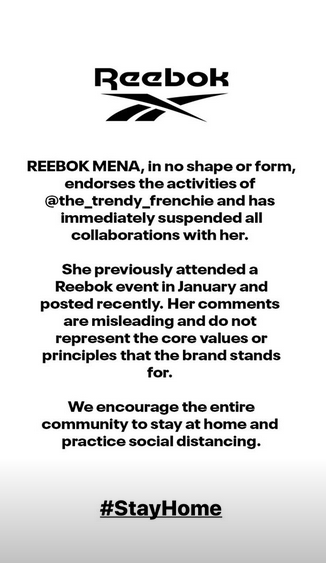


Instagram/@reebokmena

Azaiz’s comments came just after the Crown Prince of Dubai, Sheikh Hamdan, took to Instagram and Twitter to share a lengthy, heartfelt plea urging the residents of UAE to stay home amid the rapidly spreading coronavirus. 

Meanwhile, on Monday night, Dubai’s Burj Khalifa lit up with the message “Stay Home... Stay Safe.”


#StayHome #خلك_في_البيت

A post shared by Burj Khalifa (@burjkhalifa) on


Decoding villains at an Emirates LitFest panel in Dubai

Updated 25 January 2026
Follow

Decoding villains at an Emirates LitFest panel in Dubai

DUBAI: At this year’s Emirates Airline Festival of Literature in Dubai, a panel on Saturday titled “The Monster Next Door,” moderated by Shane McGinley, posed a question for the ages: Are villains born or made?

Novelists Annabel Kantaria, Louise Candlish and Ruth Ware, joined by a packed audience, dissected the craft of creating morally ambiguous characters alongside the social science that informs them. “A pure villain,” said Ware, “is chilling to construct … The remorselessness unsettles you — How do you build someone who cannot imagine another’s pain?”

Candlish described character-building as a gradual process of “layering over several edits” until a figure feels human. “You have to build the flesh on the bone or they will remain caricatures,” she added.

The debate moved quickly to the nature-versus-nurture debate. “Do you believe that people are born evil?” asked McGinley, prompting both laughter and loud sighs.

Candlish confessed a failed attempt to write a Tom Ripley–style antihero: “I spent the whole time coming up with reasons why my characters do this … It wasn’t really their fault,” she said, explaining that even when she tried to excise conscience, her character kept expressing “moral scruples” and second thoughts.

“You inevitably fold parts of yourself into your creations,” said Ware. “The spark that makes it come alive is often the little bit of you in there.”

Panelists likened character creation to Frankenstein work. “You take the irritating habit of that co‑worker, the weird couple you saw in a restaurant, bits of friends and enemies, and stitch them together,” said Ware.

But real-world perspective reframed the literary exercise in stark terms. Kantaria recounted teaching a prison writing class and quoting the facility director, who told her, “It’s not full of monsters. It’s normal people who made a bad decision.” She recalled being struck that many inmates were “one silly decision” away from the crimes that put them behind bars. “Any one of us could be one decision away from jail time,” she said.

The panelists also turned to scientific findings through the discussion. Ware cited infant studies showing babies prefer helpers to hinderers in puppet shows, suggesting “we are born with a natural propensity to be attracted to good.”

Candlish referenced twin studies and research on narrative: People who can form a coherent story about trauma often “have much better outcomes,” she explained.

“Both things will end up being super, super neat,” she said of genes and upbringing, before turning to the redemptive power of storytelling: “When we can make sense of what happened to us, we cope better.”

As the session closed, McGinley steered the panel away from tidy answers. Villainy, the authors agreed, is rarely the product of an immutable core; more often, it is assembled from ordinary impulses, missteps and circumstances. For writers like Kantaria, Candlish and Ware, the task is not to excuse cruelty but “to understand the fragile architecture that holds it together,” and to ask readers to inhabit uncomfortable but necessary perspectives.