

Pakistanis stranded in UAE reach home on special flight

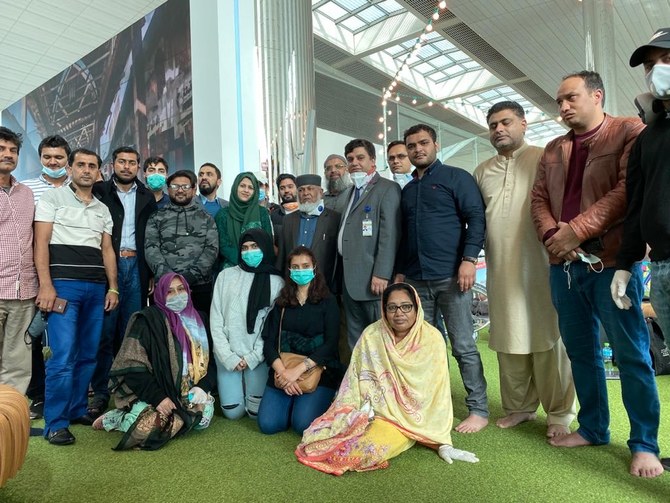
Pakistan's consul general to Dubai, Ahmed Amjad Ali (center), poses for a photograph with nationals stranded at Dubai International Airport on March 23, 2020. (Photo courtesy: Pakistan Consulate General in Dubai)
Short Url
Updated 24 March 2020
Follow

Pakistanis stranded in UAE reach home on special flight

  • Airlines are not charging cancelation or reschedule fees
  • Persons stranded at airports given first priority for special flight

DUBAI: More than a hundred Pakistanis reached homeland on a special flight Tuesday morning, after they found themselves stranded in the United Arab Emirates, when amid the coronavirus outbreak Pakistan suspended inbound air traffic.

According to Ahmed Amjad Ali, Pakistan’s consul general in Dubai, nationals stuck at UAE airports after Pakistan halted international flights on Saturday were given first priority in the special homecoming process, as 101 passengers were sent on a FlyDubai flight — 73 of them from the Dubai airport, five from Abu Dhabi, and 26 from Dubai city.
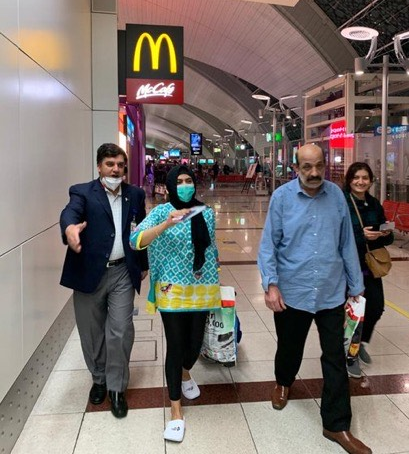


Pakistani nationals who were stranded in the UAE are walking toward their boarding gate at Dubai International Airport to depart for Islamabad on March 23, 2020. (Photo courtesy: Pakistan Consulate General in Dubai)

The Ministry of Overseas Pakistanis told Arab News on Monday that 150 nationals were stranded at Dubai and Abu Dhabi airports. Another 72 nationals stuck in Qatar are also expected to reach Pakistan on Tuesday.

Preparations for the arrivals in Islamabad International Airport were overseen by the prime minister’s special assistant for overseas Pakistanis, Syed Zulfi Bukhari.


Pakistani nationals are walking through Dubai International Airport to leave on a special flight to Islamabad on March 23, 2020. (Photo courtesy: Pakistan Consulate General in Dubai)

The passengers will be subject to strict health screening, as advised by the Ministry of Health, Pakistan’s Aviation Division said in a statement.

Abbas Raza Dar, AirBlue senior manager for UAE, told Arab News that all 47 weekly flights of the low-cost airline have been canceled. “The notification is for two weeks and could be extended, since the situation is changing.”
He also said the airline was not charging any fee to change the travel dates of its passengers. “A full refund is being given to those who ask, and we are also changing the dates for other passengers who ask for it,” he added.

Emirates airline has also canceled all of its 58 weekly Pakistan flights.

A spokesperson of the Pakistani Consulate General in Dubai said hotlines and social media channels have been set up to guide people on whatever kind of assistance they may need. 

“We have been getting mostly travel and visa-related calls and we are offering advice as per the situation. Others are concerned about collection of their NICs (national identity cards), for which we are encouraging people to apply online and limit their visit to the consulate,” the spokesperson said.


Pakistan PM orders accelerated privatization of power sector to tackle losses

Updated 4 sec ago
Follow

Pakistan PM orders accelerated privatization of power sector to tackle losses

  • Tenders to be issued for privatization of three major electricity distribution firms, PMO says
  • Sharif says Pakistan to develop battery energy storage through public-private partnerships

ISLAMABAD: Pakistan’s prime minister on Monday directed the government to speed up privatization of state-owned power companies and improve electricity infrastructure nationwide, as authorities try to address deep-rooted losses and inefficiencies in the energy sector that have weighed on the economy and public finances.

Pakistan’s electricity system has long struggled with financial distress caused by a combination of factors including theft of power, inefficient collection of bills, high costs of generating electricity and a large burden of unpaid obligations known as “circular debt.” In the first quarter of the current financial year, government-owned distribution companies recorded losses of about Rs171 billion ($611 million) due to poor bill recovery and operational inefficiencies, official documents show. Circular debt in the broader power sector stood at around Rs1.66 trillion ($5.9 billion) in mid-2025, a sharp decline from past peaks but still a major fiscal drain. 

Efforts to contain these losses have been a focus of Pakistan’s economic reform program with the International Monetary Fund, which has urged structural changes in the energy sector as part of financing conditions. Previous government initiatives have included signing a $4.5 billion financing facility with local banks to ease power sector debt and reducing retail electricity tariffs to support economic recovery. 

“Electricity sector privatization and market-based competition is the sustainable solution to the country’s energy problems,” Prime Minister Shehbaz Sharif said at a meeting reviewing the roadmap for power sector reforms, according to a statement from the prime minister’s office.

The meeting reviewed progress on privatization and infrastructure projects. Officials said tenders for modernizing one of Pakistan’s oldest operational hubs, Rohri Railway Station, will be issued soon and that the Ghazi Barotha to Faisalabad transmission line, designed to improve long-distance transmission of electricity, is in the initial approval stages. While not all power-sector decisions were detailed publicly, the government emphasized expanding private sector participation and completing priority projects to strengthen the electricity grid.

In another key development, the prime minister endorsed plans to begin work on a battery energy storage system with participation from private investors to help manage fluctuations in supply and demand, particularly as renewable energy sources such as solar and wind take a growing role in generation. Officials said the concept clearance for the storage system has been approved and feasibility studies are underway.

Government briefing documents also outlined steps toward shifting some electricity plants from imported coal to locally mined Thar coal, where a railway line expansion is underway to support transport of fuel, potentially lowering costs and import dependence in the long term.

State authorities also pledged to address safety by converting unmanned railway crossings to staffed ones and to strengthen food safety inspections at stations, underscoring broader infrastructure and service improvements connected to energy and transport priorities.