



JEDDAH: Olympics chiefs have postponed the 2020 Games due to begin in Tokyo in July, International Olympic Committee member Dick Pound said on Monday.
Australia and Canada had already withdrawn earlier in the day as organizers came under global pressure to call off the event because of the COVID-19 pandemic.
“On the basis of the information the IOC has, postponement has been decided,” Pound said. “The parameters going forward have not been determined, but the Games are not going to start on July 24, that much I know.”
The event, scheduled for July 24-Aug. 9, is now likely to be held in 2021, with the details to be worked out in the next four weeks.
More than 337,000 people worldwide have been infected by the novel coronavirus and over 14,600 have died in a pandemic that the World Health Organization said was accelerating.
The IOC and the Japanese government have both edged back from weeks of blanket insistence the Games would go ahead, announcing a month-long consultation on scenarios including postponement.
The Olympics have never been delayed before, though they were canceled in 1916, 1940 and 1944 during the two world wars, and major Cold War boycotts disrupted the Moscow and Los Angeles Games in 1980 and 1984.
Canada and Australia both bluntly said they would not participate this year. “We are in the midst of a global health crisis that is far more significant than sport,” said Canada’s Olympic Committee and Paralympic Committee.
“The moment the IOC indicates that it is thinking about other solutions, it has already decided to delay the Games,” said French Olympic Committee President Denis Masseglia.
Canada and Australia both bluntly said they would not participate this year.
“We are in the midst of a global health crisis that is far more significant than sport,” said Canada’s Olympic Committee and Paralympic Committee.
The Australian Olympic Committee (AOC) also told its athletes to prepare for a Tokyo Games in 2021.
“Our athletes have been magnificent in their positive attitude to training and preparing, but the stress and uncertainty have been extremely challenging for them,” said Australia’s Olympics Chef de Mission Ian Chesterman.
Paralympic athletes were considered at particular risk from the epidemic given some had underlying health problems.
Various nations urged a quick decision from the IOC, which is led by its powerful president, Thomas Bach, a German lawyer and former Olympic fencing champion.
ALSO READ: Canada, Australia pull out of 2020 Tokyo Olympics
Sad but supportive
Athletes were broadly supportive of postponing the Games, though sad at seeing their dreams in doubt.
“Competing in the Olympics is my #1 goal but I fully support this decision and I commend our leadership for taking a stand,” tweeted Canadian tennis player Gabriela Dabrowski.
Only a few dissented, reigning Pan American 400 meters hurdles champion Sage Watson calling Canada’s move “premature.”
Monday’s announcements followed growing pressure from big stakeholders including US Track and Field, UK Athletics and other national Olympic committees.
“An Olympic Games in July this year is neither feasible nor desirable,” World Athletics chief Sebastian Coe said. “We owe it to our athletes to give them respite where we can.”
Japan’s government seemed to be bowing to the inevitable despite the massive losses and logistics headaches it would face.
'No option but to postpone
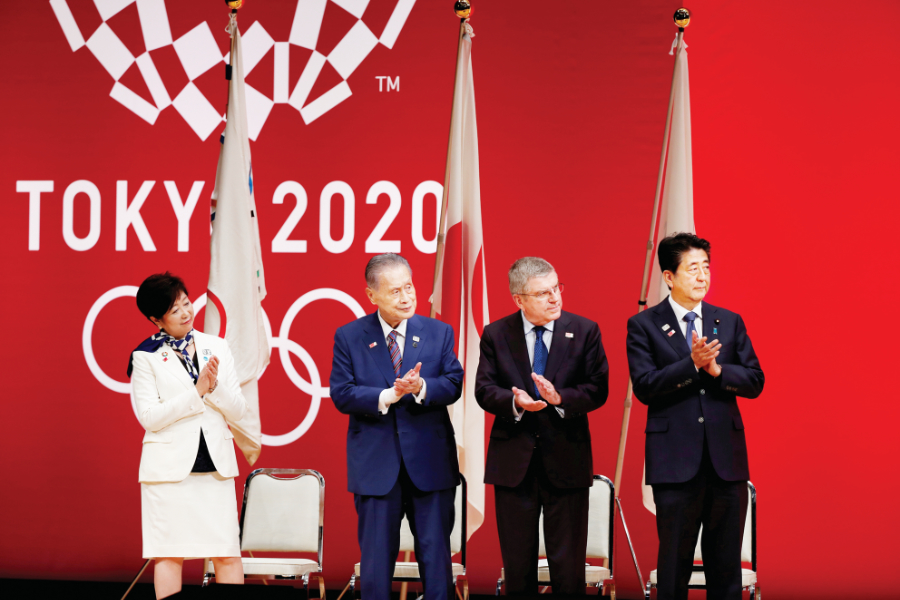
Tokyo Gov. Yuriko Koike, Tokyo 2020 President Yoshiro Mori, IOC chief Thomas Bach and Prime Minister Shinzo Abe at the ‘One Year to Go ceremony.’ (Reuters file photo)
Prime Minister Shinzo Abe told parliament that if holding the event as planned was too difficult, “we may have no option but to consider postponing the Games, given the Olympic principle of putting the health of athletes first.”
Abe has staked his legacy as Japan’s longest-serving premier on the Games and was hoping for a boom in tourism and consumer spending. At risk is more than $3 billion in domestic sponsorship. But finding a new date could be complicated as the summer 2021 calendar is already crowded, while 2022 will see the soccer World Cup and the Beijing Winter Olympics.
Japanese sponsors, from Toyota Motor Corp. to Panasonic Corp, were nervously watching.
But Tokyo stocks sensitive to the success of the Olympics surged on Monday, after sharp falls in prior weeks, thanks to expectations of a delay rather than a cancelation.
Postponement is a potential major blow to the IOC’s prestige and power after its insistence the Games would go ahead.
Many athletes already felt disrespected during the Russian doping scandal when Bach ensured Russians could carry on competing, albeit as neutrals.
And his iron grip on the IOC could weaken after various national committees at the weekend distanced themselves from his stance over Tokyo. He is up for re-election in 2021.
(With Reuters)


