

Londoners outraged as Underground trains packed despite coronavirus outbreak

1 / 4
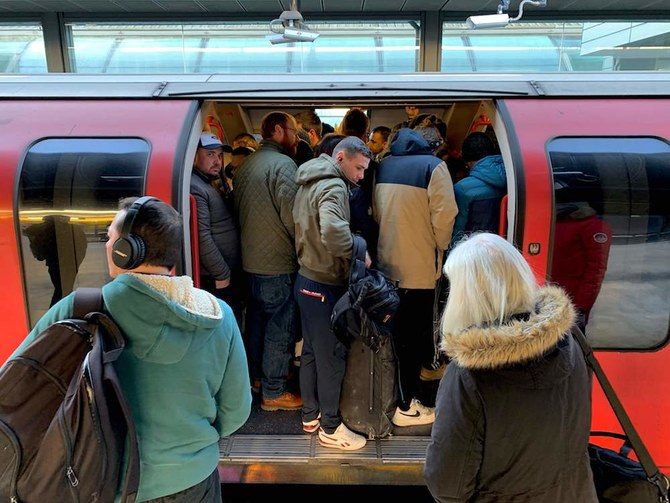
London’s transport authorities have been criticized after Underground trains were packed with people on Monday morning, despite government calls for people to stay at home, social distance and avoid using public transport. (Reuters)
2 / 4
London’s transport authorities have been criticized after Underground trains were packed with people on Monday morning, despite government calls for people to stay at home, social distance and avoid using public transport. (Reuters)
3 / 4
London’s transport authorities have been criticized after Underground trains were packed with people on Monday morning, despite government calls for people to stay at home, social distance and avoid using public transport. (Reuters)
4 / 4
London’s transport authorities have been criticized after Underground trains were packed with people on Monday morning, despite government calls for people to stay at home, social distance and avoid using public transport. (Reuters)
Short Url
Updated 23 March 2020
Follow

Londoners outraged as Underground trains packed despite coronavirus outbreak

  • TfL urged Londoners not to travel unless their journey was “absolutely essential.”

LONDON: London’s transport authorities have been criticized after Underground trains were packed with people on Monday morning, despite government calls for people to stay at home, social distance and avoid using public transport during the coronavirus outbreak.

People took to social media to call the current transport situation in the UK capital “dangerous” and “unacceptable,” highlighting the increased exposure risk for the nation’s key workers.

Images and videos of the chaos led social media users to speculate that Londoners were not following government instructions issued in prime minister Boris Johnson’s daily briefings.

Transport for London (TfL) announced last week that 40 of its rail stations would close and a reduced service would be running with 15 trains per hour on its rail networks through central London.

It also urged Londoners not to travel unless their journey was “absolutely essential.”

There were also reduced services on national rail services coming into London for commuters who live outside the capital. 

But with many businesses remaining open for their staff and key healthcare workers in the UK capital needing to use the TfL network to travel to work, commuters have been forced to stand close to each other on packed trains exposing themselves to greater risk of contracting the virus.

Underground drivers also expressed anger at the amount of people still using the Underground during rush hour, according to Underground union bosses.

TfL said it had reduced its services in a hope of deterring people from using its services and wanted to limit the risk for their staff and drivers.

Despite the dire situation depicted in the images, TfL said on Friday there had been a 70 percent fall in the number of passengers on the Underground and a 40 percent reduction in passengers on its bus network.

A spokesperson from the Mayor of London’s office said: “Londoners should not be travelling by any mode of transport unless it is absolutely necessary, and only critical workers should be using public transport. The number of journeys on the Tube is down significantly compared to the same time last year, with an 87 percent reduction this weekend. 

“But we need Londoners to stop travelling. TfL will continue to do everything it can to provide a safe service but like many organisations it is dealing with rising absence levels and needs Londoners’ cooperation in these challenging times.”


Germany takes delivery of Israeli-made underwater drone

Updated 9 sec ago
Follow

Germany takes delivery of Israeli-made underwater drone

  • "The army said the Blue Whale was the navy’s “largest and most advanced unmanned underwater vehicle to date“
  • The device was tested in the Baltic Sea

BERLIN: The German navy on Wednesday said it had taken delivery of an Israeli-made Blue Whale underwater drone intended for reconnaissance and detecting “hybrid threats at sea.”
The autonomous underwater vehicle, developed by Israeli company IAI together with German submarine- and warship-maker TKMS, was received in the northern port of Eckernfoerde, the navy said in a statement.
The army on its website said the Blue Whale was the navy’s “largest and most advanced unmanned underwater vehicle to date.”
The device was tested in the Baltic Sea, a flashpoint for tensions between Russia and NATO since Moscow’s 2022 invasion of Ukraine, the army said.
Military experts and European leaders say Russia has ramped up its “hybrid war” in the strategic region — now bordered entirely by NATO members, with the exception of Russia — through airspace incursions and suspected sabotage of undersea cables.
TKMS said the Blue Whale was capable of “conducting reconnaissance operations, detecting targets above and below the sea surface, collecting acoustic information, and locating sea mines on the seabed.”
Israel and Germany have upped their defense cooperation in recent months and in January signed a security pact to expand joint work on counterterrorism and cyber defense.
In December, Germany approved a $3.1 billion expansion of a contract for the Arrow 3 anti-ballistic missile defense system, which is Israeli-made and developed with US support.