

Drastic decline in new coronavirus cases in Saudi Arabia’s Qatif

Prince Faisal bin Khalid bin Sultan bin Abdul Aziz, governor of the Northern Borders Region, visits the command and control center on Sunday, which has been established by the health authorities to contain the coronavirus. (SPA)
Short Url
Updated 23 March 2020
Follow

Drastic decline in new coronavirus cases in Saudi Arabia’s Qatif

  • 119 new cases reported pushing the total to 511

JEDDAH: Following strict precautionary measures, the number of new coronavirus cases in the eastern Saudi city of Qatif has drastically fallen.

The city was locked down two weeks ago to contain the spread of the virus, and so far only four new cases have been reported, said Saudi health authorities on Sunday.
The current situation in Qatif shows that the spread of the virus in the city has been contained due to the steps taken by the authorities, said Health Ministry spokesman Dr. Mohammed Al-Abd Al-Aly at a press conference. “The infection rate has fallen, which is very reassuring for the people of Qatif,” he added.
The ministry confirmed 119 new cases nationwide on Sunday, pushing the total number in the country to 511.
Most of the cases reported on Sunday had been in contact with those who had earlier contracted the virus, a trend the spokesman described as “worrying.”
Of the 119 new cases, 72 were reported in Makkah and are Turkish nationals. “All of them were infected from people who had earlier tested positive for the virus,” the spokesman said.
Another 40 of the new cases were involved in a social gathering with previously announced cases.
Al-Aly stressed that people must limit their movements, stay home, and avoid gatherings and activities of any kind.
“This is unfortunate. We’ve repeatedly warned against social gatherings, whether inside or outside homes. Even a group of 10 people or less is dangerous,” he said, adding that further preventive measures, such as a curfew in any other area of the country, cannot be ruled out.
He stressed that everyone who is instructed to remain in quarantine should commit to the 14-day period.
The number of people currently in quarantine and domestic isolation under the ministry’s mentorship is 4,000, while the cumulative total exceeds 10,000.
“It isn’t enough to maintain personal hygiene and avoid contact. All of these measures are important but not enough. Contact is very dangerous for adults, young people and children alike. Please be careful,” Al-Aly said.
“The matter isn’t limited to the efforts of governments. Everyone must be aware of their responsibility to protect themselves and those around them.”
He urged citizens and residents to avoid traveling between cities unless absolutely necessary. He also invited everyone to benefit from the ministry’s services, such as its hotline 937, and its Mawid and Seha apps.
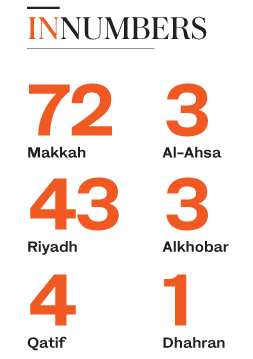
The city-wise breakdown of the new cases of coronavirus is Makkah (72), Riyadh (43), Qatif (4), Al-Ahsa (3), Alkhobar (3), Dhahran (1) and Dammam (1).


Minzal brings Saudi traditions to life in Diriyah

Updated 07 January 2026
Follow

Minzal brings Saudi traditions to life in Diriyah

  • From leather crafts and archery to Saudi coffee, Minzal offers a lesson in ‘Sloum Al-Arab’

RIYADH: This season of Minzal places social norms and traditional etiquette at its center, with tents set up to teach what is locally known as “Sloum Al-Arab” alongside gatherings for coffee, dinner and stargazing around campfires.

“Sloum Al-Arab” refers to the unwritten customers and values that have shaped Arab and Bedouin society for centuries, including generosity, coffee preparation, courage and archery. 

In Saudi Arabia, these traditions are closely ties to cultural identity and religious belief. 

Leather products and the making of leather goods is one of the crafts featured at Minzal this year and is one of the oldest crafts still practiced in the kingdom.

“The most difficult thing I faced to work on was camel leather because it is a little tough,” Nada Samman, a leather trainer and craftsman at Minzal, told Arab News. 

Minzal continues to evolve with each season, offering activities that highlight Bedouin values, traditional skills and sports. (AN photo by Haifa Alshammari)

“The work on leather is wonderful whether it is goat leather, cow leather, Sawakni sheep, and of course, camel leather. At Minzal, we are offering multiple handicraft workshops, most specifically the leather handicrafts. We want visitors to spend time at something useful and fun."

Samman explained the workshops allowed participants to preserve heritage while engaging in meaning, hands on activities. 

Faisal Al-Khaled, a visual artist and craftsman specializing in Saudi designs at Minzal, shared a similar goal: “I want people to have, by the end of this experience, a unique and traditional art piece created by them, and that I know I helped them to preserve this craft.”

Minzal, which has been organized for several years now, continues to evolve with each season, offering activities that highlight Bedouin values, traditional skills and sports. Archery is a key feature, reflecting its deep roots in Arab and Islamic history.

Mohammed Al-Sharif, a certified archery player and coach with the Saudi Archery Federation since 2028, said the sport was closely connected to Saudi culture. It was encouraged by the Prophet Muhammad, which led people to learn and teach it through generations.

“Our traditional bow is considered one of the most important and widely used bows in Arab culture,” Al-Sharif said. “We have several styles, and professional archers specializing in traditional bow shooting … There are various types of archery, such as horseback archery and standing archery, where bow sizes vary according to specific needs, such as types used for hunting and others used during warfare.”

He explained that archery was historically part of daily life, used for protection and hunting. 

Saudi coffee also plays a significant role in the Minzal experience, with live demonstrations. One of the most frequently consumed beverages in the Kingdom, it is a symbol of hospitality and generosity.

Ahmed Al-Shuaibi explained how it was prepared at the Sloum tent, first by roasting the beans and then allowing them to cool. The beans are ground with spices in a Nigr.

“Coffee is passed from our grandparents,” he added. “In significant majlis, you see them offering our local coffee and not other types of coffee. We organized this corner so that young generations can visit and learn this.”