Prayers at Jerusalem’s Al-Aqsa mosque compound suspended over virus

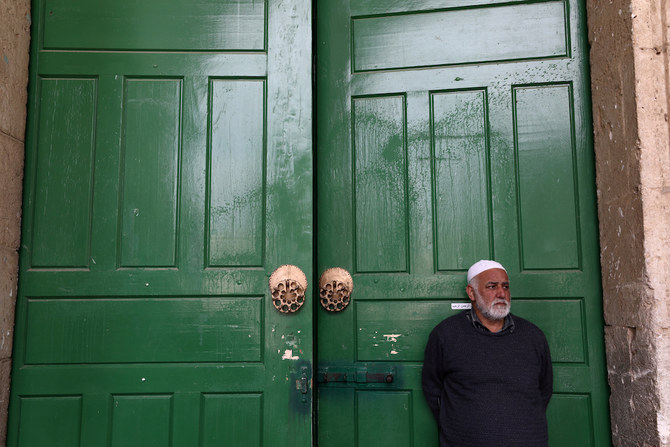
An employee of the Islamic Waqf stands in front of the closed doors of Al-Aqsa mosque in the compound known to Muslims as Noble Sanctuary and to Jews as Temple Mount in Jerusalem’s Old City, after Muslim clerics shut the mosque until further notice as a precaution against coronavirus. (File/Reuters)
Short Url
Updated 22 March 2020
Follow

Prayers at Jerusalem’s Al-Aqsa mosque compound suspended over virus

  • The mosque's doors and the adjoining Dome of the Rock had already been shut
  • Religious leaders at other holy sites in Jerusalem’s walled Old City have also set precautionary limitations

JERUSALEM: All Muslim prayers at Jerusalem’s Al-Aqsa mosque compound will be suspended from Monday until further notice in an effort to prevent the spread of coronavirus, religious officials said on Sunday.
The doors of the mosque and the adjoining Dome of the Rock had already been shut, but worshippers were still able to gather in the open areas of the hilltop compound, known to Muslims as the Noble Sanctuary and to Jews as the Temple Mount.
“It was decided to suspend the arrival of worshippers to prayers through all the gates to Al-Aqsa mosque starting Monday,” said a statement issued by the Ministry of Endowments and Islamic Affairs in Jordan, which acts as custodian of the site, the third holiest in Islam after Makkah and Medina.
The new edict suspends the outdoor prayers as well. Those sessions usually draw large crowds, though the numbers have dwindled in recent weeks.
The Palestinian director of the mosque, Sheikh Omar Kisawni, confirmed the decision to Reuters.
Religious leaders at other holy sites in Jerusalem’s walled Old City, such as the adjacent Western Wall and the Church of the Holy Sepulchre, have also set precautionary limitations.
The compound’s religious workers and guards will continue to be allowed entry and the Muslim call to prayer will continue as normal, said the Waqf council, which oversees Jerusalem’s Islamic sites.


Turkiye’s Kurdish party says Syria deal leaves Ankara ‘no excuses’ on peace process

Updated 58 min 12 sec ago
Follow

Turkiye’s Kurdish party says Syria deal leaves Ankara ‘no excuses’ on peace process

  • Turkish officials said earlier on Monday that the Syrian integration deal, if implemented, could advance the more than year-long process with the ​PKK, which is based in northern Iraq

ANKARA: Turkiye’s pro-Kurdish DEM Party said on Monday that the Turkish government had no more “excuses” to delay a peace process with the Kurdistan Workers Party (PKK) now that a landmark integration deal was achieved in neighboring Syria.
On Sunday in Syria, the Kurdish-led Syrian Democratic Forces (SDF) agreed to come under the control of authorities in Damascus — a move that Ankara had long sought as integral to ‌its own peace ‌effort with the PKK. “For more than a ‌year, ⁠the ​government ‌has presented the SDF’s integration with Damascus as the biggest obstacle to the process,” Tuncer Bakirhan, co-leader of the DEM Party, told Reuters, in some of the party’s first public comments on the deal in Syria.
“The government will no longer have any excuses left. Now it is the government’s turn to take concrete steps.” Bakirhan cautioned President Tayyip Erdogan’s ⁠government against concluding that the rolling back Kurdish territorial gains in Syria negated the need ‌for a peace process in Turkiye. “If the ‍government calculates that ‘we have weakened ‍the Kurds in Syria, so there is no longer a ‍need for a process in Turkiye,’ it would be making a historic mistake,” he said in the interview.
Turkish officials said earlier on Monday that the Syrian integration deal, if implemented, could advance the more than year-long process with the ​PKK, which is based in northern Iraq. Erdogan urged swift integration of Kurdish fighters into Syria’s armed forces. Turkiye, the strongest ⁠foreign backer of Damascus, has since 2016 repeatedly sent forces into northern Syria to curb the gains of the SDF — which after the 2011–2024 civil war had controlled more than a quarter of Syria while fighting Islamic State with strong US backing.
The United States has built close ties with Damascus over the last year and was closely involved in mediation between it and the SDF toward the deal.
Bakirhan said progress required recognition of Kurdish rights on both sides of the border.
“What needs to be done is clear: Kurdish rights must be recognized ‌in both Turkiye and Syria, democratic regimes must be established, and freedoms must be guaranteed,” he said.