

Health experts' guide on how to combat coronavirus

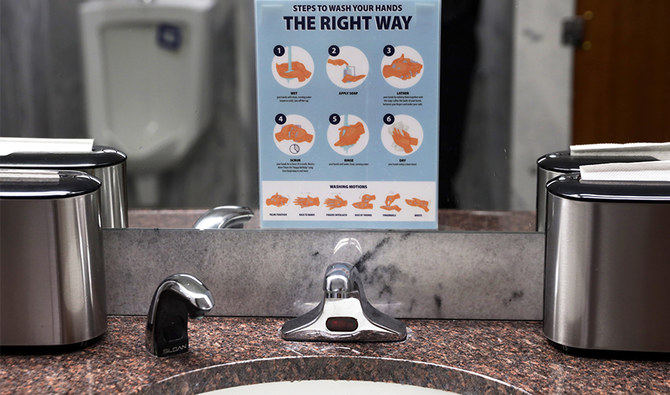
Instructions on correct way of hand washing is posted in a restroom at Hart Senate Office Building March 19, 2020. (AFP)
Short Url
Updated 21 March 2020
Follow

Health experts' guide on how to combat coronavirus

  • Frequently wash hands with regular soap and water, following 20 sec rule, doctors say
  • Wipe of disinfectant can do wonders for keeping your home and its residents safe

ISLAMABAD: Coronavirus has struck Pakistan with more than 400 confirmed cases across the nation today. With awareness and fear growing, hand sanitizers have been bought in bulk and with such frequency that many Pakistanis are facing trouble in procuring some. But if hand sanitizer is out of your grasp, there are plenty and, in some cases, more effective precautions one can take to keep healthy and safe.

“Wash your hands,” said Dr. Shahab Zahid, an Intensive Care Specialist at Islamabad’s PIMS hospital. “It cannot be stressed enough that handwashing can keep an entire home safe.”

Handwashing has been stressed by governments, health experts and the World Health Organization. They recommend at least 20 seconds of scrubbing with soap and water, soap’s chemical makeup being effective in breaking down the virus’ barrier and killing it before it spreads from one’s touch.

Although there is much that still remains unknown about the coronavirus and is still being studied by experts around the world, it is clear that the infection mostly spreads by touching things, such as money or a railing at a public staircase like those in office or Metro bus stations.

In addition to handwashing, there is the use of sanitizer, which is harder and harder to come by. Arab News spoke to infectious disease specialist, Dr. Saquib Malik, who is currently in New York where the pandemic has taken an alarming hold of the city.

“Number one, do not, I repeat do not, go out if you are sick,” he said to Arab News. If people are exhibiting any symptoms at all, Malik recommends to monitor the situation, alert one’s doctors and check the protocol of the city or province for reporting and getting tested. “Keeping your illness contained to the space you are occupying is going to matter in halting the spread,” he continued.

Social distancing, the act of avoiding unnecessary interaction with people, is also strongly encouraged. “Avoiding physical contact and proximity is a big precautionary measure,” Malik told Arab News over the phone.

When it comes to inevitable reasons of leaving home, such as doing groceries, picking up medication or handling other major errands, Malik recommends timing oneself to avoid big crowds.

“Go in the morning or the late evening to do whatever you can,” said Malik. “Try to avoid rush hours if you have the ability to do so.”

He also recommends being conscious of shared surfaces at home.

“It is a pain but that added wipe of disinfectant can do wonders for keeping your home and its residents safe,” he noted.

Communal spaces at one’s residence must be kept free of outside contaminants. When one gets home they should change their clothes, remove their shoes and maintain a disinfected space.

“A bit of vigilance now will hopefully pay off in the long run,” he said.


Pakistan mulls 'Super App' for public services, document verification in major technology push

Updated 15 February 2026
Follow

Pakistan mulls 'Super App' for public services, document verification in major technology push

  • Pakistan has been urging technology adoption in public, private sectors as it seeks to become a key tech player globally
  • The country this month launched the Indus AI Week to harness technology for productivity, skills development and innovation

KARACHI: Pakistan is planning to launch a “Super App” to deliver public services and enable digital document verification, the country's information technology (IT) minister said on Sunday, amid a major push for technology adoption in public and private sectors.

Pakistan, a country of 240 million people, seeks to become a key participant in the global tech economy, amid growing interest from governments in the Global South to harness advanced technologies for productivity, skills development and innovation.

The country's information and communications technology (ICT) exports hit a record $437 million in Dec. last year, according to IT Minister Shaza Fatima Khawaja. This constituted a 23% increase month on month and a 26% increase year on year.

Pakistan's technology sector is also advancing in artificial intelligence (AI) and cloud computing, marked by the launch of Pakistan’s first sovereign AI cloud in November, designed to keep sensitive data domestic and support growth in the broader digital ecosystem.

“In developed countries, citizens can access all government services from a mobile phone,” Fatima said, announcing plans for the Super App at an event in Karachi where more than 7,000 students had gathered for an AI training entrance test as part of the ‘Indus AI Week.’

“We will strive to provide similar facilities in the coming years.”

Khawaja said the app will reduce the need for in-person visits to government offices such as the National Database and Registration Authority (NADRA) and the Higher Education Commission (HEC).

The Indus AI Week initiative, which ran from Feb. 9 till Feb. 15. was aimed at positioning Pakistan as a key future participant in the global AI revolution, according to the IT minister.

At the opening of the weeklong initiative, Prime Minister Shehbaz Sharif announced that Pakistan would invest $1 billion in AI by 2030 to modernize the South Asian nation’s digital economy.

“These initiatives aim to strengthen national AI infrastructure and make the best use of our human resource,” Khawaja said, urging young Pakistanis to become creators, inventors and innovators rather than just being the consumers of technology.