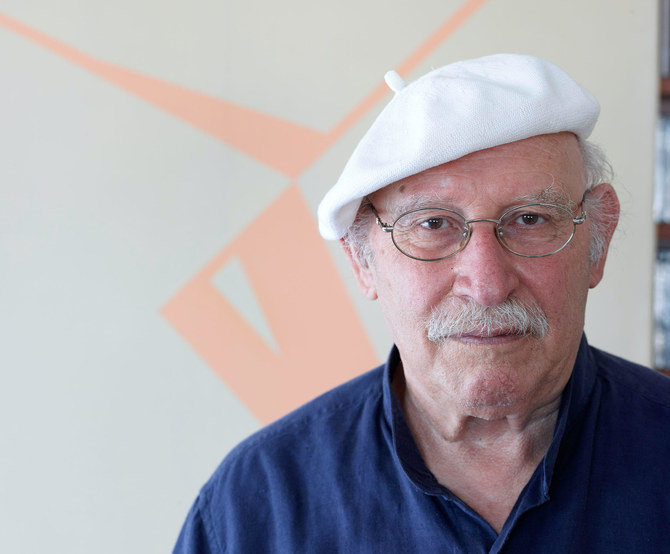

BEIRUT: “Here you have the spirit of calligraphy,” says the artist Samir Sayegh, pointing to one long fluid brushstroke on canvas. “It is energy that gives it balance. This energy comes from a certain set of feelings — feelings that are deep inside — and the contemplation of who you are as a human being. Life, love, fear, anxiety, stress… all these feelings. This internal spectrum of emotions is what moves the hand and gives it a sense of steadfast purpose.”
If you were to imagine an artist in your mind’s eye, Sayegh might possibly be the end result. Although without his trademark French beret, he is dressed in a brown kimono and has a slate-gray scarf wrapped loosely around his neck. His studio — as cluttered and eccentric as one would hope — is filled with the tools of his trade, while the walls are adorned with works of varying size and style. A selection of tools — pliers, end cutters, a hacksaw, two wooden mallets and an old hand-powered drill — hang in one corner beneath 22 small geometric art pieces and the studio’s medley of surfaces and bookcases are either partially or fully covered by the workings of his imagination.

This artwork by Sayegh was created in 2014. (Supplied)
Sayegh’s art, although based on individual letters or words, has little to do with language or meaning. It is purely aesthetic. He has, during the course of his career, stylized both the geometric and free-flowing variations of Arabic calligraphy, creating a universally appreciable practice based on form and beauty. For his geometric work, that has meant a focus on equilibrium and a dialogue between line and space. For the more free-flowing pieces, it has meant a system based on movement and balance.
“What unifies my two styles is a spirit of freedom,” he says in his home in Beirut, pouring three cups of coffee; the strong, thick, aromatic kind capable of raising the dead. One cup for him, one for me, and one for his wife Mona, who is helping out as a translator.

“3ain” is a 100x100cm Acrylic canvas created in 2008. (Supplied)
The words ‘spirit’ and ‘energy’ are sprinkled liberally throughout our conversation, just as certain words are repeated within his work, particularly hob (love) and salam (peace). You get the sense that Sayegh, who is also a poet and a critic, is a hippy at heart, although he is more often described as avant-garde or a “pioneer” of Arab modernism. The latter label stems largely from his experimentation with the structural and abstract possibilities of traditional calligraphy.
Sayegh, in essence, has ignored the calligraphic rules established by Ibn Muqla during the Abbasid Caliphate and later refined by Ibn al-Bawwab and the Ottomans, and has concentrated instead on freeing calligraphy from the constraints of language. That liberation has stemmed, in part, from a love of modern art and geometric minimalism. It has also emerged from an interest in the relationship between traditional and contemporary art and from a love of mathematical precision.

Sayegh created “Fa’” in 2013. (Supplied)
“The thin line here is slim according to a regulation whereby it’s a third of the space that a thicker line takes,” he says, explaining a large geometric representation of the letter ‘qaf’ that hangs on the wall. “It’s a mathematical process between symmetry and balance. It’s a conversation between parts that are full and parts that are vacant, between the long and the short, between the horizontal and the vertical, between the thin and the thick, all according to a set of regulations. This is what gives the artwork a dimension and a spirit. This is what renews the art of calligraphy and makes it universal.”
Like many Arabic calligraphers, Sayegh was first introduced to the art form at school. It was there that he first used forbidden ink, immersed himself in the Arabic dictionary (Al-Munjid), and was praised for the beauty of his handwriting. It was within Al-Munjid that he first encountered Kufic and the six scripts codified by Ibn Muqla — Naskh, Muhaqqaq, Rayhani, Thuluth, Ruqʿah and Tawqi. However, Kufic, with its long vertical lines, pronounced angularity and proportional measurements, was a favorite and remains so.

Sayegh finished working on “LOVE” in 2016. (Supplied)
His work is not without its critics, not least because his focus on aesthetics — both in terms of form and the colors and inks he uses — can be misunderstood. There’s also a certain level of ambiguity to his art. Some of his work, particularly those pieces that are free-flowing, could just as easily be interpreted as representations of individual letters as not. What’s more, he has been critical of traditional calligraphy — outspoken even — stating that it reduces the individual practitioner to a master craftsman at best, rather than an artist.
“I have been calling for 40 years to put an end to traditional calligraphy,” says Sayegh, who was a lecturer at the American University of Beirut for 14 years. “Classical calligraphy no longer has a path in life. It has been dead since the time of the Ottomans. This viewpoint might seem controversial, but that’s because people consider calligraphy only to be related to language and religion. They see it as a nationalistic thing, as a matter of identity, and this is a political and social issue and has nothing to do with art.”

“Nūn” was done by Sayegh in 2017. (Supplied)
For Sayegh, the rules and regulations of traditional calligraphy should be discarded, not just because they limit creativity and expression, but because they have no real place in the modern world.
“I personally believe, after a lifetime and all of my experience, in the unity of the universe and the oneness of humankind,” says Sayegh, who readily admits that people never truly understand what he’s trying to say. “People are one. And if we searched deep, deep, deep inside we would all meet each other there. Because when your inner voice, or your inner energy, is transmitted truthfully, people will understand it no matter who they are.

“Jīm-Jā” is one of Sayegh’s most recent creations done in 2019. (Supplied)
“My understanding of calligraphy is that it’s not the calligraphy that carries the final meaning. The last word is not declared by this painting or drawing. The true meaning of the drawing is in the interpretation of it by the viewer. Because the viewer will have interacted with it or somehow conversed with it. The drawing is a loud voice and whoever can hear it will understand what it’s saying — as if the painting is calling out for them, either to come closer or to move away. This is art.”