Emirates asks pilots and cabin crew to take unpaid leave

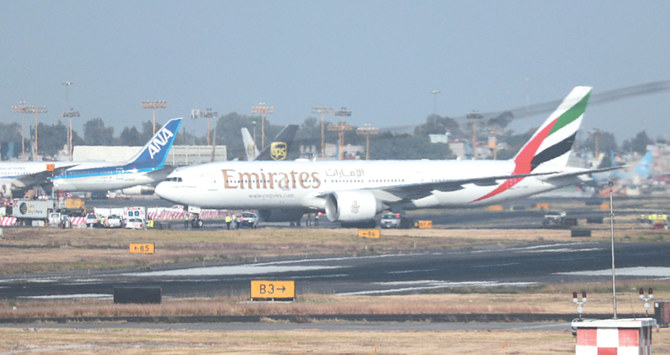
The state-owned airlines have slashed dozens of routes crucial to their Gulf hubs dependent on millions of passengers passing through each year. (Reuters/File)
Short Url
Updated 19 March 2020
Follow

Emirates asks pilots and cabin crew to take unpaid leave

  • The airlines had over 21,000 cabin crew and 4,000 pilots at the end of March 2019

DUBAI, MANILA: Emirates is asking pilots and cabin crew to take unpaid leave and Qatar Airways laid off about 200 staff in Doha this week as the coronavirus outbreak hammers demand for travel.

The state-owned airlines have slashed dozens of routes crucial to their Gulf hubs dependent on millions of passengers passing through each year.

Dubai’s Emirates, one of the world’s biggest international airlines, is offering pilots and cabin crew unpaid leave, according to internal staff emails seen by Reuters.

“You are strongly encouraged to make use of this opportunity to volunteer for additional paid and unpaid leave,” an email to pilots said.

There is limited opportunity for unpaid leave for cabin crew who are being encouraged to take paid leave, another email said.

The airline did not immediately respond to requests for comment.

Tourism and aviation are vital to the economy of Dubai, which does not have the vast oil wealth of some of its Gulf neighbors.

Emirates employed over 21,000 cabin crew and 4,000 pilots among more than 100,000 employees overall at the end of March 2019.

Emirates has told staff the coronavirus epidemic could be the biggest challenge it has faced in many years, frozen recruitment and continues to cut flights as the situation worsens globally.

The UAE on Wednesday said it would bar entry to foreigners apart from diplomats and residents.

Philippine Labor Secretary Silvestre Bello told Reuters on Wednesday that the government was trying to ascertain the “real cause” behind the Qatar Airways’ unexpected decision to lay off about 200 Filipino workers.

Qatar Airways, which employed 46,000 people at the end of March 2019, declined to comment.

The layoffs were reported earlier by ABS-CBN. It said the Filipino employees, including engineers and maintenance staff, were laid off on Tuesday and others had also lost their jobs.

State-owned Qatar Airways had warned it would report its third consecutive loss this financial year, which ends this month, before the outbreak battered global travel demand.

Abu Dhabi’s Etihad Airways, another Gulf carrier, announced more flight cancellations on Wednesday, including to Egypt and India.


‘Get in the queue now, win the game’ — why fusion energy could solve global energy dilemma

Updated 5 sec ago
Follow

‘Get in the queue now, win the game’ — why fusion energy could solve global energy dilemma

DAVOS: Fusion energy is closer to commercial reality than many assume, and countries in the Gulf could be among those best positioned to benefit if they move early, executives at Commonwealth Fusion Systems told Arab News in Davos.
Speaking at the World Economic Forum, Rick Needham, chief commercial officer at CFS, said that the company was on track to demonstrate net energy gain from fusion within the next two years. “We are building a demonstration device right now outside of Boston,” he said.
“That’s expected to turn on in 2027 and hit net energy gain, producing more energy out of the reaction than goes in,” he added.
“If you’ve ever played the video game SimCity, fusion is the last card you play,” Needham said.
“You build coal, oil and gas, and then there’s a fusion power plant. Once you get fusion, the game is essentially won.
“From a fuel perspective, fusion is effectively a limitless energy source, the fuel comes from water, it’s abundant, and it’s available everywhere, which fundamentally changes the energy equation.”
For Middle Eastern economies investing heavily in artificial intelligence, data centres and next-generation infrastructure, Needham argues that fusion represents not just a clean energy source, but a competitive advantage.
“If you want to be a leader in AI, you have to be a leader in energy,” he said. “Power has become the binding constraint.”
And CFS believes commercial fusion is now within reach.
The company is currently building SPARC, the demonstration fusion device outside Boston. It will generate about 100 megawatts of thermal power, paving the way for CFS’s first commercial power plant, ARC, a 400-megawatt net facility planned in Virginia through a partnership with Dominion Energy.
Google has already committed to purchase half of ARC’s output. Construction is expected to begin around 2028, with power coming online in the early 2030s, they explained to Arab News.
Jennifer Ganten, chief global affairs officer at CFS, said that fusion’s shift from theory to execution is what sets this moment apart.
“We use a magnetic confinement approach known as a tokamak, which has been studied and built for decades,” she said. “What hasn’t existed before is a design optimised for commercial power.”
She continued: “For us, this is no longer a physics challenge, it’s an engineering and systems integration challenge, and those are problems we know how to solve.”
That distinction, she said, is why fusion has started appearing more prominently on policy and investment agendas, including in the Middle East.
“Energy demand is rising everywhere, and the push for AI leadership is accelerating that,” Ganten said. “Fusion has begun to feature not just at energy conferences, but at forums like COP in Dubai and here at Davos.”
A critical factor in determining where fusion plants are ultimately built will be regulation and how quickly governments move to put frameworks in place.
“Fusion should not be regulated like nuclear fission,” Ganten said. “There’s no chain reaction, no risk of meltdown, and no long-lived radioactive waste.”
She pointed to the UK and US, which regulate fusion similarly to particle accelerators, as early movers. Germany, Canada and Japan have since followed.
“Getting regulation right makes a country an attractive market for deployment,” she said. “It lowers cost, reduces timelines and signals seriousness.”
Needham said that the difference is material. “Instead of five to ten years and hundreds of millions of dollars for licensing, fusion projects can move in roughly 12 to 18 months,” he said. “That changes everything.”
For Gulf states accustomed to long-term energy planning, both executives stressed that waiting for fusion to be fully proven could mean missing out on early deployment.
“If you wait until fusion is obvious, you’re at the back of the queue,” Needham said.
“The countries that start preparing now, with regulation, grid planning, supply chains, they will be at the front.”
Ganten agreed. “Once fusion is demonstrated at scale, demand will spike very quickly,” she said. “The jurisdictions that created the right conditions early will secure the first plants.”
Beyond decarbonization, fusion offers energy security, a powerful proposition for governments seeking resilience in a volatile geopolitical climate.
“Fusion breaks the link between energy and fragile global fuel supply chains,” Needham said.
For Middle Eastern economies balancing growth, sustainability and technological ambition, fusion may not just be a future option, but a strategic decision about when to get in line.
As Needham puts it, getting fusion can “win you the game.”