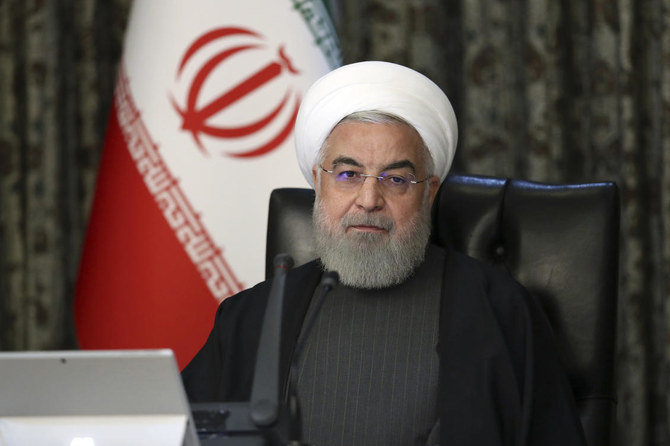
TEHRAN: Iranian President Hassan Rouhani on Wednesday defended his government’s response to the coronavirus outbreak in the face of widespread criticism that officials acted too slowly and may have even covered up initial cases before infections rapidly spread across the country.
Iran has been the hardest hit country in the region, with nearly 1,000 dead and roughly 90 percent of the over 18,000 confirmed cases of the virus in the Middle East. Its leadership announced Tuesday that “millions” could die in the Islamic Republic if people keep traveling and ignore health guidance.
In a speech to his Cabinet, Rouhani said the government was “straightforward” with the nation, saying it announced the outbreak as soon as it learned about it on Feb. 19.
“We spoke to people in an honest way. We had no delay,” he added.
The government has come under heavy criticism for what has been seen as a slow and inadequate response. For weeks, government officials implored clerics to shut down crowded holy shrines to stymie the spread of the virus. The government finally closed the shrines this week.
“It was difficult of course to shut down mosques and holy sites, but we did it. It was a religious duty to do it,” Rouhani said.
The outbreak has cast a shadow over the Persian New Year, Nowruz, a normally joyous holiday that begins on Friday. Health officials have urged the public to avoid travel and crowded places. But many seem to be ignoring the warnings, raising the risk of further outbreaks.
Some food markets in the capital, Tehran, were still packed on Wednesday, and highways were crowded with traffic as families traveled between cities. Iran also announced it would close mosques for communal Friday prayers for a third consecutive week.

Iranian president rejects criticism of coronavirus response
https://arab.news/n6unv
Iranian president rejects criticism of coronavirus response
- Iran has been the hardest hit country in the region, with nearly 1,000 dead
- Iranian leadership said that ‘millions’ could die if people keep traveling and ignore health guidance
Kurds in Turkiye protest over Syria Aleppo offensive
- Several hundred people gathered in Diyarbakir while hundreds more joined a protest in Istanbul
- In the capital, Ankara, DEM lawmakers protested in front of the Turkish parliament
DIYARBAKIR, Turkiye: Protesters rallied for a second day in Turkiye’s main cities on Thursday to demand an end to a deadly Syrian army offensive against Kurdish fighters in Aleppo, an AFP correspondent said.
Several hundred people gathered in Diyarbakir, southeastern Turkiye’s main Kurdish-majority city, while hundreds more joined a protest in Istanbul that was roughly broken up by riot police who arrested around 25 people, the pro-Kurdish DEM party said.
In the capital, Ankara, DEM lawmakers protested in front of the Turkish parliament, denouncing the targeting of Kurds in Aleppo as a crime against humanity.
The protesters demanded an end to the operation by Syrian government forces against the Kurdish-led SDF force in Aleppo, where at least 21 people have been killed in three days of violent clashes.
It was the worst violence in the northwestern city since Syria’s Islamist authorities took power a year ago. The fighting erupted as both sides struggled to implement a March agreement to integrate autonomous Kurdish institutions into the new Syrian state.
In Istanbul, hundreds of protesters waving flags braved heavy rain near Galata Tower to denounce the Aleppo operation under the watchful eye of hundreds of riot police, an AFP correspondent said.
But some of the slogans drew a sharp warning from the police, who moved to roughly break up the gathering and arrested some 25 people, DEM’s Istanbul branch said.
“We condemn in the strongest terms the police attack on the Rojava solidarity action in Sishane. This brutal intervention, oppression, and violence against our young comrades is unacceptable!” the party wrote on X, demanding the immediate release of those arrested.
At the Diyarbakir protest during the afternoon, protesters carried a huge portrait of the jailed PKK militant leader Abdullah Ocalan, an AFP video journalist reported.
“We urge states to act as they did for the Palestinian people, for our Kurdish brothers who are suffering oppression and hardship,” Zeki Alacabey, 64, told AFP in Diyarbakir.
Although Turkiye has embarked on a peace process with the PKK, it remains hostile to the SDF, which controls swathes of northeastern Syria, seeing it as an extension of the banned militant group and a major threat along its southern border.
It has repeatedly demanded that the SDF merge into the main Syrian military. A defense ministry official said on Thursday that Ankara was ready to “support” Syria’s operation against the Kurdish fighters if needed.
Demonstrators had already taken to the streets in several major Turkish cities with Kurdish majorities on Wednesday, including Diyarbakir and Van, according to images broadcast by the DEM.


