France pledges €45 billion for ‘war’ on coronavirus

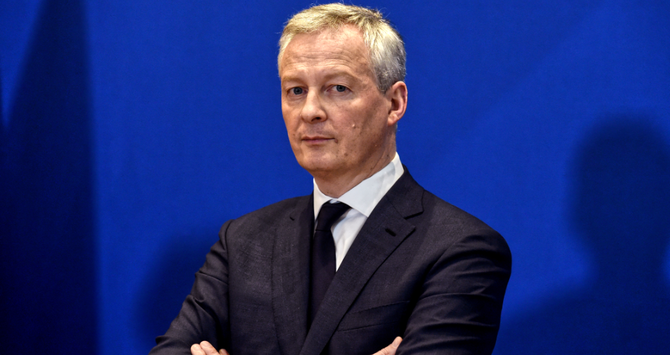
Finance Minister Bruno Le Maire said the coronavirus will require us to mobilize all our forces. (AFP)
Short Url
Updated 18 March 2020
Follow

France pledges €45 billion for ‘war’ on coronavirus

  • The government said France’s national debt will exceed 100 percent of its GDP this year
  • Le Maire said the new aid package will include €32 billion for canceled or deferred taxes and social charges of companies

PARIS: France on Tuesday pledged tens of billions of euros in financial aid and mooted the nationalization of large companies to wage an “economic and financial war” on the coronavirus which has sent most of the country’s workforce into lockdown.

Finance Minister Bruno Le Maire announced a €45 billion ($50 billion) aid package to help businesses and employees cope with the escalating health crisis and brace for a recession.

“This war will require us to mobilize all our forces,” the minister said, and warned the fight “will be lengthy, it will be violent.”

“I will not hesitate to use any means at my disposal to protect large French enterprises,” added Le Maire — citing capital injections, stake purchases, and even “nationalization if necessary.”

The government said France’s national debt will exceed 100 percent of its GDP this year, well above the EU’s guideline of no more than 60 percent.

And its GDP will contract by an estimated 1 percent, a dramatic reversal on pre-virus projections of 1.3 percent growth for 2020.

Budget Minister Gerald Darmanin told daily financial newspaper Les Echos the public deficit will likely grow to 3.9 percent of the GDP. The government had hoped to shrink it to 2.2 percent.

The economic hit of the coronavirus, which saw the government confine most residents to their homes starting Tuesday and closing all nonessential businesses, comes hot on the heels of a damaging public transport strike which lasted weeks and hurt the earnings of small businesses in particular.

Le Maire said the new aid package will include €32 billion for canceled or deferred taxes and social charges of companies plunged into difficulty by the unprecedented health crisis.

“If we put this much money on the table it is to aid (the economy) to restart quickly” once the outbreak recedes, said the minister.

Several companies have already warned of tough times ahead.

Air France said Monday it would slash flight capacity by 70-90 percent over the next two months and expected its financial situation to be “badly impacted.”

Carmakers Renault and PSA Peugeot-Citroen, and tiremaker Michelin have closed factories in France, and Airbus has suspended some production in Europe — now the epicenter of the epidemic that started in China.

For small- and micro-businesses and self-employed entrepreneurs, Le Maire said two billion euros would be set aside in a “solidarity fund” to help those that lose 70 percent of their turnover between March 2019 and March 2020.

France’s markets regulator on Tuesday banned short-selling in 92 stocks for the day in a bid to tame the fierce volatility on financial markets as nervous investors try to assess the virus’ economic toll.

Targeted were stocks that were especially hard hit when a global sell-off saw Wall Street plunge nearly 13 percent on Monday.

Short-selling involves borrowing shares to sell them, effectively betting their price will fall so they can be bought back cheaper, allowing the investor to pocket the difference.

The practice can put immense downward pressure on prices at times when buyer interest is virtually non-existent.

Le Maire said he was prepared to impose a short-selling ban of up to a month if necessary.


Saudi ports brace for cargo surge as shipping lines reroute

Updated 09 March 2026
Follow

Saudi ports brace for cargo surge as shipping lines reroute

RIYADH: Preliminary estimates suggest that several global shipping lines could reroute part of their operations to Saudi Arabia’s Red Sea ports, potentially adding 250,000 containers and 70,000 vehicles per month, according to Rayan Qutub, head of the Logistics Council at the Jeddah Chamber of Commerce, in an interview with Al-Eqtisadiah.

“Any disruption in the Strait of Hormuz not only affects maritime traffic in the Arabian Gulf but could also reshape global trade routes,” Qutub said, highlighting the strait’s status as one of the world’s most critical maritime chokepoints for energy and goods transport.

With rising regional tensions, international shipping companies are reassessing their routes, adjusting shipping lines, or exploring alternative sea lanes. This signals that the current challenges extend beyond the Arabian Gulf, impacting the global supply chain as a whole.

Limited impact on US, European shipments

The effects of these developments will not be uniform across trade routes. Qutub noted that goods from China and India, which rely heavily on routes through the Arabian Gulf, are most vulnerable to disruption. In contrast, shipments from Europe and the US typically traverse western maritime routes via the Suez Canal and the Red Sea, making them less susceptible to regional disturbances.

Saudi Arabia’s strategic location, he emphasized, strengthens the resilience of regional trade. The Kingdom operates an integrated network of Red Sea ports — including Jeddah, Rabigh, Yanbu, and Neom — that have benefited from substantial infrastructure upgrades and technological enhancements in recent years, boosting their capacity to absorb increased cargo volumes.

Red Sea bookings

Several major carriers, including MSC, CMA CGM, and Maersk, have already opened bookings to Saudi Red Sea ports, signaling a shift in operational focus to these strategically positioned hubs.

However, Qutub warned that rerouted shipments could increase sailing times. Cargo from Asia, which normally takes 30-45 days, might now require longer voyages via the Cape of Good Hope and the Mediterranean, potentially extending transit to 60-75 days in some cases.

These changes are also reflected in rising shipping costs, driven by longer routes, higher fuel consumption, and increased insurance premiums — a typical response when global trade patterns shift due to geopolitical pressures.

Qutub emphasized that Saudi Arabia’s transport and logistics sector is managing these developments through coordinated government oversight. The Ministry of Transport and Logistics, the Logistics National Committee, and the Logistics Partnership Council recently convened to evaluate the impact on trade and supply chains. Regular weekly meetings have been established to monitor developments and implement solutions to safeguard the stability of supplies and continuity of trade.

He noted that the Kingdom’s logistical readiness is the result of long-term strategic investments, encompassing ports, airports, road networks, rail systems, and logistics zones. Today, Saudi logistics integrates maritime, land, rail, and air transport, enabling a resilient response to global disruptions.

Qutub also highlighted the need for the private sector to continuously review logistics and crisis management strategies, develop alternative plans, and manage strategic stockpiles. Such measures are essential to mitigate temporary fluctuations in global trade and ensure smooth supply chain operations.