

Punjab chief minister denies report of first coronavirus death in Pakistan

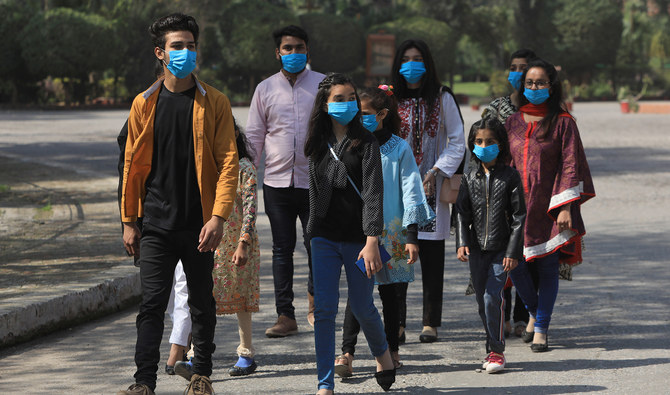
Volunteers wear masks as a preventive measure against the coronavirus, as they walk during an awareness compaign by a NGO at the premises of the St John Cathedral in Peshawar, Pakistan March 15, 2020. REUTERS/Fayaz Aziz
Short Url
Updated 15 October 2020
Follow

Punjab chief minister denies report of first coronavirus death in Pakistan

  • The death was announced on National Health Ministry's web portal on Tuesday
  • Medical report for 30-year-old man came negative for COVID-19 hours after his death from hepatic failure

ISLAMABAD: Punjab Chief Minister Usman Buzdar on Tuesday denied reports that a 30-year-old resident of the province, who recently returned to Pakistan from Oman, had lost his life in a hospital due to coronavirus infection.
“We have received test reports of Imran Ali, who lost his life in Mayo Hospital, and his cause of death was not #COVID19,” he wrote in a Twitter post. “So far Punjab has 8 confirmed cases and are being provided best available treatment. I urge everyone that these are testing times & we should act responsibly!“

Earlier in the day, Pakistan’s National Health Ministry claimed the first death inside the country resulting from coronavirus infection.
The National Command and Control Center for Coronavirus confirmed that 30-year-old Ghulam Imran — a resident of Chowki Sukheki area of Mandi Bahauddin, Punjab — had returned from Muscat, Oman on March 15.
He was brought to the District Headquarters Hospital Hafizabad, a district in Punjab, in a critical condition with altered sensorium, shortness of breath and 100 degree fever where he later died of hepatic failure while his test reports were still awaited, the authority said.
Punjab health minister Yasmin Rashid said during a press conference in Lahore shortly after the incident that the patient’s medical report from a test conducted in Oman “did not rule out the possibility of coronavirus.” She said the patient was quarantined upon return and the family was also tested which did not show any signs of the infection.
Novel coronavirus continues to spread in Pakistan as the number of confirmed virus cases reached 193 on Tuesday.
On March 13, Prime Minister Imran Khan chaired the country’s first National Security Committee (NSC) meeting summoned on health emergency and announced unified measures to curb the virus spread.
The country closed its western borders with Iran and Afghanistan, banned public gathering, and ordered cinemas and wedding halls for two weeks. All educational institutions in the country had also been closed until April. Pakistan also limited international flight operations to three airports — Islamabad, Lahore and Karachi.
Meanwhile, Tania Aidrus, head of the prime minister’s ‘Digital Pakistan’ initiative, said that government launched a “chatbot” to address public concerns and give information regarding the ongoing coronavirus outbreak.
“Our team wanted to build an effective way to get information out to Pakistanis. We’ve launched a chatbot to address common concerns on #Coronavirus. You can find labs near you and even do a quick test to assess your risk of #Coronavirus. Please try it out!” Aidrus said in a Twitter post.
“We’re using data analytics techniques and cutting edge technology to get ahead of the #Coronavirus. We’re trying to modernize and streamline data collection from the frontlines,” she added.


Pakistan stocks recover as oil supply fears ease after Islamabad seeks Red Sea route— analyst

Updated 05 March 2026
Follow

Pakistan stocks recover as oil supply fears ease after Islamabad seeks Red Sea route— analyst

  • Pakistan has sought Saudi help to secure oil supplies via Red Sea port after Iran’s closure of Strait if Hormuz
  • Analyst says higher crude oil prices, expectations of IMF releasing next loan tranche also triggered bullish activity

ISLAMABAD: Pakistani stocks marked a sharp recovery when trading closed on Thursday, as institutional activity increased following Islamabad’s move to seek crude oil supplies through the Red Sea port eased oil supply fears, a financial analyst said. 

Pakistani stocks have recorded a sharp decline this week, with the benchmark KSE-100 index recording its largest-ever single-day decline on Monday when it plunged 16,089 points. Escalating conflict in the Middle East triggered panic selling at the Pakistani bourse, forcing a temporary trading halt on Monday. 

The KSE-100 index, however, gained 3.49 percent or 5,433.46 points to close at 161,210.67 when trading ended on Thursday, up from the previous close of 155,777.21 points, according to Pakistan Stock Exchange’s (PSX) data.

Pakistan’s Petroleum Minister Ali Pervaiz Malik met Saudi Ambassador Nawaf bin Said Al-Malki on Wednesday to discuss Iran’s closure of the key Strait of Hormuz, which has threatened Pakistan’s energy supply. Roughly 20 percent of the global oil and gas supply passes through the route. Saudi Arabia indicated it could facilitate shipments through the Red Sea port of Yanbu, offering an alternative route if Gulf shipping lanes remain disrupted, the petroleum ministry said on Wednesday. 

“Stocks staged a sharp recovery at PSX amid institutional activity on easing fuel supply fears after KSA [Kingdom of Saudi Arabia] commits oil supplies through the Red Sea port,” Ahsan Mehanti, chief executive officer at Arif Habib Commodities, told Arab News.

He said higher global crude oil prices and expectations of the International Monetary Fund releasing its next tranche of the $7 billion loan for Pakistan also helped bullish activity at the PSX.

An IMF mission was in Pakistan to hold talks on the third review of a $7 billion Extended Fund Facility multi-year program, and for the second review of the $1.4 billion Resilience and Sustainability Facility this week.

However, the delegation left for Türkiye amid tensions in the Gulf. Pakistani officials have said talks are likely to continue virtually in the coming days. 

Pakistani brokerage Topline Securities said in its daily market review report that strong institutional buying “turned the tide” on Thursday after the market’s recent overreaction to regional issues.

The report added that Hub Power Company (HUBC), Oil & Gas Development Company (OGDC), Fauji Fertilizer Company (FFC), Engro Corporation (ENGROH), and Meezan Bank Limited (MEBL) collectively contributed 2,197 points to the KSE benchmark’s gain.

Topline Securities said 723 million shares were traded on Thursday, with K-Electric Limited (KEL) stealing the spotlight as more than 1.17 billion shares changed hands.

Pakistani investors are closely monitoring developments in the Gulf, particularly around energy routes and further retaliatory actions, as the conflict’s trajectory remains uncertain.