

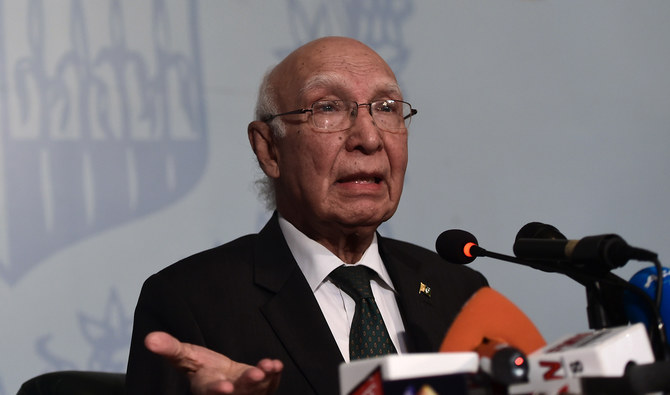

ISLAMABAD: Sartaj Aziz, who served as foreign policy chief to former Prime Minister Nawaz Sharif’s administration, on Monday rejected claims by two former diplomats that the premier had barred them from speaking against India during his term in office.
In an interview on YouTube on Sunday, Tasneem Aslam, who served as foreign office spokesperson during Sharif’s tenure, said the ex-PM had advised the foreign office against making comments that could be seen as critical of India.
“It is totally out of context, there were no such instructions to foreign office about not to criticize India,” Aziz, Sharif’s de facto foreign policy chief, told Arab News over the phone. “As the in-charge of foreign ministry, I have given many statements which were very critical of Indian actions.”
“During our tenure we were engaged through dialogue with India on Kashmir,” Aziz said. “Our policy on Kashmir was more active than the current government's, which is doing nothing except issuing statements while we were indulged in practical efforts with India.”
Kashmir has been disputed by the two nuclear-armed neighbors since they both received independence in 1947. The two countries fought two of their three wars over the region.
Tensions between the two countries have flared and there has been intermittent cross-border firing since August last year, when New Delhi flooded Indian-administered Kashmir with troops to quell unrest after it revoked the region’s special autonomous status. Pakistan has since suspended diplomatic ties with India.
In 2015, Indian Prime Minister Narendra Modi made a surprise stopover in Pakistan to meet his counterpart, the first time an Indian premier had visited the rival nation in over a decade.
The visit, requested by Modi just hours earlier before he flew back home from Afghanistan, raised hopes that stop-and-start negotiations between the nuclear-armed neighbors might finally make progress. The trip also cemented impressions that Sharif had a “soft spot” for the arch-rival.
But in 2016, Sharif addressed the United Nations General Assembly and accused India of putting unacceptable conditions on dialogue, saying the world would ignore rising tension in South Asia at its peril.
Sharif also said Pakistan could not ignore India’s “unprecedented” arms build-up and would “take whatever measures are necessary to maintain credible deterrence”.
On Monday, another former diplomat who served as Pakistan’s high commissioner to India, Abdul Basit, told Arab News Sharif had advised him not to be critical of India.
“As I was high commissioner to India during former premier Nawaz Sharif’s tenure, he always wanted from us not to be very critical of India,” he said. “I had several one-on-one meetings with him (Sharif) and he called me many times; his instructions and discussions mainly revolved around how to improve relations with India.”
“He was of the view that the establishment is not on his side to improve relations with India but he wanted to have good relations which created a lot of confusion in our dealings with India,” Basit said.
Pakistan’s foreign office spokeswoman Aisha Farooqui declined comment on the statements by Aslam and Basit.
Another senior leader of Sharif’s party, Khawaja Muhammad Asif, who also served as foreign minister during Sharif’s term, called the diplomats’ claims “propaganda.”
“As foreign minister and defense minister, my hardline approach towards India is on the record. No one stopped me or gave any instructions to change my approach,” Asif said in a tweet on Monday.


