

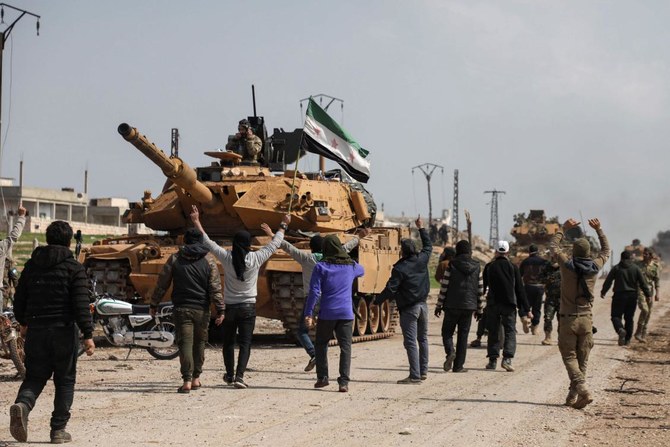
Civilian protests hamper new joint patrols in Idlib

Protesters surround a Turkish military M60T tank as they attempt to block traffic on the M4 highway, which links the northern Syrian provinces of Aleppo and Latakia. (AFP file photo)
Short Url
Updated 17 March 2020
Follow

Civilian protests hamper new joint patrols in Idlib

  • Turkish self-interest in northwest Syria will lead to crackdown on militants it once supported, analysts tell Arab News

ANKARA: Turkish and Russian troops who began joint patrols on Sunday on the key east-west M4 highway in northwest Syria faced protests and roadblocks set up by local residents.

Militant fighters in Idlib also launched attacks despite a cease-fire agreement between Turkey and Russia signed in Moscow on March 5, and the planned route for the patrols had to be shortened.

The M4 runs from the Mediterranean through northern Syria to the Iraqi border, and has been partially closed for the past eight years. Some parts of it remain under opposition control.

“These patrols are meant to be politically symbolic, demonstrating both countries’ ability to cut through rebel-controlled Idlib and secure the highway,” Dareen Khalifa, a senior Syria analyst at the International Crisis Group, told Arab News.

But she said the blocking of the patrols by local residents suggests that the cease-fire deal is unpopular among opposition groups, who fear that Turkey will hand areas south of the M4 to Russia.

Prof. Michael Tanchum, senior fellow at the Austrian Institute for European and Security Policy, said Ankara had to cooperate with Moscow to preserve Turkey’s larger interests in Syria. “Ankara won’t tolerate these opposition groups derailing its renewed cooperation with Moscow,” he said.

“Turkey’s priority is to secure Russia’s consent to Turkey asserting its influence in Kobani and other Kurdish-dominated regions in northern Syria. As part of this objective, Turkish construction projects in the region are essential.”


Algeria inaugurates strategic railway to giant Sahara mine

President Tebboune attended an inauguration ceremony in Bechar. (AFP file photo)
Updated 4 sec ago
Follow

Algeria inaugurates strategic railway to giant Sahara mine

  • The mine is expected to produce 4 million tons per year during the initial phase, with production projected to triple to 12 million tons per year by 2030, according to estimates by the state-owned Feraal Group, which manages the site
  • The project is financed by the Algerian state and partly built by a Chinese consortium

ALGEIRS: Algerian President Abdelmadjid Tebboune on Sunday inaugurated a nearly 1,000-kilometer (621-mile) desert railway to transport iron ore from a giant mine, a project he called one of the biggest in the country’s history.
The line will bring iron ore from the Gara Djebilet deposit in the south to the city of Bechar located 950 kilometers north, to be taken to a steel production plant near Oran further north.
The project is financed by the Algerian state and partly built by a Chinese consortium.
During the inauguration, Tebboune described it as “one of the largest strategic projects in the history of independent Algeria.”
This project aims to increase Algeria’s iron ore extraction capacity, as the country aspires to become one of Africa’s leading steel producers.
The iron ore deposit is also seen as a key driver of Algeria’s economic diversification as it seeks to reduce its reliance on hydrocarbons, according to experts.
President Tebboune attended an inauguration ceremony in Bechar, welcoming the first passenger train from Tindouf in southern Algeria and sending toward the north a first charge of iron ore, according to footage broadcast on national television.
The mine is expected to produce 4 million tons per year during the initial phase, with production projected to triple to 12 million tons per year by 2030, according to estimates by the state-owned Feraal Group, which manages the site.
It is then expected to reach 50 million tons per year in the long term, it said.
The start of operations at the mine will allow Algeria to drastically reduce its iron ore imports and save $1.2 billion per year, according to Algerian media.