Yemen government halts flights, closes schools

1 / 2
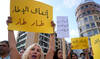
Houthi deputy minister for Development and Economic Affairs Hussein Makbouli holds a press conference to address the coronavirus outbreak (COVID-19), in Sanaa on March 14, 2020. (AFP)
2 / 2
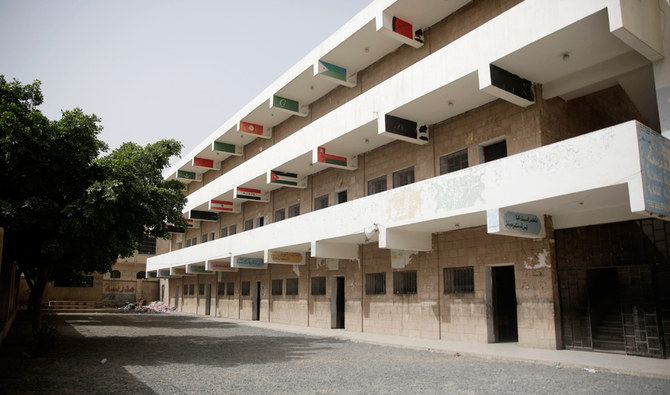
A closed school is seen in Sanaa, Yemen, Sunday, March 15, 2020. (AP)
Short Url
Updated 16 March 2020
Follow

Yemen government halts flights, closes schools

  • On the streets, life has been largely uninterrupted by the government’s precautionary measures as large gatherings are still taking place across the country

AL-MUKALLA: Yemen’s internationally recognized government has canceled flights to and from the country’s airports for two weeks, and ordered the closure of schools for one week, to prevent the spread of coronavirus.
These decisions were made by the Yemeni Cabinet during a meeting in Riyadh on Saturday. Humanitarian flights are exempt from the ban.
Until last week, the country’s national carrier Yemenia flew weekly to Jeddah, Cairo, Amman and Mumbai.
Yemen’s Health Minister Nasir Baoum said health facilities across the war-torn country have not recorded any coronavirus cases, and all arrivals through air, land and seaports are subject to checks.
In Aden, health officials approved a plan to set up a quarantine for coronavirus patients at Al-Amel hospital after residents protested against establishing a quarantine at Al-Sadaka hospital for fear of an outbreak in densely populated areas of the port city.
In Hadramout, health officials said emergency teams in the province have not recorded any unusual deaths of patients at local intensive care units.
“Until now, there aren’t even suspected cases of coronavirus,” Dr. Riyadh Al-Jariri, head of the Health Ministry office in Hadramout, told Arab News on Sunday. “Why would we hide information about new cases?”
The absence of coronavirus cases in Yemen “is expected given that the country has been on lockdown since the beginning of the war,” he said, denying rumors that some cases have been detected in Hadramout.

BACKGROUND

Measures come amid public skepticism that country is free of coronavirus.

In Houthi-controlled provinces, where most of the country’s population lives, the Iran-backed militia halted UN flights from and into Sanaa and closed schools.
But in the streets of Al-Mukalla, Hadramout’s capital, people expressed skepticism about official reports that the country is free of coronavirus.
“I don’t trust them,” English teacher Abdullah Saleh told Arab News. “It’s impossible that they haven’t been able to record a suspected case. We’ve never seen them testing large gatherings inside cities.”
On the streets, life has been largely uninterrupted by the government’s precautionary measures as large gatherings are still taking place across the country.
On Saturday night, hundreds of football fans roamed the streets of Al-Mukalla honking cars, playing music and setting off fireworks following a local football tournament. Mosques, malls and shops are bustling with people.
“I can’t stop working. I’ll be burdened with debts if I stay at home,” said Abdullah, a middle-aged fish seller.
“The virus will face the fate of other diseases that die before spreading in Yemen. God will protect us.”


Trump warns US to end support for Iraq if Al-Maliki returns

Updated 8 sec ago
Follow

Trump warns US to end support for Iraq if Al-Maliki returns

WASHINGTON: President Donald Trump on Tuesday threatened to end all US support for Iraq if Nouri Al-Maliki, a former prime minister with ties to Iran, returns to the post.
Trump, in his latest blatant intervention in another country’s politics, said that Iraq would make a “very bad choice” with Maliki, who has been nominated as prime minister by the largest Shiite bloc.
“Last time Al-Maliki was in power, the Country descended into poverty and total chaos. That should not be allowed to happen again,” Trump wrote on his Truth Social platform.
“Because of his insane policies and ideologies, if elected, the United States of America will no longer help Iraq,” he said.
“If we are not there to help, Iraq has ZERO chance of Success, Prosperity, or Freedom. MAKE IRAQ GREAT AGAIN!” he wrote, adopting his slogan at home.
Maliki left power in 2014 following pressure from the United States, which blamed his nakedly sectarian Shiite agenda for giving rise to the Daesh group of ultra-violent Sunni extremists.
The United States wields key leverage over Iraq as its oil export revenue is largely held at the Federal Reserve Bank in New York, in an arrangement reached after the 2003 US invasion that toppled Saddam Hussein.
Oil sales account for around 90 percent of Iraqi government revenues.
Trump’s statement came days after Secretary of State Marco Rubio voiced similar concerns in a telephone call with the incumbent prime minister, Mohammed Shia Al-Sudani. The United States had also sent a letter to Iraqi politicians saying that Washington views Al-Maliki negatively, political sources said.

Delay in parliament

By convention, a Shiite Muslim has been prime minister since the fall of Saddam, who ruthlessly repressed the Shiite majority in Iraq.
On Saturday, the Coordination Framework, an alliance of Shiite parties with varying ties to Iran that holds a parliamentary majority, endorsed Maliki.
Normally he would then be nominated by the president, who holds a largely ceremonial role.
Iraq’s parliament was set to elect a president on Tuesday but the vote was abruptly delayed.
The presidency traditionally goes to a Kurd, and the official INA press agency said that the two main Kurdish parties had requested more time to come to a consensus on a candidate.
Before Trump’s open call to dump Maliki, an Iraqi political source said that the Coordination Framework was set on moving forward with the nomination, believing that Al-Maliki could eventually allay Washington’s concerns.
A pro-Iranian government in Iraq would be a rare boon for Tehran’s Shiite clerical state after it suffered major setbacks at home and in the region.
The Islamic republic has killed thousands of Iranians since mass protests erupted in late December in one of the largest threats to the clerics’ rule since the 1979 Islamic revolution.
Since suffering the October 7, 2023 attacks, Israel has hit Iran both with strikes inside the country and heavy blows against Tehran’s Lebanese ally Hezbollah, while Iran lost its main Arab ally with the fall of Bashar Assad in Syria.
The United States has enjoyed smooth relations with Sudani, who has worked quietly to prevent violence by Iraqi Shiite armed groups tied to Iran.
Sudani has also cooperated with the United States to bring into Iraq a caravan of Islamic State prisoners from Syria, where the army recently moved on Kurdish fighters who had run the detention camps.
Even during Sudani’s term, Al-Maliki annoyed the then US administration of Joe Biden by helping push through a harsh anti-LGBTQ law.
The United States has long intervened in other countries, but Trump has broken precedent by meddling openly.
Trump has backed fellow right-wing candidates in elections in Poland, Romania and Honduras, where the Trump-backed winner was inaugurated Tuesday.
Trump earlier this month ordered a deadly military operation into Venezuela that removed leftist president Nicolas Maduro, a longtime US nemesis.