

Saudi desert offers respite from virus lockdown

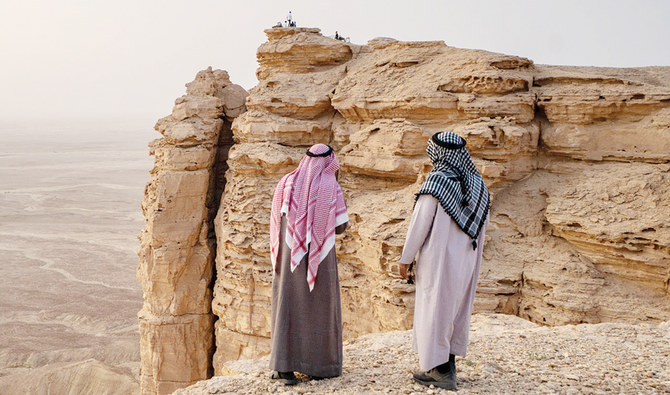
The site offers stunning views of the valley below, a lush grove of acacia trees teeming with wildlife. (Shutterstock)
Short Url
Updated 18 March 2020
Follow

Saudi desert offers respite from virus lockdown

  • Corona is negative, but the positive is that this place is full of people, says rescue volunteer of the Edge of the World

JABAL FIHRAYN: As Saudi Arabia suspended international flights and shuttered entertainment venues this weekend over coronavirus fears, locals and residents once again turned to wide-open desert spaces for recreation, including the breathtaking “Edge of the World.”

There has been a surge of interest in getaways to the rugged desert just outside the capital Riyadh, guides say.
Those seeking isolation away from home can make the two-hour drive northwest from the capital Riyadh to the Edge of the World site, where 300-meter-high cliffs offer expansive desert vistas.
Described as a “window framed by rock,” the site offers stunning views of the valley below, a lush grove of acacia trees teeming with wildlife and vegetation.
“I came to enjoy trail hiking because many places are closed: Cinemas, public spaces and we cannot travel,” Khalid Al-Harbi, a Saudi from the Eastern Province, told Reuters.
Sarah, a Briton living in Riyadh, said the metropolis had gone quiet nowadays. “But here is an incredible place to come, lots of fresh air, you’re outside. There are lots of people here but there’s such a lot of space,” she said.

HIGHLIGHT

Those seeking isolation away from home can make the two-hour drive northwest from the capital Riyadh to the Edge of the World site, where 300-meter-high cliffs offer expansive desert vistas.

Saudi Arabia has reported 118 coronavirus cases but no deaths. It suspended the Umrah pilgrimage and locked down its eastern Qatif region where many infections are located.
The authorities have shuttered sports, entertainment and wedding halls, asked people to avoid shaking hands, and urged the population of 30 million to limit their movements.
Buses and 4x4s transport families and young people to the desert site for a day of trekking and a campfire barbecue with music, dancing and waterpipes. The cliffs, officially known as Jabal Fihrayn, overlook ancient caravan trade routes.
The cliffs in the areas were formed as a result of the tectonic movement of the Arabian plate toward the northeast because of the spread of the Red Sea rift situated 1,000 km to the west of Tuwaiq.
“Corona is negative, but the positive is that this place is full of people,” said Abdulrahman Edres, who knows the area well as a rescue volunteer.


Swedish king awards American Saudi scientist, Omar Yaghi, Nobel Prize in Chemistry 2025

Nobel Prize in Chemistry 2025 laureate US-Saudi chemist Omar M. Yaghi poses with award during the award ceremony in Stockholm.
Updated 10 December 2025
Follow

Swedish king awards American Saudi scientist, Omar Yaghi, Nobel Prize in Chemistry 2025

  • Yaghi will share $1.2m prize with British Australian and Japanese scientists Richard Robson and Susumu Kitagawa
  • He is the 1st Saudi national to be awarded the Nobel Prize and 2nd Arab-born to win in the chemistry category since 1999

STOCKHOLM: King Carl XVI Gustaf of Sweden on Wednesday awarded American Saudi scientist Omar Yaghi the Nobel Prize in Chemistry for his breakthrough development of metal-organic frameworks, a sponge-like structure that could store CO2 or harvest water from the air, alongside the British Australian and Japanese scientists Richard Robson and Susumu Kitagawa.

Yaghi, Robson and Kitagawa have each contributed over the past 50 years to developing scalable, reliable MOF models that can be deployed in industry to address climate-related issues and deliver clean air and water. They will share the $1.2 million prize.

Yaghi, 60, who grew up in a refugee camp in Jordan to a Palestinian family expelled from their property by Zionist militias in 1948, is the second Arab-born laureate to be awarded the Nobel Prize in Chemistry by the Royal Swedish Academy of Sciences.

The Nobel Foundation said that MOFs, which are structures with large internal spaces, “can be used to harvest water from desert air, capture carbon dioxide, store toxic gases or catalyze chemical reactions.”

In 2015, Yaghi received the King Faisal International Prize for Chemistry, and in 2021, King Salman granted him Saudi citizenship for his scientific achievements. He holds the James and Neeltje Tretter Chair in Chemistry at UC Berkeley and is the founding director of the Berkeley Global Science Institute. In addition, Yaghi has branched into entrepreneurial activity since 2018, founding Atoco, which works on water harvesting and carbon capture, and co-founding H2MOF for hydrogen storage and WaHa Inc. for water harvesting with projects in the Middle East.

His focus on harvesting water from the air in arid conditions stems from his upbringing in Jordan, where water reached homes every 14 days. He began field tests in the Arizona desert in the 1990s to capture water from the air using the MOF-303 model he had developed.

Yaghi is the first Saudi national to be awarded the Nobel Prize and the second Arab-born to win in the chemistry category since the Egyptian American chemist and scientist Ahmed Zewail was honored in 1999.

Zewail’s model of the “femtochemistry apparatus” is on display at the Nobel Prize Museum. He used the apparatus to demonstrate the principle behind his method of studying chemical reactions using laser technology, capturing it in a femtosecond, which is to a second what a second is to 32 million years.

He is one of dozens of laureates who donated objects to the museum since its foundation in 2001 to mark the 100th anniversary of the Nobel Prize, which began in 1901, five years after the death of the Swedish chemist Alfred Nobel. Since 2001, it has become tradition that each December the winners of that year bring an item to be displayed that reflects their work, personal life or inspiration, Karl Johan, a curator at the museum, told Arab News.

“Zewail wanted to donate an object that could visualize his work and his experiment. He constructed (the interactive apparatus) specifically for the museum. As one of the first objects to be displayed after 2001, it got lots of attention,” Johan said.

The award ceremony in the Swedish capital is the latest event to wrap up Nobel Week, which, since Friday, has featured Nobel laureates in the fields of literature, chemistry, physics, medicine and economic sciences engaging in public events. The Nobel Peace Prize was awarded in the Norwegian capital of Oslo on Wednesday, where the daughter of the Venezuelan opposition leader, Maria Corina Machado, accepted it in her mother’s name after authorities prevented her from leaving early to attend the ceremony.