Italians sing out from balconies during coronavirus lockdown

1 / 7
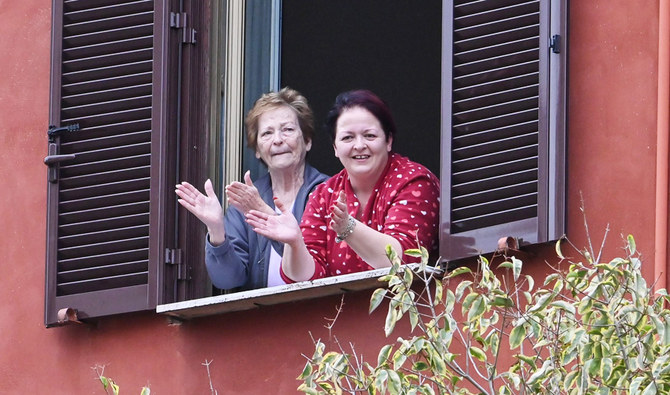
People wave and clap their hands, during a flash mob "Un applauso per l'Italia" (An applause for Italy) at the Garbatella district in Rome on March 14, 2020. (AFP)
2 / 7
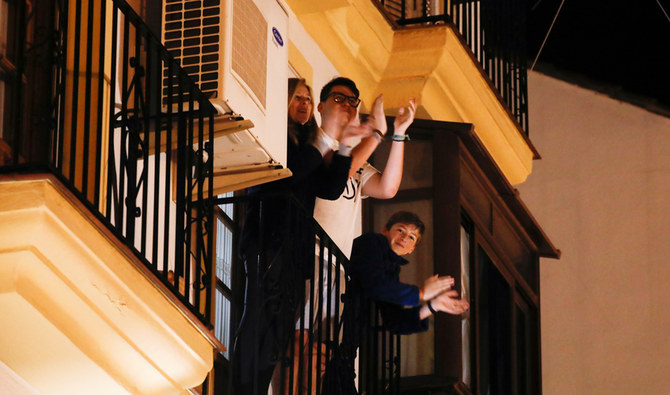
A family applaud from their balcony during a call on social media to thank Spanish medical staff fighting against coronavirus as they remain confined inside their homes due to the coronavirus outbreak, in downtown Ronda, southern Spain March 14, 2020. (REUTERS)
3 / 7
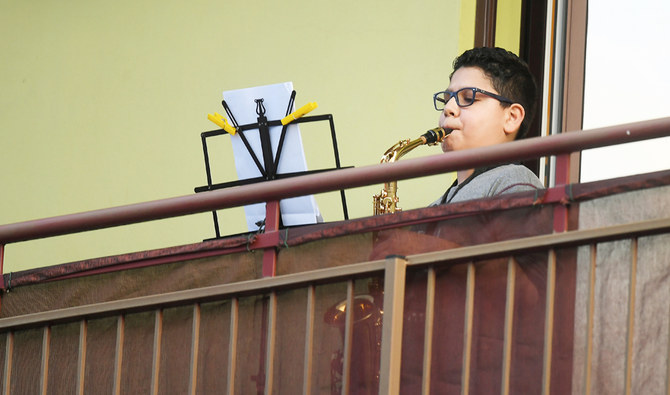
A boy plays the saxophone from a balcony during a flash mob to raise morale as Italian government continues restrictive movement measures to combat the coronavirus outbreak, in Milan, Italy March 14, 2020. (REUTERS)
4 / 7
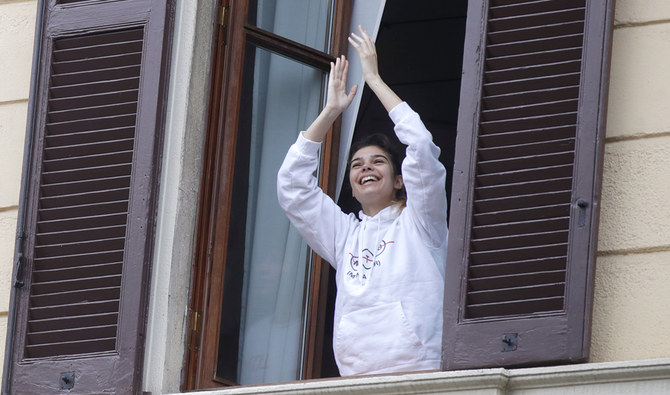
A girl applauds from her balcony, in Milan, Italy, Saturday, March 14, 2020. (AP)
5 / 7
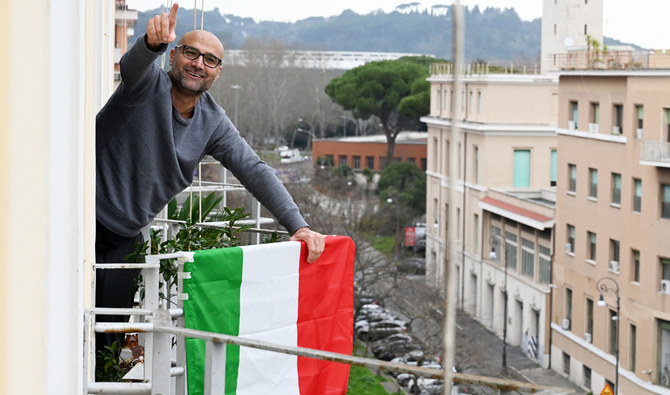
A man waves from his balcony as part of a flash mob "Un applauso per l'Italia" (An applause for Italy) at the Garbatella district in Rome on March 14, 2020, during the COVID-19 outbreak caused by the novel coronavirus. (AFP)
6 / 7
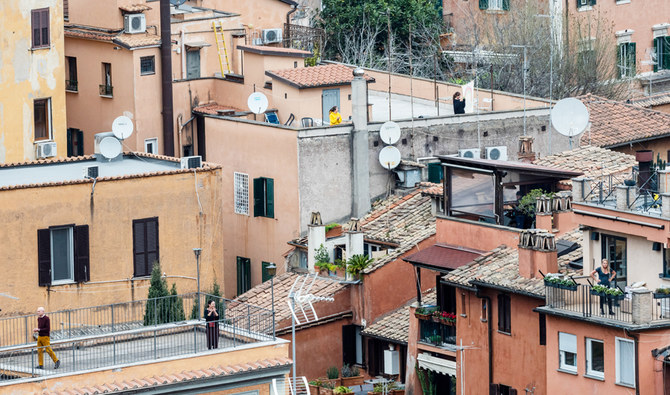
People clap their hands in appreciation for the efforts of Italian doctors and paramedics as they stand on their roof in Rome, Saturday, March 14, 2020. (AP)
7 / 7
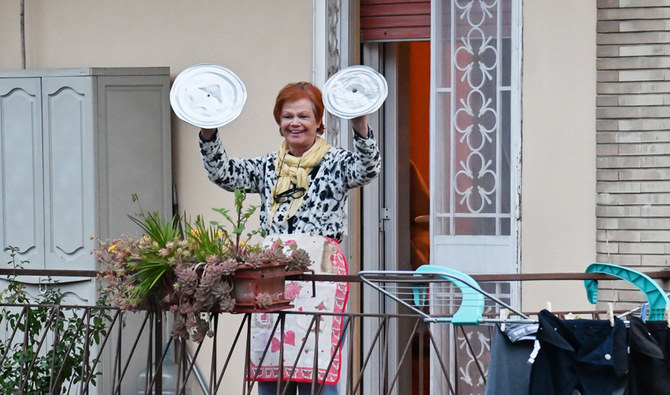
A residents uses pot lids to play cymbals as she takes part in a music flash mob called "Look out from the window, Rome mine !" (Affacciati alla Finestra, Roma Mia !) aimed at liven up the city's silence during the new coronavirus lockdown, from her balcony in Rome on March 13, 2020. (AFP)
Short Url
Updated 15 March 2020
Follow

Italians sing out from balconies during coronavirus lockdown

  • Many people across the country went onto their balconies to offer a round of applause to the doctors and nurses working on the frontlines of the crisis

MILAN: Italians blocked in their homes by the coronavirus outbreak joined together to sing patriotic songs from their balconies, a defiant response to a crisis that has pushed the country’s health system to the limit and turned daily life on its head.
From Milan, near the northern epicenter of the crisis, to the capital Rome and Naples and Palermo in the south, social media showed people on their balconies or leaning from windows and singing the national anthem or popular songs over the past couple of days.
On Saturday at noon, many people across the country went onto their balconies to offer a round of applause to the doctors and nurses working on the frontlines of the crisis.
With the coronavirus pandemic spreading rapidly across the world, Italy is the worst affected country in Europe, with at least 17,660 cases and 1,266 deaths by Friday.
Italy’s hardest hit area remains the prosperous northern region of Lombardy around the financial capital Milan, but the virus has spread across the country.
The government has imposed an unprecedented lockdown, closing schools and most shops, barring all but essential movement and telling people to remain in their homes.
On social media, celebrities have urged people to stay at home and to wash their hands regularly.
Ordinary Italians have posted a flood of images showing life under lockdown, as well as jokes about the crisis and the difficulty of maintaining domestic harmony.
The government and leading public figures have also sought to reassure the public. Hashtags with encouraging messages like #allwillbewell have proliferated as authorities and individuals have tried to maintain a sense of optimism amid the shutdown. 


Cambodia takes back looted historic artifacts handled by British art dealer

Updated 28 February 2026
Follow

Cambodia takes back looted historic artifacts handled by British art dealer

  • The objects were returned under a 2020 agreement between the Ministry of Culture and Fine Arts and the family of the late Douglas Latchford, a British art collector and dealer who allegedly had the items smuggled out of Cambodia

PHNOM PENH, Cambodia: Cambodian officials on Friday received more than six dozen historic artifacts described as part of the country’s cultural heritage that had been looted during decades of war and instability.
At a ceremony attended by Deputy Prime Minister Hun Many, the 74 items were unveiled at the National Museum in Phnom Penh after their repatriation from the United Kingdom.
The objects were returned under a 2020 agreement between the Ministry of Culture and Fine Arts and the family of the late Douglas Latchford, a British art collector and dealer who allegedly had the items smuggled out of Cambodia.
“This substantial restitution represents one of the most important returns of Khmer cultural heritage in recent years, following major repatriations in 2021 and 2023 from the same collection,” the Culture Ministry said in a statement. “It marks a significant step forward in Cambodia’s continued efforts to recover, preserve, and restore its ancestral legacy for future generations.”
The artifacts were described as dating from the pre-Angkorian period through the height of the Angkor Empire, including “monumental sandstone sculptures, refined bronze works, and significant ritual objects.” The Angkor Empire, which extended from the ninth to the 15th century, is best known for the Angkor Wat archaeological site, the nation’s biggest tourist attraction.
Latchford was a prominent antiquities dealer who allegedly orchestrated an operation to sell looted Cambodian sculptures on the international market.
From 1970 to the 1980s, during Cambodia’s civil wars and the communist Khmer Rouge ‘s brutal reign, organized looting networks sent artifacts to Latchford, who then sold them to Western collectors, dealers, and institutions. These pieces were often physically damaged, having been pried off temple walls or other structures by the looters.
Latchford was indicted in a New York federal court in 2019 on charges including wire fraud and conspiracy. He died in 2020, aged 88, before he could be extradited to face charges.
Cambodia, like neighboring Thailand, has benefited from a trend in recent decades involving the repatriation of art and archaeological treasures. These include ancient Asian artworks as well as pieces lost or stolen during turmoil in places such as Syria, Iraq and Nazi-occupied Europe. New York’s Metropolitan Museum of Art is one of the prominent institutions that has been returning illegally smuggled art, including to Cambodia.
“The ancient artifacts created and preserved by our ancestors are now being returned to Cambodia, bringing warmth and joy, following the country’s return to peace,” said Hun Many, who is the younger brother of Prime Minister Hun Manet.