

Pope holds his first ever virtual general audience with Italy on lockdown

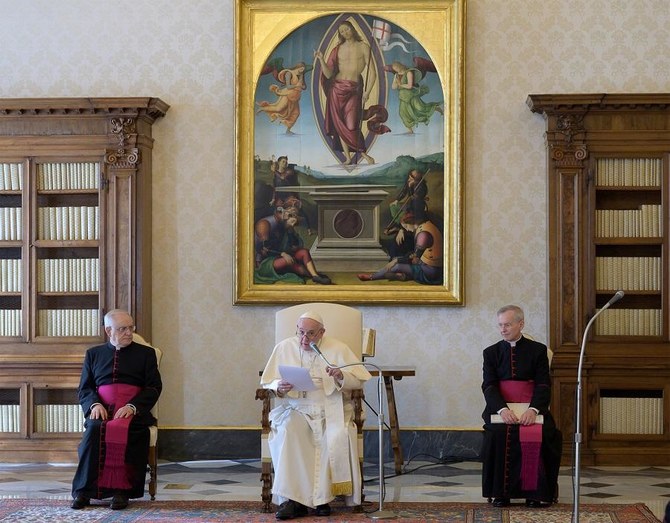
This photo taken and handout on March 11, 2020 by the Vatican Media shows Pope Francis (C), flanked by Monsignor Leonardo Sapienza (L) and Monsignor Luis Maria Rodrigo Ewart, holding a private and restricted weekly general audience in the library of the Apostolic Palace in the Vatican, as part of precautionary measures against the spread of the new COVID-19 coronavirus. (File/AFP)
Short Url
Updated 11 March 2020
Follow

Pope holds his first ever virtual general audience with Italy on lockdown

  • Most of Francis’ general audiences are held in St. Peter’s Square and attract tens of thousands of people
  • Italy is the worst-affected country in the world after China

VATICAN CITY: Pope Francis, holed up in the Vatican by Italy’s coronavirus epidemic, held his first virtual general audience on Wednesday, thanking medical staff but urging the world not to forget the plight of Syrian refugees.

Most of Francis’ general audiences are held in St. Peter’s Square and attract tens of thousands of people.
But the square was empty on Wednesday as the Vatican, which is surrounded by Rome, adhered to a national lockdown aimed at stopping the virus by outlawing gatherings in public.

Francis and ten priests, some of whom translate his words into other languages — all sitting in a horseshoe pattern of chairs with space between them — gathered in the official papal library for an audience that was streamed on the Internet and broadcast live on television.

Francis, who has suspended all similar public appearances, said he felt close to “all the sick people who have contracted the virus and are suffering from sickness and the many who are suffering from uncertainty.”

The 83-year-old pontiff thanked medical staff and volunteers laboring “in this very difficult moment.” Italy is the worst-affected country in the world after China, with some 631 deaths and 10,149 confirmed cases.

But, speaking without prepared remarks, he said that “this pain, this epidemic,” should not make the world forget about Syrian refugees on the Greek-Turkish border.

“They are a people who have been suffering for years. They have to escape from war, hunger and illness. Let’s not forget our brothers and sisters, so many children who are suffering there,” he said.

Tens of thousands of migrants have been trying to get into Greece, a European Union member state, since Turkey said on Feb. 28 it would no longer keep them on its territory as part of a 2016 deal with Brussels in return for EU aid for the refugees.

He thanked believers of all faiths who were praying for an end to the epidemic. “All united, regardless of which religion they belong to. Heartfelt thanks for this effort,” he said. (Reporting by Philip Pullella Editing by Alexandra Hudson)


Australia Day protesters demand Indigenous rights

Updated 7 sec ago
Follow

Australia Day protesters demand Indigenous rights

SYDNEY: Thousands of people rallied in cities across Australia demanding justice and rights for Indigenous peoples on Monday, a national holiday marking the 1788 arrival of a British fleet in Sydney Harbor.
Crowds took to the streets in Sydney, Melbourne, Canberra, Perth and other cities on Australia Day, many with banners proclaiming: “Always was, always will be Aboriginal land.”
In Sydney, police allowed the protests to go ahead despite new curbs introduced after gunmen opened fire on a Jewish Hanukkah festival on Bondi Beach on December 14, killing 15 people.
Millions of Australians celebrate the annual holiday with beers and backyard barbecues or a day by the sea, and this year a broad heatwave was forecast to push the temperature in South Australian capital Adelaide to 45C.
Shark sightings forced people out of the water at several beaches in and around Sydney, however, after a string of shark attacks in the region this month — including one that led to the death of a 12-year-old boy.
Many activists describe the January 26, 1788, British landing as “Invasion Day,” a moment that ushered in a period of oppression, lost lands, massacres and Indigenous children being removed from their families.
Aboriginal and Torres Strait Islander peoples make up about four percent of the population.
They still have a life expectancy eight years shorter than other Australians, higher rates of incarceration and deaths in custody, steeper youth unemployment and poorer education.

- Anti-immigration protests -

“Let’s celebrate on another day, because everyone loves this country and everyone wants to celebrate. But we don’t celebrate on a mourning day,” Indigenous man Kody Bardy, 44, told AFP in Sydney.
Another Indigenous protester in Sydney, 23-year-old Reeyah Dinah Lotoanie, called for people to recognize that a genocide happened in Australia.
“Ships still came to Sydney and decided to kill so many of our people,” she said.
Separately, thousands of people joined anti-immigration “March for Australia” protests in several cities, with police in Melbourne mobilizing to keep the two demonstrations apart.
In Sydney, “March for Australia” protesters chanted, “Send them back.” Some carried banners reading: “Stop importing terrorists” or “One flag, one country, one people.”
“There’s nowhere for people to live now, the hospitals are full, the roads are full, you’ve got people living on the streets,” said one demonstrator, 66-year-old Rick Conners.
Several also held aloft placards calling for the release of high-profile neo-Nazi Joel Davis, who is in custody after being arrested in November on allegations of threatening a federal lawmaker.
“There will be no tolerance for violence or hate speech on Sydney streets,” New South Wales Premier Chris Minns told reporters.
“We live in a beautiful, multicultural community with people from around the world, but we will not tolerate a situation where on Australia’s national day, it’s being pulled down by divisive language, hate speech or racism,” he said.
“Police are ready and willing to engage with people that breach those rules.”