

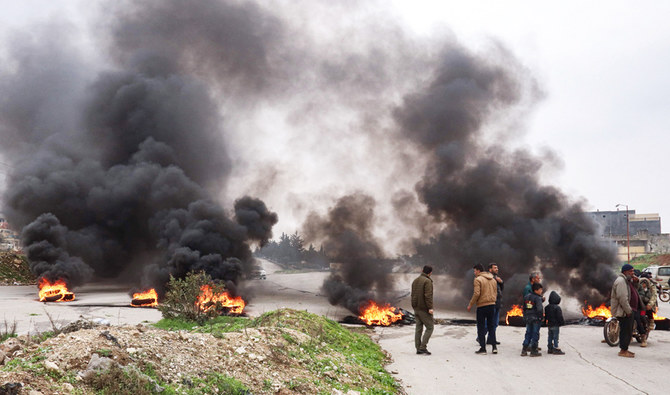

BEIRUT: At least 384,000 people have died in Syria, including more than 116,000 civilians, since the war began in March 2011, the Syrian Observatory for Human Rights said on Saturday.
Sparked by deadly repression of peaceful pro-democracy protests, the conflict has drawn in outside powers in a complex war involving opposition factions, militant groups and foreign interests.
As the war enters its 10th year, the regime of Bashar Assad now controls more than 70 percent of Syrian territory, thanks to the military support of its allies Russia, Iran and Lebanese militant group Hezbollah.
The conflict is the “worst manmade disaster since World War II,” the UN human rights chief declared in 2017.
The war has destroyed the economy and caused more than 11 million Syrians to flee their homes.
According to the Observatory, which relies on a network of sources in Syria, the latest death toll includes about 22,000 children and 13,000 women.
At least 129,476 regime soldiers, allied forces and militiamen have died, according to the Britain-based war monitor, including 1,697 members of Hezbollah.
Nearly 57,000 opposition figures have died, as well as 13,624 members of the Kurdish-led Syrian Democratic Forces, which spearheaded the US-backed campaign against Daesh, the Observatory said.
The Observatory tallied 67,296 deaths among militants loyal to Daesh or to Hayat Tahrir Al-Sham, an alliance led by a former Al-Qaeda affiliate that dominates the last opposition enclave in the Idlib region in the northwest.
FASTFACTS
• The war has destroyed the economy and caused more than 11 million Syrians to flee their homes.
• The latest death toll includes about 22,000 children and 13,000 women.
The death toll included 421 unidentified victims.
After recent regime advances, Idlib province is the last battleground between regime forces, and the militants and their allies.
Damascus launched an offensive to take the region in December, causing close to 1 million people to flee, according to the UN, before Ankara and Moscow negotiated a cease-fire earlier this month.
NGOs continue to denounce human rights abuses by the Syrian regime, including lethal chemical attacks, torture and arbitrary arrest.
Tens of thousands of people have been subject to forced disappearances by the government or a myriad of armed groups, NGOs report.
The war has destroyed infrastructure and crucial sectors of the economy including the oil industry.


